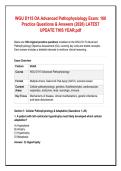
WGU D115 OA Advanced Pathophysiology Exam: 160
Practice Questions & Answers (2026) LATEST
UPDATE THIS YEAR.pdf
Below are 160 original practice questions modeled on the WGU D115 Advanced
Pathophysiology Objective Assessment (OA), covering key units and tested concepts .
Each answer includes a detailed rationale to reinforce clinical reasoning .
Exam Overview
Feature Detail
Course WGU D115 Advanced Pathophysiology
Format Multiple-choice, Select-All-That-Apply (SATA), scenario-based
Content Cellular pathophysiology, genetics, fluid/electrolytes, cardiovascular,
Areas respiratory, endocrine, renal, neurologic, immune
Key Focus Mechanisms of disease, clinical manifestations, genetic inheritance,
acid-base disturbances
Section 1: Cellular Pathophysiology & Adaptation (Questions 1–20)
1. A patient with left ventricular hypertrophy most likely developed which cellular
adaptation?
A) Hyperplasia
B) Atrophy
C) Hypertrophy
D) Metaplasia
Answer: C) Hypertrophy
, Cardiac muscle cells enlarge in response to increased workload (afterload from
hypertension). Because cardiac myocytes cannot significantly divide, the heart
compensates by increasing cell size rather than cell number .
2. Which statement accurately describes the difference between necrosis and
apoptosis?
A) Necrosis is programmed cell death; apoptosis is unregulated
B) Necrosis triggers an inflammatory response; apoptosis does not
C) Apoptosis always leads to cell swelling; necrosis does not
D) Necrosis is energy-dependent; apoptosis is not
Answer: B) Necrosis triggers an inflammatory response; apoptosis does not
Necrosis is unregulated cell death that triggers inflammation due to the release of cellular
contents. Apoptosis is a highly regulated, energy-dependent process that does not elicit an
inflammatory response .
3. The cellular adaptation characterized by a decrease in cell size and function in
response to decreased workload is called:
A) Hyperplasia
B) Hypertrophy
C) Atrophy
D) Metaplasia
Answer: C) Atrophy
Atrophy is a decrease in cell size due to reduced workload, disuse, denervation, or
decreased blood supply. It is a common adaptation in immobilized muscles or aging tissues
.
4. Which cellular adaptation involves the replacement of one mature cell type with
another in response to chronic irritation?
A) Hyperplasia
B) Hypertrophy
C) Atrophy
D) Metaplasia
Answer: D) Metaplasia
, Metaplasia is the reversible replacement of one differentiated cell type with another in
response to chronic irritation or inflammation. It is a protective mechanism but can increase
cancer risk (e.g., Barrett's esophagus) .
5. Ischemia causes cellular injury primarily through which mechanism?
A) Excess ATP production
B) Decreased oxygen delivery leading to anaerobic metabolism and lactic acidosis
C) Hyperkalemia from cell rupture
D) Increased protein synthesis
Answer: B) Decreased oxygen delivery leading to anaerobic metabolism and lactic
acidosis
Ischemia reduces oxygen delivery to cells. This forces the cell into anaerobic metabolism,
which produces lactic acid and decreases ATP production, leading to cell swelling and injury
.
6. Free radicals cause cellular damage by which mechanism?
A) Promoting DNA repair
B) Stealing electrons from cellular structures like DNA, lipids, and proteins
C) Increasing ATP production
D) Activating apoptosis pathways only
Answer: B) Stealing electrons from cellular structures like DNA, lipids, and proteins
Free radicals are highly reactive molecules with unpaired electrons. They cause oxidative
stress by stealing electrons from cellular structures, leading to DNA damage, lipid
peroxidation, and protein dysfunction .
7. Which condition is most likely to cause cellular hypertrophy?
A) Chronic hypertension
B) Acute infection
C) Radiation exposure
D) Starvation
Answer: A) Chronic hypertension
Chronic hypertension increases the workload on the left ventricle, causing cardiac
myocytes to undergo hypertrophy (increase in cell size) to compensate for the increased
afterload .
, 8. A patient with prolonged immobilization is at risk for which cellular adaptation in
skeletal muscle?
A) Hyperplasia
B) Hypertrophy
C) Atrophy
D) Metaplasia
Answer: C) Atrophy
Disuse atrophy occurs in skeletal muscle when there is decreased workload from
prolonged immobility, resulting in decreased muscle mass and function .
9. Which of the following is an example of pathologic hyperplasia?
A) Breast tissue enlargement during pregnancy
B) Endometrial hyperplasia from unopposed estrogen
C) Liver regeneration after partial hepatectomy
D) Erythrocyte production in high altitude
Answer: B) Endometrial hyperplasia from unopposed estrogen
Endometrial hyperplasia from unopposed estrogen is a pathologic hyperplasia that
increases the risk of endometrial cancer. The others are physiologic responses to normal
stimuli .
10. The hallmark of irreversible cellular injury is:
A) Cellular swelling
B) Fatty change
C) Membrane damage and lysosomal rupture
D) Decreased protein synthesis
Answer: C) Membrane damage and lysosomal rupture
Irreversible injury is characterized by severe membrane damage, lysosomal rupture, and
mitochondrial dysfunction. These changes lead to cell death by necrosis .
11. A patient with chronic lung disease develops squamous metaplasia in the
bronchial epithelium. What is the most likely cause?
A) Chronic irritation from smoking
B) Genetic mutation
Practice Questions & Answers (2026) LATEST
UPDATE THIS YEAR.pdf
Below are 160 original practice questions modeled on the WGU D115 Advanced
Pathophysiology Objective Assessment (OA), covering key units and tested concepts .
Each answer includes a detailed rationale to reinforce clinical reasoning .
Exam Overview
Feature Detail
Course WGU D115 Advanced Pathophysiology
Format Multiple-choice, Select-All-That-Apply (SATA), scenario-based
Content Cellular pathophysiology, genetics, fluid/electrolytes, cardiovascular,
Areas respiratory, endocrine, renal, neurologic, immune
Key Focus Mechanisms of disease, clinical manifestations, genetic inheritance,
acid-base disturbances
Section 1: Cellular Pathophysiology & Adaptation (Questions 1–20)
1. A patient with left ventricular hypertrophy most likely developed which cellular
adaptation?
A) Hyperplasia
B) Atrophy
C) Hypertrophy
D) Metaplasia
Answer: C) Hypertrophy
, Cardiac muscle cells enlarge in response to increased workload (afterload from
hypertension). Because cardiac myocytes cannot significantly divide, the heart
compensates by increasing cell size rather than cell number .
2. Which statement accurately describes the difference between necrosis and
apoptosis?
A) Necrosis is programmed cell death; apoptosis is unregulated
B) Necrosis triggers an inflammatory response; apoptosis does not
C) Apoptosis always leads to cell swelling; necrosis does not
D) Necrosis is energy-dependent; apoptosis is not
Answer: B) Necrosis triggers an inflammatory response; apoptosis does not
Necrosis is unregulated cell death that triggers inflammation due to the release of cellular
contents. Apoptosis is a highly regulated, energy-dependent process that does not elicit an
inflammatory response .
3. The cellular adaptation characterized by a decrease in cell size and function in
response to decreased workload is called:
A) Hyperplasia
B) Hypertrophy
C) Atrophy
D) Metaplasia
Answer: C) Atrophy
Atrophy is a decrease in cell size due to reduced workload, disuse, denervation, or
decreased blood supply. It is a common adaptation in immobilized muscles or aging tissues
.
4. Which cellular adaptation involves the replacement of one mature cell type with
another in response to chronic irritation?
A) Hyperplasia
B) Hypertrophy
C) Atrophy
D) Metaplasia
Answer: D) Metaplasia
, Metaplasia is the reversible replacement of one differentiated cell type with another in
response to chronic irritation or inflammation. It is a protective mechanism but can increase
cancer risk (e.g., Barrett's esophagus) .
5. Ischemia causes cellular injury primarily through which mechanism?
A) Excess ATP production
B) Decreased oxygen delivery leading to anaerobic metabolism and lactic acidosis
C) Hyperkalemia from cell rupture
D) Increased protein synthesis
Answer: B) Decreased oxygen delivery leading to anaerobic metabolism and lactic
acidosis
Ischemia reduces oxygen delivery to cells. This forces the cell into anaerobic metabolism,
which produces lactic acid and decreases ATP production, leading to cell swelling and injury
.
6. Free radicals cause cellular damage by which mechanism?
A) Promoting DNA repair
B) Stealing electrons from cellular structures like DNA, lipids, and proteins
C) Increasing ATP production
D) Activating apoptosis pathways only
Answer: B) Stealing electrons from cellular structures like DNA, lipids, and proteins
Free radicals are highly reactive molecules with unpaired electrons. They cause oxidative
stress by stealing electrons from cellular structures, leading to DNA damage, lipid
peroxidation, and protein dysfunction .
7. Which condition is most likely to cause cellular hypertrophy?
A) Chronic hypertension
B) Acute infection
C) Radiation exposure
D) Starvation
Answer: A) Chronic hypertension
Chronic hypertension increases the workload on the left ventricle, causing cardiac
myocytes to undergo hypertrophy (increase in cell size) to compensate for the increased
afterload .
, 8. A patient with prolonged immobilization is at risk for which cellular adaptation in
skeletal muscle?
A) Hyperplasia
B) Hypertrophy
C) Atrophy
D) Metaplasia
Answer: C) Atrophy
Disuse atrophy occurs in skeletal muscle when there is decreased workload from
prolonged immobility, resulting in decreased muscle mass and function .
9. Which of the following is an example of pathologic hyperplasia?
A) Breast tissue enlargement during pregnancy
B) Endometrial hyperplasia from unopposed estrogen
C) Liver regeneration after partial hepatectomy
D) Erythrocyte production in high altitude
Answer: B) Endometrial hyperplasia from unopposed estrogen
Endometrial hyperplasia from unopposed estrogen is a pathologic hyperplasia that
increases the risk of endometrial cancer. The others are physiologic responses to normal
stimuli .
10. The hallmark of irreversible cellular injury is:
A) Cellular swelling
B) Fatty change
C) Membrane damage and lysosomal rupture
D) Decreased protein synthesis
Answer: C) Membrane damage and lysosomal rupture
Irreversible injury is characterized by severe membrane damage, lysosomal rupture, and
mitochondrial dysfunction. These changes lead to cell death by necrosis .
11. A patient with chronic lung disease develops squamous metaplasia in the
bronchial epithelium. What is the most likely cause?
A) Chronic irritation from smoking
B) Genetic mutation