

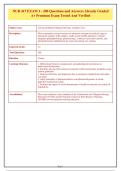
NUR 417 EXAM 1 - 200 Questions and Answers Already Graded
A+ Premium Exam Tested And Verified
Subject Area Advanced Medical-Surgical Nursing: Complex Care
Description This examination assesses mastery of advanced concepts in medical-surgical
nursing for patients with complex, multi-system health alterations. Content
integrates pathophysiology, pharmacology, evidence-based interventions, and
interprofessional collaboration for acute and critical care settings.
Expected Grade A+
Total Questions 200
Duration 3 hours
Learning Outcomes 1. Differentiate between compensatory and pathological mechanisms in
multi-organ dysfunction.
2. Prioritize nursing interventions for patients with hemodynamic instability using
current guidelines.
3. Interpret laboratory and diagnostic data to anticipate complications and adjust
care plans.
4. Apply principles of pharmacokinetics and pharmacodynamics to titrate
high-alert medications safely.
5. Evaluate the impact of social determinants of health on outcomes in acutely ill
populations.
Accreditation This exam conforms to the standards of the Commission on Collegiate Nursing
Education (CCNE) and the National Council of State Boards of Nursing
(NCSBN) for baccalaureate nursing education.
Page 1
,ati. NUR 417 EXAM 1 - 200 Questions and Answers Already Graded A+ Premium Exam
Tested And Verified
Question: 1 of 200
A patient admitted with sepsis develops acute respiratory distress syndrome (ARDS).
The nurse notes that despite increasing FiO, the patient's PaO remains below 60
mmHg, and a chest radiograph shows bilateral infiltrates. Which pathophysiological
mechanism best explains the refractory hypoxemia?
Increased pulmonary capillary hydrostatic pressure causing cardiogenic pulmonary edema
Alveolar-capillary membrane thickening due to surfactant dysfunction and hyaline membrane
formation
Ventilation-perfusion mismatch from atelectasis and mucus plugging
Right-to-left intrapulmonary shunting secondary to collapsed alveoli with persistent perfusion
PREVIOUS
Question: 2 of 200
A patient with a history of heart failure with reduced ejection fraction (HFrEF) is
admitted for decompensation. The provider orders a titration of intravenous
nitroprusside. Which assessment finding would necessitate immediate discontinuation
of the infusion?
Decrease in mean arterial pressure from 80 to 65 mmHg
Increase in heart rate from 72 to 95 beats per minute
Plasma thiocyanate level of 12 mg/dL
Urine output of 30 mL/hour over the last 2 hours
PREVIOUS
Page 2
,ati. NUR 417 EXAM 1 - 200 Questions and Answers Already Graded A+ Premium Exam
Tested And Verified
Question: 3 of 200
Which of the following represents the most significant risk factor for the development
of contrast-induced acute kidney injury (CI-AKI) in a patient undergoing coronary
angiography?
Pre-procedure serum creatinine of 1.0 mg/dL
Pre-procedure hemoglobin A1c of 6.5%
Concurrent administration of N-acetylcysteine
Pre-procedure use of metformin
PREVIOUS
Question: 4 of 200
A patient with acute pancreatitis develops scleral icterus and dark urine. Laboratory
results show total bilirubin 4.2 mg/dL, direct bilirubin 3.8 mg/dL, AST 120 U/L, ALT 90
U/L, and ALP 350 U/L. Which of the following is the most likely cause of this patient's
jaundice?
Hepatocellular injury due to alcoholic hepatitis
Extrahepatic biliary obstruction from a common bile duct stone
Hemolysis due to pancreatitis-induced coagulopathy
Intrahepatic cholestasis from sepsis
PREVIOUS
Page 3
, ati. NUR 417 EXAM 1 - 200 Questions and Answers Already Graded A+ Premium Exam
Tested And Verified
Question: 5 of 200
A patient receiving mechanical ventilation with volume-controlled mode has a plateau
pressure of 35 cm HO and a peak inspiratory pressure of 50 cm HO. Which
interpretation is most accurate?
Decreased lung compliance with increased airway resistance
Decreased lung compliance with normal airway resistance
Normal lung compliance with increased airway resistance
Normal lung compliance with decreased airway resistance
PREVIOUS
Question: 6 of 200
A patient with cirrhosis and ascites is started on spironolactone. Which laboratory
finding would indicate a therapeutic response to this medication?
Serum sodium of 135 mEq/L
Urine sodium of 25 mEq/L
Serum potassium of 5.2 mEq/L
Urine sodium to potassium ratio of 1.5
PREVIOUS
Page 4
A+ Premium Exam Tested And Verified
Subject Area Advanced Medical-Surgical Nursing: Complex Care
Description This examination assesses mastery of advanced concepts in medical-surgical
nursing for patients with complex, multi-system health alterations. Content
integrates pathophysiology, pharmacology, evidence-based interventions, and
interprofessional collaboration for acute and critical care settings.
Expected Grade A+
Total Questions 200
Duration 3 hours
Learning Outcomes 1. Differentiate between compensatory and pathological mechanisms in
multi-organ dysfunction.
2. Prioritize nursing interventions for patients with hemodynamic instability using
current guidelines.
3. Interpret laboratory and diagnostic data to anticipate complications and adjust
care plans.
4. Apply principles of pharmacokinetics and pharmacodynamics to titrate
high-alert medications safely.
5. Evaluate the impact of social determinants of health on outcomes in acutely ill
populations.
Accreditation This exam conforms to the standards of the Commission on Collegiate Nursing
Education (CCNE) and the National Council of State Boards of Nursing
(NCSBN) for baccalaureate nursing education.
Page 1
,ati. NUR 417 EXAM 1 - 200 Questions and Answers Already Graded A+ Premium Exam
Tested And Verified
Question: 1 of 200
A patient admitted with sepsis develops acute respiratory distress syndrome (ARDS).
The nurse notes that despite increasing FiO, the patient's PaO remains below 60
mmHg, and a chest radiograph shows bilateral infiltrates. Which pathophysiological
mechanism best explains the refractory hypoxemia?
Increased pulmonary capillary hydrostatic pressure causing cardiogenic pulmonary edema
Alveolar-capillary membrane thickening due to surfactant dysfunction and hyaline membrane
formation
Ventilation-perfusion mismatch from atelectasis and mucus plugging
Right-to-left intrapulmonary shunting secondary to collapsed alveoli with persistent perfusion
PREVIOUS
Question: 2 of 200
A patient with a history of heart failure with reduced ejection fraction (HFrEF) is
admitted for decompensation. The provider orders a titration of intravenous
nitroprusside. Which assessment finding would necessitate immediate discontinuation
of the infusion?
Decrease in mean arterial pressure from 80 to 65 mmHg
Increase in heart rate from 72 to 95 beats per minute
Plasma thiocyanate level of 12 mg/dL
Urine output of 30 mL/hour over the last 2 hours
PREVIOUS
Page 2
,ati. NUR 417 EXAM 1 - 200 Questions and Answers Already Graded A+ Premium Exam
Tested And Verified
Question: 3 of 200
Which of the following represents the most significant risk factor for the development
of contrast-induced acute kidney injury (CI-AKI) in a patient undergoing coronary
angiography?
Pre-procedure serum creatinine of 1.0 mg/dL
Pre-procedure hemoglobin A1c of 6.5%
Concurrent administration of N-acetylcysteine
Pre-procedure use of metformin
PREVIOUS
Question: 4 of 200
A patient with acute pancreatitis develops scleral icterus and dark urine. Laboratory
results show total bilirubin 4.2 mg/dL, direct bilirubin 3.8 mg/dL, AST 120 U/L, ALT 90
U/L, and ALP 350 U/L. Which of the following is the most likely cause of this patient's
jaundice?
Hepatocellular injury due to alcoholic hepatitis
Extrahepatic biliary obstruction from a common bile duct stone
Hemolysis due to pancreatitis-induced coagulopathy
Intrahepatic cholestasis from sepsis
PREVIOUS
Page 3
, ati. NUR 417 EXAM 1 - 200 Questions and Answers Already Graded A+ Premium Exam
Tested And Verified
Question: 5 of 200
A patient receiving mechanical ventilation with volume-controlled mode has a plateau
pressure of 35 cm HO and a peak inspiratory pressure of 50 cm HO. Which
interpretation is most accurate?
Decreased lung compliance with increased airway resistance
Decreased lung compliance with normal airway resistance
Normal lung compliance with increased airway resistance
Normal lung compliance with decreased airway resistance
PREVIOUS
Question: 6 of 200
A patient with cirrhosis and ascites is started on spironolactone. Which laboratory
finding would indicate a therapeutic response to this medication?
Serum sodium of 135 mEq/L
Urine sodium of 25 mEq/L
Serum potassium of 5.2 mEq/L
Urine sodium to potassium ratio of 1.5
PREVIOUS
Page 4


