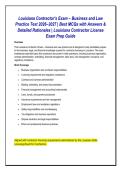
Louisiana Contractor’s Exam – Business and Law
Practice Test 2026–2027 | Best MCQs with Answers &
Detailed Rationales | Louisiana Contractor License
Exam Prep Guide
Overview
This Louisiana Contractor’s Exam – Business and Law practice test is designed to help candidates prepare
for the business, legal, and financial knowledge required for contractor licensing in Louisiana. The exam
emphasizes essential topics that contractors encounter in daily operations, including business organization,
contract administration, estimating, financial management, labor laws, risk management, insurance, and
regulatory compliance.
Short Coverage
Business organization and contractor responsibilities
Licensing requirements and regulatory compliance
Contracts and contract administration
Bidding, estimating, and project documentation
Financial management and accounting fundamentals
Liens, bonds, and payment procedures
Insurance requirements and risk management
Employment laws and workplace regulations
Safety responsibilities and recordkeeping
Tax obligations and business operations
Dispute resolution and legal responsibilities
Ethics and professional business practices
Aligned with contractor licensing requirements administered by the Louisiana State
Licensing Board for Contractors.
,1.
A contractor is considering operating as a sole proprietorship rather than forming a
corporation. Which characteristic is generally associated with a sole proprietorship?
A. Separate legal existence from the owner
B. Limited liability protection for business debts
C. Unlimited personal liability for business obligations
D. Ownership by shareholders and directors
Answer: C
Explanation: A sole proprietorship is not legally separate from its owner, so the owner is
personally responsible for business debts and liabilities.
2.
Before submitting a construction bid, a contractor should primarily ensure that:
A. Material prices will never increase
B. The project can be completed profitably and according to contract requirements
C. Competitors are charging higher prices
D. Equipment purchases can be postponed indefinitely
Answer: B
Explanation: Contractors should carefully evaluate project requirements, costs, and risks
before submitting a bid.
3.
Which financial statement provides a snapshot of a company's assets, liabilities, and
owner's equity at a specific point in time?
A. Income statement
B. Cash flow statement
C. Job cost report
D. Balance sheet
Answer: D
Explanation: A balance sheet shows the financial position of a business on a specific date.
,4.
What is the primary purpose of workers' compensation insurance?
A. Protect company vehicles from damage
B. Cover defective workmanship claims
C. Provide benefits for employees injured during the course of employment
D. Guarantee project completion
Answer: C
Explanation: Workers' compensation provides medical and wage benefits to employees
injured on the job.
5.
A written agreement between parties that creates legally enforceable obligations is known
as:
A. An estimate
B. A specification
C. A permit
D. A contract
Answer: D
Explanation: Contracts establish rights and responsibilities that can be enforced by law.
6.
What is the primary purpose of maintaining accurate job cost records?
A. Eliminate tax obligations
B. Determine project profitability and improve estimating accuracy
C. Reduce employee supervision needs
D. Avoid preparing financial statements
Answer: B
Explanation: Job cost records help contractors monitor expenses and improve future bids.
, 7.
Which type of bond guarantees that a contractor will complete the work according to the
contract terms?
A. Payment bond
B. Performance bond
C. Bid bond
D. License bond
Answer: B
Explanation: A performance bond protects the owner if the contractor fails to complete the
project.
8.
A contractor receives a change order that modifies the scope of work. Before proceeding,
the contractor should:
A. Perform the additional work without documentation
B. Wait until project completion to discuss costs
C. Obtain written approval and document any cost and schedule changes
D. Refuse all project modifications
Answer: C
Explanation: Written documentation helps prevent disputes over scope, cost, and time
adjustments.
9.
Which business expense is generally considered an overhead cost?
A. Concrete for a specific project
B. Lumber installed on one jobsite
C. Labor assigned to one project
D. Office rent for the contractor's business
Answer: D
Explanation: Overhead costs are expenses that support the business but cannot be
directly assigned to one project.
Practice Test 2026–2027 | Best MCQs with Answers &
Detailed Rationales | Louisiana Contractor License
Exam Prep Guide
Overview
This Louisiana Contractor’s Exam – Business and Law practice test is designed to help candidates prepare
for the business, legal, and financial knowledge required for contractor licensing in Louisiana. The exam
emphasizes essential topics that contractors encounter in daily operations, including business organization,
contract administration, estimating, financial management, labor laws, risk management, insurance, and
regulatory compliance.
Short Coverage
Business organization and contractor responsibilities
Licensing requirements and regulatory compliance
Contracts and contract administration
Bidding, estimating, and project documentation
Financial management and accounting fundamentals
Liens, bonds, and payment procedures
Insurance requirements and risk management
Employment laws and workplace regulations
Safety responsibilities and recordkeeping
Tax obligations and business operations
Dispute resolution and legal responsibilities
Ethics and professional business practices
Aligned with contractor licensing requirements administered by the Louisiana State
Licensing Board for Contractors.
,1.
A contractor is considering operating as a sole proprietorship rather than forming a
corporation. Which characteristic is generally associated with a sole proprietorship?
A. Separate legal existence from the owner
B. Limited liability protection for business debts
C. Unlimited personal liability for business obligations
D. Ownership by shareholders and directors
Answer: C
Explanation: A sole proprietorship is not legally separate from its owner, so the owner is
personally responsible for business debts and liabilities.
2.
Before submitting a construction bid, a contractor should primarily ensure that:
A. Material prices will never increase
B. The project can be completed profitably and according to contract requirements
C. Competitors are charging higher prices
D. Equipment purchases can be postponed indefinitely
Answer: B
Explanation: Contractors should carefully evaluate project requirements, costs, and risks
before submitting a bid.
3.
Which financial statement provides a snapshot of a company's assets, liabilities, and
owner's equity at a specific point in time?
A. Income statement
B. Cash flow statement
C. Job cost report
D. Balance sheet
Answer: D
Explanation: A balance sheet shows the financial position of a business on a specific date.
,4.
What is the primary purpose of workers' compensation insurance?
A. Protect company vehicles from damage
B. Cover defective workmanship claims
C. Provide benefits for employees injured during the course of employment
D. Guarantee project completion
Answer: C
Explanation: Workers' compensation provides medical and wage benefits to employees
injured on the job.
5.
A written agreement between parties that creates legally enforceable obligations is known
as:
A. An estimate
B. A specification
C. A permit
D. A contract
Answer: D
Explanation: Contracts establish rights and responsibilities that can be enforced by law.
6.
What is the primary purpose of maintaining accurate job cost records?
A. Eliminate tax obligations
B. Determine project profitability and improve estimating accuracy
C. Reduce employee supervision needs
D. Avoid preparing financial statements
Answer: B
Explanation: Job cost records help contractors monitor expenses and improve future bids.
, 7.
Which type of bond guarantees that a contractor will complete the work according to the
contract terms?
A. Payment bond
B. Performance bond
C. Bid bond
D. License bond
Answer: B
Explanation: A performance bond protects the owner if the contractor fails to complete the
project.
8.
A contractor receives a change order that modifies the scope of work. Before proceeding,
the contractor should:
A. Perform the additional work without documentation
B. Wait until project completion to discuss costs
C. Obtain written approval and document any cost and schedule changes
D. Refuse all project modifications
Answer: C
Explanation: Written documentation helps prevent disputes over scope, cost, and time
adjustments.
9.
Which business expense is generally considered an overhead cost?
A. Concrete for a specific project
B. Lumber installed on one jobsite
C. Labor assigned to one project
D. Office rent for the contractor's business
Answer: D
Explanation: Overhead costs are expenses that support the business but cannot be
directly assigned to one project.