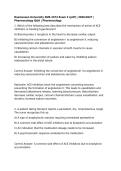
Rasmussen University NUR 2474 Exam 3 (pdf) | 2026/2027 |
Pharmacology Q&A | Pharmacology
1. Which of the following best describes the mechanism of action of an
agonist medication?
A) It binds to a receptor and prevents a response
B) It binds to a receptor and produces a response
C) It binds to a receptor and has no effect
D) It destroys the receptor
Correct Answer: It binds to a receptor and produces a response
Rationale: Agonists bind to receptors and activate them, producing a
response. Antagonists bind but prevent a response. Partial agonists produce
a weaker response. No medication destroys receptors.
2. What is the therapeutic index of a medication?
A) The time required for the drug to be eliminated from the body
B) The ratio of the drug's lethal dose to its effective dose
C) The percentage of the drug that reaches systemic circulation
D) The time required for the drug concentration to decrease by 50%
Correct Answer: The ratio of the drug's lethal dose to its effective dose
Rationale: The therapeutic index is the ratio of a drug's LD50 (lethal dose) to
its ED50 (effective dose). A higher therapeutic index indicates a safer drug.
Bioavailability is the percentage reaching circulation. Half-life is the time for
concentration to decrease by 50%.
,3. A patient is prescribed a medication with a narrow therapeutic index. The
nurse should prioritize which action?
A) Monitoring serum drug levels regularly
B) Administering the medication with food
C) Instructing the patient to double the dose if a dose is missed
D) Encouraging the patient to take the medication at bedtime
Correct Answer: Monitoring serum drug levels regularly
Rationale: Medications with a narrow therapeutic index have a small margin
between therapeutic and toxic levels. Serum drug levels must be monitored
to prevent toxicity. Taking with food, doubling doses, or taking at bedtime do
not address this risk.
4. A nurse is preparing to administer a medication. Which of the following
represents the standard "six rights" of medication administration?
A) Right patient, drug, dose, time, route, documentation
B) Right patient, drug, dose, time, route, assessment
C) Right patient, drug, dose, time, route, evaluation
D) Right patient, drug, dose, time, route, reason
Correct Answer: Right patient, drug, dose, time, route, documentation
Rationale: The standard six rights are right patient, drug, dose, time, route,
and documentation. Assessment, evaluation, and reason are considered
"extra rights" but are not part of the core six.
5. The nurse is caring for a patient who is experiencing an adverse effect
from a medication. Which of the following is an example of an adverse
effect?
,A) Mild nausea after taking an antibiotic
B) Drowsiness after taking an antihistamine
C) Anaphylaxis after taking penicillin
D) Dry mouth after taking an anticholinergic
Correct Answer: Anaphylaxis after taking penicillin
Rationale: Adverse effects are noxious, unintended, and harmful reactions.
Anaphylaxis is a severe, harmful reaction. Nausea, drowsiness, and dry
mouth are expected side effects at therapeutic levels.
6. What is the primary function of pharmacokinetics in pharmacology?
A) To study what the drug does to the body
B) To study the movement of the drug through the body
C) To study the chemical structure of the drug
D) To study the cost-effectiveness of the drug
Correct Answer: To study the movement of the drug through the body
Rationale: Pharmacokinetics is the study of drug movement throughout the
body, including absorption, distribution, metabolism, and excretion.
Pharmacodynamics is what the drug does to the body.
7. Which of the following correctly lists the four phases of pharmacokinetics
in order?
A) Distribution, Absorption, Metabolism, Excretion
B) Absorption, Distribution, Metabolism, Excretion
C) Metabolism, Absorption, Distribution, Excretion
, D) Absorption, Metabolism, Distribution, Excretion
Correct Answer: Absorption, Distribution, Metabolism, Excretion
Rationale: The correct order is absorption, distribution, metabolism, and
excretion. Absorption is first, followed by distribution, then metabolism, and
finally excretion.
8. A patient is receiving an intravenous (IV) medication. Which
pharmacokinetic phase is bypassed with this route?
A) Distribution
B) Metabolism
C) Absorption
D) Excretion
Correct Answer: Absorption
Rationale: IV administration delivers the drug directly into the bloodstream,
bypassing the absorption phase. Distribution, metabolism, and excretion still
occur.
9. A patient is prescribed a medication that is highly protein-bound. A second
highly protein-bound medication is added. The nurse should monitor for
which potential complication?
A) Decreased effectiveness of both medications
B) Increased risk of toxicity of the first medication
C) Decreased absorption of both medications
D) Increased excretion of both medications
Pharmacology Q&A | Pharmacology
1. Which of the following best describes the mechanism of action of an
agonist medication?
A) It binds to a receptor and prevents a response
B) It binds to a receptor and produces a response
C) It binds to a receptor and has no effect
D) It destroys the receptor
Correct Answer: It binds to a receptor and produces a response
Rationale: Agonists bind to receptors and activate them, producing a
response. Antagonists bind but prevent a response. Partial agonists produce
a weaker response. No medication destroys receptors.
2. What is the therapeutic index of a medication?
A) The time required for the drug to be eliminated from the body
B) The ratio of the drug's lethal dose to its effective dose
C) The percentage of the drug that reaches systemic circulation
D) The time required for the drug concentration to decrease by 50%
Correct Answer: The ratio of the drug's lethal dose to its effective dose
Rationale: The therapeutic index is the ratio of a drug's LD50 (lethal dose) to
its ED50 (effective dose). A higher therapeutic index indicates a safer drug.
Bioavailability is the percentage reaching circulation. Half-life is the time for
concentration to decrease by 50%.
,3. A patient is prescribed a medication with a narrow therapeutic index. The
nurse should prioritize which action?
A) Monitoring serum drug levels regularly
B) Administering the medication with food
C) Instructing the patient to double the dose if a dose is missed
D) Encouraging the patient to take the medication at bedtime
Correct Answer: Monitoring serum drug levels regularly
Rationale: Medications with a narrow therapeutic index have a small margin
between therapeutic and toxic levels. Serum drug levels must be monitored
to prevent toxicity. Taking with food, doubling doses, or taking at bedtime do
not address this risk.
4. A nurse is preparing to administer a medication. Which of the following
represents the standard "six rights" of medication administration?
A) Right patient, drug, dose, time, route, documentation
B) Right patient, drug, dose, time, route, assessment
C) Right patient, drug, dose, time, route, evaluation
D) Right patient, drug, dose, time, route, reason
Correct Answer: Right patient, drug, dose, time, route, documentation
Rationale: The standard six rights are right patient, drug, dose, time, route,
and documentation. Assessment, evaluation, and reason are considered
"extra rights" but are not part of the core six.
5. The nurse is caring for a patient who is experiencing an adverse effect
from a medication. Which of the following is an example of an adverse
effect?
,A) Mild nausea after taking an antibiotic
B) Drowsiness after taking an antihistamine
C) Anaphylaxis after taking penicillin
D) Dry mouth after taking an anticholinergic
Correct Answer: Anaphylaxis after taking penicillin
Rationale: Adverse effects are noxious, unintended, and harmful reactions.
Anaphylaxis is a severe, harmful reaction. Nausea, drowsiness, and dry
mouth are expected side effects at therapeutic levels.
6. What is the primary function of pharmacokinetics in pharmacology?
A) To study what the drug does to the body
B) To study the movement of the drug through the body
C) To study the chemical structure of the drug
D) To study the cost-effectiveness of the drug
Correct Answer: To study the movement of the drug through the body
Rationale: Pharmacokinetics is the study of drug movement throughout the
body, including absorption, distribution, metabolism, and excretion.
Pharmacodynamics is what the drug does to the body.
7. Which of the following correctly lists the four phases of pharmacokinetics
in order?
A) Distribution, Absorption, Metabolism, Excretion
B) Absorption, Distribution, Metabolism, Excretion
C) Metabolism, Absorption, Distribution, Excretion
, D) Absorption, Metabolism, Distribution, Excretion
Correct Answer: Absorption, Distribution, Metabolism, Excretion
Rationale: The correct order is absorption, distribution, metabolism, and
excretion. Absorption is first, followed by distribution, then metabolism, and
finally excretion.
8. A patient is receiving an intravenous (IV) medication. Which
pharmacokinetic phase is bypassed with this route?
A) Distribution
B) Metabolism
C) Absorption
D) Excretion
Correct Answer: Absorption
Rationale: IV administration delivers the drug directly into the bloodstream,
bypassing the absorption phase. Distribution, metabolism, and excretion still
occur.
9. A patient is prescribed a medication that is highly protein-bound. A second
highly protein-bound medication is added. The nurse should monitor for
which potential complication?
A) Decreased effectiveness of both medications
B) Increased risk of toxicity of the first medication
C) Decreased absorption of both medications
D) Increased excretion of both medications