

Written by students who passed Immediately available after payment Read online or as PDF Wrong document? Swap it for free 4.6 TrustPilot
logo-home
Document preview thumbnail
Preview 3 out of 25 pages
Exam (elaborations)

NUR 204 / NUR204 Exam 3 V2 – Leadership and Management Review (Latest 2026/2027 Update) | Fortis College | Complete Study Guide | Verified Questions & Answers | 100% Correct Solutions | Grade A

Document preview thumbnail
Preview 3 out of 25 pages

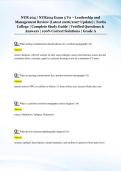
NUR 204 / NUR204 Exam 3 V2 – Leadership and Management Review (Latest 2026/2027 Update) | Fortis College | Complete Study Guide | Verified Questions & Answers | 100% Correct Solutions | Grade A Q: What nursing considerations should educate for a cerebral angiography? (8) Answer remove dentures, will feel warmth, lie still, assess allergies, assess renal function, assess site and circulation below extremity, apply ice, pressure dressing at site for a minimum of 2 hours Q: What are nursing considerations for a position emission tomography? (3) Answer patient must be NPO, no caffeine or tobacco 12 hours before scan, increase fluids after scan Q: What is a position emission tomography used to diagnose? (4) Answer cancer, Parkinson's, Epilepsy, Alzheimer's Q: What does an electroencephalography diagnose? (5) Answer seizures, epilepsy, head injuries, certain headaches, and confirm if a patient is brain dead or not Q: What should we educate a patient to do during an electroencephalography? Answer we should inform them not to move Q: What are symptoms of a migraine? (6) Answer intense unilateral pain, photophobia (light sensitivity), phonophobia (sensitivity to noise), nausea, vomiting, sensitivity to head movement Q: What are triggers of a migraine? (10) Answer caffeine, red wine, lack of exercise, lack of sleep and tyramine foods ( cheddar, blue cheese, sausage, salami, beer) Q: What is the treatment for a migraine headache? (5) Answer lie down in a darkened room, cold compresses, get sleep, yoga, meditation Q: What are side effects of Imitrex (sumatriptan)? (3) Answer flushing, tingling, and a hit sensation Q: What should we teach patients when taking Imitrex (Sumatriptan)? (4) Answer they should take medication as soon as symptoms develop, inform provider of chest pain and tightness (because this med can mimic a heart attack), use contraception if sexually active, no st. john's wart Q: What medication is prescribed for cluster or tension headaches? Answer tylenol Q: What classifies you as having epilepsy? Answer having two or more seizures in their lifetime Q: What does a generalized seizure affect? Answer the whole body Q: What does a partial seizure affect? Answer one side of body only Q: What puts you at risk for a seizure? (8) Answer metabolic disorders, acute alcohol withdrawal, electrolyte disturbances, heart disease, high blood pressure, high fever, stroke, substance abuse Q: What medication should we give to prevent a seizure from occurring? Answer magnesium sulfate Q: What seizure precautions should we take? (5) Answer provide oxygen, have suction equipment, maintain IV access, have side rails up and padded, maintain airway Q: What action should we take post seizure? Answer put the patient in a side lying left position Q: What are Grand mal seizure signs and symptoms? (4) Answer unconsciousness, muscle rigidity, tonic/clonic weakness, rhythmic jerking Q: What are signs and symptoms of an Absence seizure? (2) Answer a brief loss of consciousness and blank staring Q: What are signs and symptoms of a Myoclonic seizure? Answer sporadic jerking movements Q: What does an Atonic seizure cause and what are these patients at risk for? Answer a loss of muscle tone which puts them at a high risk for falls Q: What is a patients conscious state after a Simple Partial seizure? Answer a patients consciousness is retained Q: What is a patients conscious state after a Complex Partial seizure? Answer a patients consciousness is impaired because they pass out for one to three minutes Q: What is an unclassified seizure? Answer a seizure of unknown origin Q: What causes Primary (Idiopathic) epilepsy? Answer it is inherited or caused by an error in genes Q: What causes Secondary (Organic) epilepsy? (6) Answer birth trauma, head trauma, tumors, infections, degenerative diseases, and CVS Q: What should we document after a seizure? (7) Answer how long it lasted, which body part was involved first, where did it progress too, LOC prior to and during, any incontinence, postictal state, and how long it took them to recover Q: What medications do we give after a seizure? (6) Answer Carbamazepine, Valproic acid, Clonazepam, Gabapentin, Diazepam, Phenytoin Q: What should we teach a patient about Phenytoin? (2) Answer If they forget to take it skip that dose and take the next dose at the normal time to prevent toxicity, do not take alcohol with this medication Q: What is Status Epilepticus? Answer a continuous, generalized, convulsive seizure lasting more than 5 minutes or two or more seizures during which the patient does not return to baseline consciousness Q: What can seizures that last longer than 10 minutes cause? (4) Answer death, stroke, fever, and extreme high and low sugar Q: What should we do if status epilepticus is identified? (4) Answer call a rapid response team, prepare for possible intubation, get a large IV needle, and give Ativan or Valium Q: When is Early Status Epilepticus (Stage 1) and how do we treat it? Answer it is the first 30 minutes and we treat with benzodiazepines When is Established Status Epilepticus (Stage 2) and how do we treat it? Answer it is 30-120 minutes and we treat with IV anti epileptic drugs When is Refractory Status Epilepticus (Stage 3) and what do we do to treat it? Answer after 120 minutes and we treat with general anesthesia What is Super refractory Status Epilepticus? it's status epilepticus that has continued or recurred despite the use of general anesthesia for 24 hours or more What are the signs and symptoms of of viral meningitis and how do we prevent it? (6) fever, photophobia, headache, myalgias (muscle pain), maybe rash and we can prevent with the flu vaccine What is bacterial meningitis considered? medical emergency How do we prevent bacterial meningitis? we prevent it with a meningitis vaccine What are general symptoms of meningitis? (11) fever, headache, photophobia (light sensitivity), nausea, vomiting, increased bp, projectile vomiting, confusion, nuchal rigidity (neck stiffness), positive Kernigs sign, positive Brudzinskis sign How do we diagnose meningitis? (4) CSF analysis, CT scan, blood cultures, CBC What is the results of a positive meningitis CSF analysis? (3) low glucose, increased WBC, increased protein What should we do if we suspect a patient has meningitis? put them into droplet precautions until bacterial meningitis is ruled out when we determine it's viral they will be put on standard precautions What should we do if a patient has bacterial meningitis? (4) for the first 24 hours give antimicrobal medications then 2 weeks of IV antibiotics, put them on seizure precautions and decrease environmental stimuli What is Encephalitis? acute inflammation of the brain What is viral Encephalitis considered? a medical emergency What are signs and symptoms of Encephalitis? (9) high fever, agitation, motor problems, fatigue, joint pain, headache, nuchal rigidity, photophobia (light sensitivity), phonophobia (sound sensitivity) What is the treatment for Encephalitis? Acyclovir How can we prevent Encephalitis? (2) vaccines and mosquito repellent What is Parkinson's Disease? an imbalance of dopamine and acetylcholine that affects motor ability What are the cardinal symptoms of Parkinson's Disease? (5) bradykinesia (slow movement), tremors, rigidity, akinesia (loss of movement), postural instability What are the stages of Parkinson's Disease? 1 is mild and 5 is complete loss of ADLS What nursing care should we do for Parkinson's regarding difficulty chewing, swallowing and speaking? (7) watch for aspiration, elevate HOB, cut food in small pieces, have RN feed, consult speech therapist to see if liquids need thickened, monitor weight, give high protein and calorie diet What nursing care should we do for Parkinson's disease? (8) prevent falls, collaborate with PT and OT to help with ADLS, prevent muscle weakness, allow time to respond, administer medication to help, assess for depression, dementia and paranoid behavior When are dopamine agonists effective for Parkinson's disease? they are effective for the first 3-5 years What is the main treatment used for Parkinson's disease? Levodopa Carbidopa (Sinemet) How do you get Huntington Disease? a gene from either parent is necessary to get the disease therefore they have to inherit it When do symptoms of Huntington Disease start? neurologic and behavioral symptoms begin in 30-50 years and worsen with age What are the symptoms of Huntington's disease? (7) progressive mental status changes, dementia, poor balance, choreiform (jerky movements that are absent while sleeping), movements in face, limbs, and trunk How long is Huntington Disease? 15 years with each three stages being 5 years each What does the last stage of Huntington Disease cause? loss of independence What should we recommend to parents with Huntington Disease? we should recommend genetic counseling to encourage them not to reproduce What are causes of low back pain? (5) spinal stenosis, osteoarthritis, osteoporosis, disk degeneration, or any one structural changes to the spine What nursing care can we do for low back pain? (7) williams position (semi fowler's, pillows under knee) because flat is not comfortable, firm mattress, NSAIDS, heat packs 20-30 minutes 4 times a day, recommend losing weight, regular exercise and no bed rest What is a Laminectomy? the most common back surgery which makes room in the spine for inflammation What are complications of a Laminectomy? (5) pneumonia, infection, paralytic ileus, urinary retention, CSF leak What are signs and symptoms of a paralytic ileus? (4) hypoactive bowel sounds, abdominal distention, nausea, vomiting What are symptoms of a CSF leak and what should we do? a wet colorless dressing with a halo and we need to notify the physician immediately What preoperative teaching should we teach for a Laminectomy? (6) if they get out of bed they need assistance, report any numbness or tingling (spinal cord compression), techniques for getting OOB, how to change positions, lie flat, log roll every 2 hours What is a complete spinal cord injury? severs all nerves and eliminates all interventions below injury What is an incomplete spinal cord injury? allows some function or movement below level of injury What is a hyperflexion injury? head moved forward causing extreme flexion of neck such as by a head on collision What is a hyperextension injury? head accelerated and then decelerated causing fracture or rupture of disk such as behind hit from behind What is an Axil loading injury? caused by a blow to the head or by landing on feet causing injuries to the vertebrae What is a rotation injury? caused by turning head beyond normal range of motion What is a penetrating trauma? caused by a bullet or knife What is a secondary injury? (4) results from bleeding, edema, ischemia, hypovolemia When should we notify the physician after neurogenic shock? (4) if we see bradycardia, a decrease in pulse ox, hypotension, urinary output of less than 30 What is the treatment for neurogenic shock? (5) apply oxygen, restore fluids, be prepared to intubate, vasopressors for low BP, epi to speed up heart rate What is Autonomic Dysreflexia? a complication of a spinal cord injury above T6 What causes Autonomic Dysreflexia? (4) restrictive clothing, full bladder, uti, fecal impaction If we suspect Autonomic Dysreflexia what should we do? check their foley bag for kinks, assess and palpate the bladder then treat the cause What are the signs and symptoms of Autonomic Dysreflexia above the level of injury? (6) increased bp, flushed face, headache, distended neck veins, decreased hr, increased sweating What are the signs and symptoms of Autonomic Dysreflexia below the level of injury? (3) pale, cool and no sweating What is Multiple Sclerosis? an autoimmune disease of the myelin sheath that causes plaque on nerves and makes it hard to transmit from the brain to body What are exacerbation triggers of Multiple Sclerosis? (5) sedatives, alcohol, extreme temperature changes, opioids, barbiturates What are signs and symptoms of Multiple Sclerosis? (7) blurred vision, numbness and tingling, bowel and bladder changes, trouble walking, sensory changes , loss of memory, Nyastagmus What is an early signs of Multiple Sclerosis? nyastagmus When is the onset of ALS? 40-60 years and death occurs in 3-5 years What is the cure for ALS? there is no cure but Riluzole extends survival time What is Guillain Barre Syndrome? an acute autoimmune inflammatory disease that affects the peripheral nervous system When does Guillain-Barre Syndrome occur? after an acute illness usually something viral What are the symptoms of Guillian Barre Syndrome? (3) sudden onset of weakness in legs, decreased drop tendon reflexes, ataxia (lack of coordination) How long does it take to get over Guillian Barre Syndrome? the maximum time it lasts is 4 weeks with an 85-90% full recovery and it may take several years to recover When do we need to intubate for Guillian Barre Syndrome? if the vital capacity is below 70 we need to intubate What is vital capacity? the greatest volume of air that can be expelled after taking a deep breath What are signs and symptoms of hypovolemia and what do we do for it? (5) increased HR, decreased urinary output, confusion and we do an ECG and provide intubation What do we need to do when using Plasmapheresis for treatment of Guillian Barre Syndrome? (3) assess for bruit and thrill prior to treatment, weight before and after, assess for hypovolemia How do we give Plasmapheresis? by giving 2-3 treatments 1-2 days apart What do we do for IV immunoglobulins for Guillian Barre Syndrome? (6) stop the infusion and give epi if we see a reaction, administer slowly, observe for chills, headache, anaphylaxis, renal failure What are causes of Myasthenia Gravis exacerbation? (4) emotional issues, stress, hormones, surgery What are signs and symptoms of Myasthenia Gravis? (8) progressive muscle weakness that improves with rest, poor posture, fatigue, ptosis (incomplete eye closure), respiratory compromise, loss of bowel/bladder, dysphagia (difficulty swallowing), ocular palsies What is the first sign a patient complains of with Myasthenia Gravis? they will say their muscles feel weak and gets better with some rest What do we need to watch for after Tensilon challenging test? (5) we need to watch for an increase or decrease in hr, respiratory rate dropping, nausea, dizziness, muscle twitching What causes a myasthenic crisis? (2) infection or not enough medication What are the signs and symptoms of Myasthenic Crisis? (7) increased pulse, increase respiration's, increased bp, decreased cough snd swallow reflex, bowel/bladder incontinence, anoxia (lack of oxygen), cyanosis (bluish color of skin) What is the treatment for Myasthenic Crisis? Tensilon for respiratory support and the antidote for Tensilon is atropine What causes Cholinergic Crisis? too much cholinergic meds such as Tensilon, occurs with Myasthenia Gravis What are the signs and symptoms of Cholinergic Crisis? (5) restlessness, diaphoresis, apprehension, weak and painful joints, increased tearing What is the treatment for Cholinergic Crisis? Atropine and suctioning airway because of increased salivation What are signs and symptoms of Restless leg syndrome? (3) intense burning, crawling type sensations, and worse at night What are the risk factors for Restless Leg Syndrome? (9) genetics, diabetes, advancing age, neuropathies (loss of feelings in extremities), sleep deprivation, caffeine, alcohol, some anti nausea meds, some anti psychotic meds What is the treatment for Restless Leg Syndrome? (3) avoid risk factors, avoid strenuous activities 2-3 hours before bed, give medications at bed time What nerve does Trigeminal Neuralgia affect? 5th cranial nerve What are signs and symptoms of of Trigeminal Neuralgia? (6) facial spasms, pain when talking, smiling, eating, shaving, brushing teeth What causes Trigeminal Neuralgia? (5) infection, trauma to teeth, jaw, ear, and dental procedures What should we educate patients about with Trigeminal Neuralgia? that it will last several weeks followed by remission and that they should not eat very warm or cold foods because this causes the pain to increase What is the treatment for Trigeminal Neuralgia? (3) treat for pain with Carbamazepine, Gabapentin, Baclofen What does Bell's Palsy effect? the 7th cranial nerve by swelling What causes Bell's palsy? (2) reaction from cold sore or mononucleosis What are symptoms of Bell's palsy? (5) temporary paralysis on one side, ear pain, tingling and ringing in ear, cannot close eyes, not paralysis anywhere else in the body How do we know a patient has unilateral facial paralysis and not a stroke? (3) the patient should be able to talk to you and respond, they should have an equal hang grasp, and they should be able to raise both hands up What should we teach patients with Bell's palsy? (6) they will be treated with steroids, artificial tears because the eye can't close and it'll dry out, wear an eye patch, may tape the eye down, should clear in 2-4 weeks, may have residual dropping permanently What are the 12 cranial nerves? 1. Olfactory 2. Optic 3. Oculomotor 4. Trochlear 5. Trigeminal 6. Abducens 7. Facial 8. Vestibulocochlear 9. Glossopharyngeal 10. Vagus 11. Accessory 12. Hypoglossal How do we do an eye response for a neuro assessment? (4) eyes open 4-spontaneously, 3-to speech, 2-to pain, 1-they don't open How do we do an motor response for a neuro assessment? (6) obeys-6, localizes-5, withdrawals from pain-4, abnormal flexion-3, abnormal extension-2, none 1 How do we do a verbal response for a neuro assessment? (5) oriented-5, confused-4, inappropriate words-3, in comprehensive-2, none-1 What should we always check for when doing an imaging assessment? always check if they have a metal implant What should we teach a patient with seizures? (8) avoid alcohol, avoid fatigue, avoid microwave ovens, avoid MRIS, wear a med alert bracelet, explain importance of follow up care, explain strict adherence to drugs is important, no over the counter meds without checking What emergency care do we need to do for a spinal injury? (5) assess respiratory status first, stabilize spine at the scene, immobilize spine, keep spine aligned when turning, give Medrol (steroid) within the first 8 hours What should we do when cervical 3-5 are injured? the patient is at a high risk for respiratory compromise therefore we need to think about intubation What does an injury to the lumbar spine affect? it affects foot and calf sensation What spine is umbilicus at? t10 What spine is the collar bone at? T3-4 What injuries cause neurogenic shock? spinal cord injuries above T6 What education should we give to a patient with Multiple Sclerosis? (4) maintain range of motion, recommend stretching exercises, educate about exacerbation triggers, drastic increase or decrease in temperature can exacerbate symptoms What should we do for an ALS patient as soon as they are diagnosed? obtain an advanced directive What are symptoms of ALS? (5) begins in one area of the body and then spreads, motor weakness, deterioration spread to entire body, inability to talk, inability to swallow, inability to breathe What do we do for ALS patients? (4) maintain optimal function as long as we can by respiratory, physical therapy, occupational therapy and range of motion treatment every 2 hours What is Restless Leg Syndrome? paresthesia and irresistible urge to move legs from nerve damage in the legs or spinal cord

Content preview

NUR 204 / NUR204 Exam 3 V2 – Leadership and
Management Review (Latest 2026/2027 Update) | Fortis
College | Complete Study Guide | Verified Questions &
Answers | 100% Correct Solutions | Grade A


Q: What nursing considerations should educate for a cerebral angiography? (8)
Answer
remove dentures, will feel warmth, lie still, assess allergies, assess renal function, assess site and
circulation below extremity, apply ice, pressure dressing at site for a minimum of 2 hours


Q: What are nursing considerations for a position emission tomography? (3)
Answer
patient must be NPO, no caffeine or tobacco 12 hours before scan, increase fluids after scan


Q: What is a position emission tomography used to diagnose? (4)
Answer
cancer, Parkinson's, Epilepsy, Alzheimer's


Q: What does an electroencephalography diagnose? (5)
Answer
seizures, epilepsy, head injuries, certain headaches, and confirm if a patient is brain dead or not

,Q: What should we educate a patient to do during an electroencephalography?
Answer
we should inform them not to move


Q: What are symptoms of a migraine? (6)
Answer
intense unilateral pain, photophobia (light sensitivity), phonophobia (sensitivity to noise),
nausea, vomiting, sensitivity to head movement


Q: What are triggers of a migraine? (10)
Answer
caffeine, red wine, lack of exercise, lack of sleep and tyramine foods ( cheddar, blue cheese,
sausage, salami, beer)


Q: What is the treatment for a migraine headache? (5)
Answer
lie down in a darkened room, cold compresses, get sleep, yoga, meditation


Q: What are side effects of Imitrex (sumatriptan)? (3)
Answer
flushing, tingling, and a hit sensation

, Q: What should we teach patients when taking Imitrex (Sumatriptan)? (4)
Answer
they should take medication as soon as symptoms develop, inform provider of chest pain and
tightness (because this med can mimic a heart attack), use contraception if sexually active, no st.
john's wart


Q: What medication is prescribed for cluster or tension headaches?
Answer
tylenol


Q: What classifies you as having epilepsy?
Answer
having two or more seizures in their lifetime


Q: What does a generalized seizure affect?
Answer
the whole body

Document information

Uploaded on
June 25, 2026
Number of pages
25
Written in
2025/2026
Type
Exam (elaborations)
Contains
Questions & answers
CA$19.28

Wrong document? Swap it for free Within 14 days of purchase and before downloading, you can choose a different document. You can simply spend the amount again.
Written by students who passed
Immediately available after payment
Read online or as PDF

Seller avatar
Reputation scores are based on the amount of documents a seller has sold for a fee and the reviews they have received for those documents. There are three levels: Bronze, Silver and Gold. The better the reputation, the more your can rely on the quality of the sellers work.
ProfGoodlucK
4.0
(18)
Sold
144
Followers
52
Items
2768
Last sold
1 week ago


Why students choose Stuvia

Created by fellow students, verified by reviews

Quality you can trust: written by students who passed their tests and reviewed by others who've used these notes.

Didn't get what you expected? Choose another document

No worries! You can instantly pick a different document that better fits what you're looking for.

Pay as you like, start learning right away

No subscription, no commitments. Pay the way you're used to via credit card and download your PDF document instantly.

Student with book image

“Bought, downloaded, and aced it. It really can be that simple.”

Alisha Student

Working on your references?

Create accurate citations in APA, MLA and Harvard with our free citation generator.

Working on your references?

Frequently asked questions
