

Written by students who passed Immediately available after payment Read online or as PDF Wrong document? Swap it for free 4.6 TrustPilot
logo-home
Document preview thumbnail
Preview 3 out of 29 pages
Exam (elaborations)

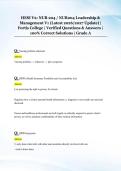
HESI V2: NUR 204 / NUR204 Leadership & Management V1 (Latest 2026/2027 Update) | Fortis College | Verified Questions & Answers | 100% Correct Solutions | Grade A

Document preview thumbnail
Preview 3 out of 29 pages

HESI V2: NUR 204 / NUR204 Leadership & Management V1 (Latest 2026/2027 Update) | Fortis College | Verified Questions & Answers | 100% Correct Solutions | Grade A Q: Nursing problem statement Answer "nursing problem -- related to -- plus symptoms Q: HIPPA (Health Insurance Portability and Accountability Act) Answer Law protecting the right to privacy for clients. Regulates how a client's personal health information i.e. diagnosis or test results are used and disclosed. Nurses and healthcare professionals are both legally an ethically required to protect client's privacy as well as maintain confidentiality of their medical information. Q: HIPPA keypoints Answer 1) only share client info with other team members directly involved with care - need to know basis - no over sharing detailed information with ''non-essential'' personnel i.e. transporters/drivers, secretaries 2) never discuss client info in the hallway, elevator, public area, outside hospital - ONLY in secure private areas at work (i.e. nurses station, private room) 3) DO NOT access charts or info that is NOT needed directly for work 4) Computer charting: NO PASSWORD sharing - not even with supervisor (charge nurse or director) and LOG OFF when stepping away and log off your coworkers if they do ''leave the computer in the hall unattended'' 5) NO taking info home. Must dispose of report sheets in a secure shredder and old medical records are kept in a locked file cabinet. 6) Information releases: Yes, client's have the right to receive a copy of their own health records but NO we cannot share info with a family or friend without the client's permission 7) Report any breath of confidentiality. Violation examples: talking about client's health condition in a hallway/elevator, takng home client's report sheet [must be shredded at the end of the shift], Q: Charge nurse from another unit asks about the client's condition stating ''the client is my neighbor and i want to check on her,'' how should the nurse respond? Answer I am sorry, I cannot tell you key term: another unit Q: The nurse looks up the chart of a cousin who is not under the care of the nurse. What is the manager's next action? Answer Contact HR department There is a breach of confidentiality in this case Q: What are the possible consequences if a nurse has shared his computer username and password with a student nurse? Answer The nurse can be prosecuted as a criminal Q: A client's spouse is asking for more information on the client, what does the nurse do next? Answer Nurse must first get permission from the client Q: Husband is requesting lab results for his wife. How should the nurse respond? Answer ''Let me check if you have permission'' Q: a 19 yo female asks for a prescription for oral contraception. She is under her parents insurance but does not want her parents to know. According to HIPPA, what should the provider tell the patient? Answer Since patient is over 18, the client's parents may not view the medical record but may learn about it from their insurance billing receipts. Is this a violation: Calling out a client's full legal first and last name in the waiting room Answer no. not a violation of hippa Q: Is this a violation: Telling the client's driver that the ''client has stage 4 pancreatic cancer for.3 weeks and needs to be handled gently'' Answer Yes, this is a violation. You can just tell the driver that the patient needs to be handled gently. Q: Client overheards the nurse giving report details on the client's roommate through the room's curtain Answer NO not a violation. Q: a new grad nurse accessing medical records of a client they took care of last week but not currently assigned Answer yes, violation. key word ''not currently assigned'' Q: Explaining the results of a client's lab reports to a unit secretary who is organizing the client's medical record Answer yes, violation. venous dressings piggyback iv math calculations normal anount of urine per hour torts dressings for which wound rectal probe inches catheter inches for male and female drainage colors from wounds Lab values (PT, PTT, INR). What's measured, what's normal & how alterations indicate pathological states pH value of gastric content Q: ANA or american nurses association Answer decides ethics of care takes care of ethi review what the UAP can and cannot do 1 teaspoon Answer 5 mL 1 tablespoon Answer 15 mL 1 ounce Answer 30 mL 1 cup Answer 8 ounces or 240 mL On admission, a client presents a signed living will that includes a Do Not Resuscitate (DNR) prescription. When the client stops breathing, the nurse performs cardiopulmonary resuscitation (CPR) and successfully revives the client. Which crime could the nurse potentially be charged with? Answer Battery Rationale: Civil laws protect individual rights and include intentional torts, such as assault (an intentional threat to engage in harmful contact with another) or battery (unwanted touching). Performing any procedure against the client's wishes can potentially pose a legal issue, such as battery, even if the procedure is of questionable benefit to the client. When evaluating a client's plan of care, the nurse determines that a desired outcome was not achieved. Which action should the nurse implement first? A) Establish a new nursing problem. B) Note which actions were not implemented. C) Add additional nursing orders to the plan. D) Collaborate with the healthcare provider to make changes. Answer B. Note which actions were not implemented. Rationale First, the nurse should review which actions in the original plan were not implemented in order to determine why the original plan did not produce the desired outcome. Appropriate revisions can then be made, which may include revising the expected outcome or identifying a new nursing problem. The nurse is developing a plan of care for a client with dementia. Which feature of confusion in the older adult is accurate? A) Bewilderment is to be expected and progresses with age. B) Disorientation often follows relocation to new surroundings. C) Uncertainty is a result of irreversible brain pathology. D) Being perplexed can be prevented with adequate sleep. B) Disorientation often follows relocation to new surroundings. Rationale Relocation often results in confusion among older clients. Moving is stressful for anyone. Which snack food is best for the nurse to provide a client with myasthenia gravis who is at risk for altered nutritional status? A) Chocolate pudding. B) Graham crackers. C) Sugar-free gelatin. D) Apple slices. A. Rationale The client with myasthenia gravis is at high risk for altered nutrition because of fatigue and muscle weakness resulting in dysphagia. Snacks that are semisolid, such as pudding are easy to swallow and require minimal chewing effort and provide calories and protein. During shift change report, the nurse receives reports that a client has abnormal heart sounds. Which placement of the stethoscope should the nurse use to hear the client's heart sounds? A) Place the stethoscope bell at random points on the posterior chest. B) Use the stethoscope bell over the valvular areas of the anterior chest. C) Move the diaphragm of the stethoscope over the left anterior chest. D) Position the diaphragm of the stethoscope at Erb's point on the chest B) Use the stethoscope bell over the valvular areas of the anterior chest. Rationale Abnormal heart sounds are best heard with the bell of the stethoscope, which picks up lower pitched sounds, that is placed at points on the anterior chest. An older client who is a resident in a long-term care facility has been bedridden for a week. Which finding should the nurse identify as a client risk factor for pressure ulcers? A) Generalized dry skin. B) Localized dry skin on lower extremities. C) Red flush over the entire skin surface. D) Rashes in the axillary, groin, and skin fold regions. D. Rationale Immobility, constant contact with bed clothing, and excessive heat and moisture in areas where airflow is limited contribute to bacterial and fungal growth, which increases the risk for rashes, skin breakdown, and the development of pressure ulcers. At the time of the first dressing change, the client refuses to look at her mastectomy incision. The nurse tells the client that the incision is healing well, but the client refuses to talk about it. Which is the best response to this client's silence? A) "It is normal to feel angry and depressed, but the sooner you deal with this surgery, the better you will feel." B) "Looking at your incision can be frightening, but facing this fear is a necessary part of your recovery." C) "It is OK if you don't want to talk about your surgery. I will be available when you are ready." D) "I will ask a woman who has had a mastectomy to come by and share her experiences with you." C. Rationale When a client is reluctant to look at a surgical wound or refuses to talk about the surgery, the nurse should reflect that these feelings are OK and that the nurse is available when the client is ready. Such a response displays sensitivity and understanding without judging the client. On the other hand, telling a client how she should feel is judgmental and insensitive. The nurse is instructing a client with high cholesterol about diet and lifestyle modification. Which comment from the client indicates that the teaching has been effective? A) "If I exercise at least two times weekly for one hour, I will lower my cholesterol." B) "I need to avoid eating proteins, including red meat." C) "I will limit my intake of beef to 4 ounces per week." D) "My blood level of low-density lipoproteins needs to increase." C. Rationale Limiting saturated fat from animal food sources to no more than 4 ounces per week is an important diet modification for lowering cholesterol. To be effective in reducing cholesterol, the client should exercise 30 minutes per day, or at least 4 to 6 times per week. Red meat and all proteins do not need to be eliminated to lower cholesterol but should be restricted to lean cuts of red meat and smaller portions (2-ounce servings). A resident in a skilled nursing facility for short-term rehabilitation after a hip replacement tells the nurse, "I don't want any more blood taken for those useless tests." Which narrative documentation should the nurse enter into the client's medical record? A) Healthcare provider was notified of the failure to collect specimens for prescribed blood studies. B) Blood specimens were not collected because the client no longer wants blood tests performed. C) The healthcare provider was notified of the client's refusal to have blood specimens collected for testing. D) The client is irritable, uncooperative, and refuses to have blood collected. The healthcare provider was notified. C. The healthcare provider was notified of the client's refusal to have blood specimens collected for testing. Rationale When a client refuses treatment, the exact words of the client regarding the client's refusal of care should be documented in a narrative format. The nurse should not editorialize, make judgments, or document assumptions about the client's wishes. Which action is most important for the nurse to implement when donning sterile gloves? A) Maintain thumb at a ninety degree angle. B) Hold hands with fingers down while gloving. C) Keep gloved hands above the elbows. D) Put the glove on the dominant hand first. C. keep gloved hands above the elbows Rationale Gloved hands held below waist level are considered unsterile. While it may be helpful to put the glove on the dominant hand first, it is not necessary to ensure asepsis. ''most important'' An older client with a fractured left hip is on strict bed rest. Which nursing measure is essential to the client's nursing care? A) Massage any reddened areas for at least five minutes. B) Encourage active range of motion exercises on extremities. C) Position the client laterally, prone, and dorsally in sequence. D) Gently lift the client when moving into a desired position. D. Gently lift the client when moving into a desired position Rationale To avoid shearing forces when repositioning, the client should be lifted gently across a surface. The nurse observes that a male client has removed the covering from an ice pack applied to his knee. Which action should the nurse take first? A) Observe the appearance of the skin under the ice pack. B) Instruct the client regarding the need for the covering. C) Reapply the covering after filling it with fresh ice. D) Ask the client how long the ice was applied to the skin. A. Observe the appearance of the skin under the ice pack Rationale The client has been using an ice pack without the protective covering. The first action the nurse should take is to assess the skin for any possible thermal injury. If no injury to the skin has occurred, the nurse can then explain the need for a cover and reapply the ice pack with the cover in place. A client who is in hospice care reports increasing amounts of pain. The healthcare provider prescribes an analgesic every four hours as needed. Which action should the nurse implement? A) Give an around-the-clock schedule for the administration of analgesics. B) Administer analgesic medication as needed when the pain is severe. C) Provide medication to keep the client sedated and unaware of stimuli. D) Offer a medication-free period so that the client can do daily activities. A.Give an around-the-clock schedule for the administration of analgesics. Rationale The most effective management of pain is achieved using an around-the-clock schedule that provides analgesic medications on a regular basis and in a timely manner. Analgesic medication should be administered before the client's pain peaks. Providing comfort is a priority for the client who is dying. During the admission interview, which technique is most efficient for the nurse to use when obtaining information about signs and symptoms of a client's primary health problem? A) Restatement of responses. B) Open-ended questions. C) Closed-ended questions. D) Problem-seeking responses. c.) Close-ended Rationale Lay descriptors of health problems can be vague and nonspecific. To efficiently obtain specific information, the nurse should use closed-ended questions that focus on common signs and symptoms of a client's health problem. An older resident of a long-term care facility is no longer able to perform self-care and is becoming progressively weaker. The resident previously requested that no resuscitative efforts be performed, and the family requests hospice care. Which action should the nurse implement first? A) Reaffirm the client's desire for no resuscitative efforts. B) Transfer the client to a hospice inpatient facility. C)Prepare the family for the client's impending death. D)Notify the healthcare provider of the family's request. D)Notify the healthcare provider of the family's request. Rationale When a family requests hospice care, the nurse should first communicate with the healthcare provider. Hospice care is provided for clients with a limited life expectancy, which must be identified by the healthcare provider. Once the healthcare provider supports the transfer to hospice care, the nurse can collaborate with the hospice staff and healthcare provider to determine what additional care should be implemented. A male client with obesity discusses with the nurse his plans to begin a long-term weight loss regimen. In addition to dietary changes, he plans to begin an intensive aerobic exercise program 3 to 4 times a week and to take stress management classes. After praising the client for his decision, which instruction is most important for the nurse to provide? A) "Be sure to have a complete physical examination before beginning your planned exercise program." B) "Be careful that the exercise program doesn't simply add to your stress level, making you want to eat more." C) "Increased exercise helps to reduce stress, so you may not need to spend money on a stress management class." D) "Make sure to monitor your weight loss regularly to provide a sense of accomplishment and motivation." A. "Be sure to have a complete physical examination before beginning your planned exercise program." Rationale A client with obesity who intends to begin a weight loss and exercise program may be at risk for cardiovascular complications. The most important teaching is to encourage the client to have a complete medical evaluation so that the client will not begin a dangerous level of exercise when he is not sufficiently fit. Vigorous exercise may result in chest pain, a heart attack, or stroke. The nurse witnesses the signature of a client who has signed an informed consent. Which statement best explains this nursing responsibility? A) The client voluntarily signed the form. B) The client fully understands the procedure. C) The client agrees with the procedure to be done. D) The client authorizes continued treatment. A.The client voluntarily signed the form. Rationale The nurse signs the consent form to witness that the client voluntarily signs the consent, that the client's signature is authentic, and that the client is otherwise competent to give consent. A client is in the radiology department at 0900 when the prescription for levofloxacin 500 mg IV every 24 hours is scheduled to be administered. The client returns to the unit at 1300. Which is the best intervention for the nurse to implement? A) Contact the healthcare provider and complete a medication variance form. B) Administer the levofloxacin at 1300 and resume the 0900 schedule in the morning. C) Notify the charge nurse and complete an incident report to explain the missed dose. D) Give the missed dose at 1300 and change the schedule to administer daily at 1300. D) Give the missed dose at 1300 and change the schedule to administer daily at 1300. Rationale To ensure that a therapeutic level of medication is maintained, the nurse should administer the missed dose as soon as possible, and revise the administration schedule accordingly to prevent dangerously increasing the level of the medication in the bloodstream. An unlicensed assistive personnel (UAP) places a client in a right lateral position prior to administering a soap suds enema. Which instruction should the nurse provide the UAP? A) Position the client on the right side of the bed in reverse Trendelenburg. B) Fill the enema container with 1,000 mL of warm water and 5 mL of castile soap. C) Reposition in a modified left lateral recumbent position with the client's weight on the anterior ilium. D) Raise the side rails on both sides of the bed and elevate the bed to waist level. C. Reposition in a modified left lateral recumbent position with the client's weight on the anterior ilium. Rationale The modified left lateral recumbent position allows the enema solution to follow the anatomical course of the intestines and allows the best overall results, so the UAP should reposition the client in the modified left lateral recumbent position, which distributes the client's weight to the anterior ilium. A client with pneumonia has a decrease in oxygen saturation from 94% to 88% while ambulating. Based on these findings, which intervention should the nurse implement first? A) Assist the ambulating client back to the bed. B) Encourage the client to ambulate to resolve pneumonia. C) Obtain a prescription for portable oxygen while ambulating. D) Move the oximetry probe from the finger to the earlobe. A.) Assist the ambulating client back to the bed. Rationale Oxygen saturation below 90% indicates inadequate oxygenation. First, the client should be assisted in returning to bed to minimize oxygen demands. Ambulation increases the aeration of the lungs to prevent the pooling of respiratory secretions, but the client's activity at this time is depleting the oxygen saturation of the blood. Increased activity increases respiratory effort, and oxygen may be necessary to continue ambulation, but first, the client should return to bed to rest. A male client with a history of hypertension tells the nurse that he is tired of taking antihypertensive medications and is going to try spiritual meditation instead. Which should be the nurse's first response? A) "It is important that you continue your medication while learning to meditate." B) "Spiritual meditation requires a time commitment of 15 to 20 minutes daily." C) "Obtain your healthcare provider's permission before starting meditation." D) "Complementary therapy and western medicine can be effective for you." A. "It is important that you continue your medication while learning to meditate." Rationale The prolonged practice of meditation may lead to a reduced need for antihypertensive medications. However, the medications must be continued while the physiologic response to meditation is monitored. The healthcare provider should be informed, but permission is not required to meditate. Although it is true that this complementary therapy might be effective, it is essential that the client continues with antihypertensive medications until the effect of meditation can be measured. Where is the center of gravity for older adults? UPPER TORSO Rationale The center of gravity for adults is the hips. However, as the person grows older, a stooped posture is common because of the changes from osteoporosis and normal bone degeneration, and the knees, hips, and elbows flex. This stooped posture results in the upper torso becoming the center of gravity for older adults. A young mother of three children complains of increased anxiety during her annual physical exam. Which information should the nurse obtain first? A) Sexual activity patterns. B) Nutritional history. C) Leisure activities. D) Financial stressors. B) Nutritional History Rationale Caffeine, sugars, and alcohol can lead to increased levels of anxiety, so a nutritional history should be obtained first so that health teaching can be initiated if indicated. The nurse observes an unlicensed assistive personnel (UAP) checking a client's blood pressure with a cuff that is too small, but the blood pressure reading obtained is within the client's usual range. Which action is most important for the nurse to implement? A) Tell the UAP to use a larger cuff at the next scheduled assessment. B) Reassess the client's blood pressure using a larger cuff. C) Have the unit educator review this procedure with the UAPs. D) Teach the UAP the correct technique for assessing blood pressure. B) Reassess the client's blood pressure using a larger cuff. Rationale An unlicensed assistive personnel (UAP) is using the wrong-sized cuff to check blood pressure. The most important action is to ensure that an accurate BP reading is obtained. The nurse should reassess the BP with the correct size cuff. Reassessment should not be postponed. Which response by a client with a nursing problem of "Spiritual distress," indicates to the nurse that a desired outcome measure has been met? E A) Expresses concern about the meaning and importance of life. B) Remains angry at God for the continuation of the illness. C) Accepts that punishment from God is not related to illness. D) Refuses to participate in religious rituals that have no meaning. C.Accepts that punishment from God is not related to illness. Rationale Acceptance that her illness is not God punishing her, indicates a desired outcome for some degree of resolution of spiritual distress. Which nutritional assessment data should the nurse collect to best reflect total muscle mass in an adolescent? Upper arm circumference (indirect measurement of muscle mass) The nurse is performing nasotracheal suctioning. After suctioning the client's trachea for fifteen seconds, large amounts of thick yellow secretions return. Which action should the nurse implement next? Reoxygenate the client before attempting to suction again A client who is a Jehovah's Witness is admitted to the nursing unit. What should the nurse be aware of when planning care in terms of the client's beliefs? A) Autopsy of the body is prohibited. B) Blood transfusions are forbidden. C) Alcohol use in any form is not allowed. D) A vegetarian diet must be followed. B. Blood transfusions are forbidden Rationale Blood transfusions are forbidden in the Jehovah's Witness religion. Judaism prohibits autopsy; Buddhism forbids the use of alcohol and drugs. Many of these sects follow a vegetarian diet, but the direct impact on nursing care concerns beliefs about transfusions. A client's spouse is learning passive range of motion for the client's contracted shoulder. The nurse observes that the spouse is holding the client's arm above and below the elbow. Which nursing action should the nurse implement? A) Acknowledge that the spouse is supporting the arm correctly. B) Encourage the spouse to keep the joint covered to maintain warmth. C) Reinforce the need to grip directly under the joint for better support. D) Instruct the spouse to grip directly over the joint for better motion. A. Acknowledge that the spouse is supporting the arm correctly. Twenty minutes after beginning a heat application, the client states that the heating pad no longer feels warm enough. Which is the best response by the nurse? A) "That means you have derived the maximum benefit, and the heat can be removed." B) "Your blood vessels are becoming dilated and removing the heat from the site." C) "We will increase the temperature by 5 degrees when the pad no longer feels warm." D) "The body's receptors adapt over time as they are exposed to heat." D. ''The body's receptors adapt over time as they are exposed to heat." Rationale Thermal adaptation occurs 20 to 30 minutes after heat application. This means the client may not feel the same level of heat as at the start of the treatment. The nurse should not increase the heat setting. A female client with a nasogastric tube attached to low suction states that she is nauseated. The nurse assesses that there has been no drainage through the nasogastric tube in the last two hours. Which action should the nurse take first? A) Irrigate the nasogastric tube with sterile normal saline. B) Reposition the client on her side. C) Advance the nasogastric tube an additional five centimeters. D) Administer an intravenous antiemetic prescribed for PRN use. B. Reposition the client on her side. Rationale The nurse has identified two things suggesting the nasogastric tube is not functioning properly: the client is nauseated and has had no drainage from the tube in 2 hours. The immediate priority is to determine if the tube is functioning correctly, which would then relieve the client's nausea. The least invasive intervention should be attempted first. This includes repositioning the client to her side. The tube may need to be irrigated or advanced, but these actions should follow repositioning the client. The nurse is administering medications through a nasogastric tube (NGT) which is connected to suction. After ensuring correct tube placement, which action should the nurse take next? A) Clamp the tube for 20 minutes. B) Flush the tube with water. C) Administer the medications as prescribed. D) Crush the tablets and dissolve them in sterile water. B) Flush the tube with water Rationale The NGT should be flushed before, after, and in between each medication administered. A client who is 5 foot 5 inches tall and weighs 200 pounds is scheduled for surgery the next day. Which question is most important for the nurse to include during the preoperative assessment? A) "What is your daily calorie consumption?" B) "What vitamin and mineral supplements do you take?" C) "Do you feel that you are overweight?" D) "Will a clear liquid diet be okay after surgery?" B. ''What vitamin and mineral supplements do you take?'' Rationale In the preoperative assessment, the nurse should assess the client's use of vitamin and mineral supplements. These products may impact medications used during the operative period. A hospitalized male client is receiving nasogastric tube feedings via a small-bore tube and a continuous pump infusion. He reports that he had a bad bout of severe coughing a few minutes ago, but feels fine now. Which action is best for the nurse to take? A) Record the coughing incident. No further action is required at this time. B) Stop the feeding, explain to the family why it is being stopped, and notify the healthcare provider. C) After clearing the tube with 30 ml of air, check the pH of the fluid withdrawn from the tube. D) Inject 30 ml of air into the tube while auscultating the epigastrium for gurgling. C.) After clearing the tube with 30 ml of air, check the pH of the fluid withdrawn from the tube. Rationale Coughing, vomiting, and suctioning can precipitate displacement of the tip of the small bore feeding tube upward into the esophagus, placing the client at increased risk for aspiration. Checking the sample of fluid withdrawn from the tube (after clearing the tube with 30 mL of air) for acidic (stomach) or alkaline (intestine) values is a more sensitive method for these tubes, and the nurse should assess tube placement in this way prior to taking any other action. The auscultating method has been found to be unreliable for small-bore feeding tubes. The nurse is teaching a client the proper use of an inhaler. When should the client administer the inhaler-delivered medication to demonstrate the correct use of the inhaler? A) Immediately after exhalation. B) During the inhalation. C) At the end of three inhalations. D) Immediately after inhalation. B) During inhalation Rationale The client should be instructed to deliver medication through a metered inhaler during the last part of inhalation. After the medication is delivered, the client should remove the mouthpiece, keep their lips closed, and hold their breath for several seconds to allow for the distribution of the medication. Three days following surgery, a male client observes his colostomy for the first time. He becomes quite upset and tells the nurse that it is much bigger than he expected. Which is the best response by the nurse? A) Reassure the client that he will become accustomed to the stoma appearance in time. B) Instruct the client that the stoma will become smaller when the initial swelling diminishes. C) Offer to contact a member of the local ostomy support group to help him with his concerns. D) Encourage the client to handle the stoma equipment to gain confidence with the procedure. B. Rationale Postoperative swelling causes enlargement of the stoma. The nurse can teach the client that the stoma will become smaller when the swelling is diminished. This will help reduce the client's anxiety and promote acceptance of the colostomy. What is the most important reason for starting intravenous infusions in the upper extremities rather than the lower extremities of adults? A) It is more difficult to find a superficial vein in the feet and ankles. B) A decreased flow rate could result in the formation of thrombosis. C) A cannulated extremity is more difficult to move when the leg or foot is used. D) Veins are located deep in the feet and ankles, resulting in a more painful procedure. B. A decreased flow rate could result in the formation of thrombosis. Rationale Venous return is usually better in the upper extremities. Cannulation of the veins in the lower extremities increases the risk of thrombus formation, which, if dislodged, could be life threatening. The nurse is assessing the nutritional status of several clients. Which client has the greatest nutritional need for additional intake of protein? A) A college-age track runner with a sprained ankle. B) A lactating woman nursing her 3-day-old infant. C) A school-aged child with Type 2 diabetes. D) An elderly man being treated for a peptic ulcer. Lactating woman Rationale A lactating woman has the greatest need for additional protein intake due to the increased metabolic protein demands of lactation. bladder training toileting schedule - this is usually to help a client's incontinence every 2 hours in the day time every 4 hours at night catheter insertion in females 2-3 inches or until you see urine, then you go in 1 inch more. catheter insertion in males catheter should be inserted 7 to 9 inches to ensure proper placement in the adult male. bladder irrigation requires clean or aseptic technique? aseptic ostomy bag should be replaced when foley catheter bag should be replaced when elevated creatinine level indicates kidney issue BUN level hydration or kidney toxicity, absorbance, half life Half-life describes the length of time required to reduce a drug level to one half of its initial value. Drugs with shorter half-lives will have to be given more frequently than those with longer half-lives. The nurse notes that the medication dosage is in the safe range for older clients, which is to be administered by IV every 12 hours. The nurse recognizes that the frequency of drug administration is based on which characteristic of the medication? bioavailability Bioavailablity describes the rate and extent to which a drug enters the systemic circulation. sleep patterns for adults An adult has four to six sleep cycles, each with non-rapid eye movement (NREM) sleep and rapid eye movement (REM) sleep, during a normal night's sleep. NREM non-rapid eye movement sleep; encompasses all sleep stages except for REM sleep is important for

Content preview

HESI V2: NUR 204 / NUR204 Leadership &
Management V1 (Latest 2026/2027 Update) |
Fortis College | Verified Questions & Answers |
100% Correct Solutions | Grade A


Q: Nursing problem statement
Answer
"nursing problem --> related to --> plus symptoms


Q: HIPPA (Health Insurance Portability and Accountability Act)
Answer
Law protecting the right to privacy for clients.


Regulates how a client's personal health information i.e. diagnosis or test results are used and
disclosed.


Nurses and healthcare professionals are both legally an ethically required to protect client's
privacy as well as maintain confidentiality of their medical information.


Q: HIPPA keypoints
Answer
1) only share client info with other team members directly involved with care
- need to know basis

,- no over sharing detailed information with ''non-essential'' personnel i.e. transporters/drivers,
secretaries


2) never discuss client info in the hallway, elevator, public area, outside hospital
- ONLY in secure private areas at work (i.e. nurses station, private room)


3) DO NOT access charts or info that is NOT needed directly for work


4) Computer charting: NO PASSWORD sharing - not even with supervisor (charge nurse or
director)
and LOG OFF when stepping away and log off your coworkers if they do ''leave the computer in
the hall unattended''


5) NO taking info home. Must dispose of report sheets in a secure shredder and old medical
records are kept in a locked file cabinet.


6) Information releases: Yes, client's have the right to receive a copy of their own health records
but NO we cannot share info with a family or friend without the client's permission


7) Report any breath of confidentiality. Violation examples: talking about client's health
condition in a hallway/elevator, takng home client's report sheet [must be shredded at the end of
the shift],


Q: Charge nurse from another unit asks about the client's condition stating ''the client is my
neighbor and i want to check on her,'' how should the nurse respond?
Answer
I am sorry, I cannot tell you

, key term: another unit


Q: The nurse looks up the chart of a cousin who is not under the care of the nurse. What is the
manager's next action?
Answer
Contact HR department


There is a breach of confidentiality in this case


Q: What are the possible consequences if a nurse has shared his computer username and
password with a student nurse?
Answer
The nurse can be prosecuted as a criminal


Q: A client's spouse is asking for more information on the client, what does the nurse do next?
Answer
Nurse must first get permission from the client


Q: Husband is requesting lab results for his wife. How should the nurse respond?
Answer
''Let me check if you have permission''


Document information

Uploaded on
June 25, 2026
Number of pages
29
Written in
2025/2026
Type
Exam (elaborations)
Contains
Questions & answers
CA$19.99

Wrong document? Swap it for free Within 14 days of purchase and before downloading, you can choose a different document. You can simply spend the amount again.
Written by students who passed
Immediately available after payment
Read online or as PDF

Seller avatar
Reputation scores are based on the amount of documents a seller has sold for a fee and the reviews they have received for those documents. There are three levels: Bronze, Silver and Gold. The better the reputation, the more your can rely on the quality of the sellers work.
ProfGoodlucK
4.0
(18)
Sold
144
Followers
52
Items
2768
Last sold
1 week ago


Why students choose Stuvia

Created by fellow students, verified by reviews

Quality you can trust: written by students who passed their tests and reviewed by others who've used these notes.

Didn't get what you expected? Choose another document

No worries! You can instantly pick a different document that better fits what you're looking for.

Pay as you like, start learning right away

No subscription, no commitments. Pay the way you're used to via credit card and download your PDF document instantly.

Student with book image

“Bought, downloaded, and aced it. It really can be that simple.”

Alisha Student

Working on your references?

Create accurate citations in APA, MLA and Harvard with our free citation generator.

Working on your references?

Frequently asked questions
