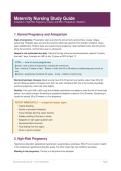
Maternity Nursing Study Guide
Antepartum | High-Risk Pregnancy | Labour and Birth | Postpartum | Newborn
1. Normal Pregnancy and Antepartum
Signs of pregnancy. Presumptive signs are what the woman feels (amenorrhea, nausea, fatigue,
quickening). Probable signs are what the examiner observes (positive hCG, Goodell, Chadwick, Hegar
signs, ballottement). Positive signs are caused only by pregnancy: fetal heartbeat heard, fetal movement
felt by the examiner, and the fetus seen on ultrasound.
Naegele's rule (estimated due date). Take the first day of the last menstrual period, subtract 3 months,
then add 7 days. Example: an LMP of July 10 gives an EDD of April 17.
GTPAL — how to count pregnancies
Gravida = total number of pregnancies, including the current one.
Term = births at 37 weeks or later. Preterm = births from 20 to 36 weeks (a multiple pregnancy counts as
one).
Abortions = pregnancies lost before 20 weeks. Living = children currently living.
Normal physiologic changes. Blood volume rises 40 to 50 percent and cardiac output rises 30 to 50
percent. Because plasma increases more than red cells, hematocrit falls; this is the normal physiologic
anemia of pregnancy. Heart rate rises slightly.
Nutrition. Folic acid (400 to 600 mcg) should ideally start before conception to lower the risk of neural tube
defects. Iron needs increase. Screening for gestational diabetes is done at 24 to 28 weeks. Quickening is
usually felt around 18 to 20 weeks in a first pregnancy.
REPORT IMMEDIATELY — antepartum danger signs
• Vaginal bleeding
• Severe or persistent headache
• Visual changes (blurring, spots, flashes)
• Sudden swelling of the face or hands
• Epigastric or right upper quadrant pain
• Decreased fetal movement
• Fluid leaking from the vagina
• Fever or painful urination
2. High-Risk Pregnancy
Hypertensive disorders (gestational hypertension, preeclampsia, eclampsia, HELLP) are covered in depth
in the companion hypertensive disorders guide. The other major high-risk conditions are below.
Bleeding in late pregnancy. The key is to tell previa from abruption.
For personal study use only — not for redistribution. Page 1
Antepartum | High-Risk Pregnancy | Labour and Birth | Postpartum | Newborn
1. Normal Pregnancy and Antepartum
Signs of pregnancy. Presumptive signs are what the woman feels (amenorrhea, nausea, fatigue,
quickening). Probable signs are what the examiner observes (positive hCG, Goodell, Chadwick, Hegar
signs, ballottement). Positive signs are caused only by pregnancy: fetal heartbeat heard, fetal movement
felt by the examiner, and the fetus seen on ultrasound.
Naegele's rule (estimated due date). Take the first day of the last menstrual period, subtract 3 months,
then add 7 days. Example: an LMP of July 10 gives an EDD of April 17.
GTPAL — how to count pregnancies
Gravida = total number of pregnancies, including the current one.
Term = births at 37 weeks or later. Preterm = births from 20 to 36 weeks (a multiple pregnancy counts as
one).
Abortions = pregnancies lost before 20 weeks. Living = children currently living.
Normal physiologic changes. Blood volume rises 40 to 50 percent and cardiac output rises 30 to 50
percent. Because plasma increases more than red cells, hematocrit falls; this is the normal physiologic
anemia of pregnancy. Heart rate rises slightly.
Nutrition. Folic acid (400 to 600 mcg) should ideally start before conception to lower the risk of neural tube
defects. Iron needs increase. Screening for gestational diabetes is done at 24 to 28 weeks. Quickening is
usually felt around 18 to 20 weeks in a first pregnancy.
REPORT IMMEDIATELY — antepartum danger signs
• Vaginal bleeding
• Severe or persistent headache
• Visual changes (blurring, spots, flashes)
• Sudden swelling of the face or hands
• Epigastric or right upper quadrant pain
• Decreased fetal movement
• Fluid leaking from the vagina
• Fever or painful urination
2. High-Risk Pregnancy
Hypertensive disorders (gestational hypertension, preeclampsia, eclampsia, HELLP) are covered in depth
in the companion hypertensive disorders guide. The other major high-risk conditions are below.
Bleeding in late pregnancy. The key is to tell previa from abruption.
For personal study use only — not for redistribution. Page 1