
Name:___________________________________________________ Date:______
Calvin Cycle Nature’s Smallest Factory (TED-ED)
https://youtu.be/0UzMaoaXKaM
1. Energy exists in the form of _________sugars___________ made by the plant.
2. Plants get their carbon from the _________CO2_________.
3. Photosynthesis occurs in two steps, the second is the _____Calvin cycle______________.
4. RuBP contains _______5___ carbons.
5. The enzyme, _____________rubisco____________ builds an initial 6 carbon sequence.
6. This sequence split into two short chains called ____3-C PGA_____.
7. NADPH transfers __hydrogen/H+ and e-__ to those molecules, they become G3P (PGAL).
8. The original RuBP must be ____regenerated_____________________.
9. How many times does the Calvin cycle need to “turn” to synthesize one glucose? _6____
10. How many times does the Calvin cycle need to turn to regenerate 3 RuBP? __3__
11. How many CO2 must be fixed in the Calvin cycle in order to synthesize 1 glucose? __6__
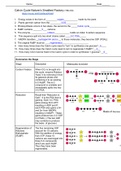
Summarize the Stage
Stage Description Molecules involved
Carbon Fixation When CO2 is brought into
the cycle, enzyme Rubisco
“fixes” it by removing it from
its gaseous phase and
combining it to an existing
5-C RuBP. This 6-C
x
compound is unstable and
immediately splits into two
3-C PGA.
Reduction Recall that “Reduction is
Gain”. It is the PGA that is
gaining. Each 3-C PGA
gains energy from ATP,
resulting in ADP and P; x
each PGA also gains a H+
and 2e- from NADPH
Basis of Glucose
resulting in NADP+. These
gains produce two 3-C G3P
(or PGAL). (The two G3P
may combine to produce
the basis of glucose.)
Regeneration of The five remaining G3P
Ribulose account for 15 carbons.
Biphosphate With the addition of energy
(RuBP) from ATP, these 15
carbons are rearranged into
three 5-C compounds
which are each RuBP.
x2
Thus they have been
regenerated.
Calvin Cycle Nature’s Smallest Factory (TED-ED)
https://youtu.be/0UzMaoaXKaM
1. Energy exists in the form of _________sugars___________ made by the plant.
2. Plants get their carbon from the _________CO2_________.
3. Photosynthesis occurs in two steps, the second is the _____Calvin cycle______________.
4. RuBP contains _______5___ carbons.
5. The enzyme, _____________rubisco____________ builds an initial 6 carbon sequence.
6. This sequence split into two short chains called ____3-C PGA_____.
7. NADPH transfers __hydrogen/H+ and e-__ to those molecules, they become G3P (PGAL).
8. The original RuBP must be ____regenerated_____________________.
9. How many times does the Calvin cycle need to “turn” to synthesize one glucose? _6____
10. How many times does the Calvin cycle need to turn to regenerate 3 RuBP? __3__
11. How many CO2 must be fixed in the Calvin cycle in order to synthesize 1 glucose? __6__
Summarize the Stage
Stage Description Molecules involved
Carbon Fixation When CO2 is brought into
the cycle, enzyme Rubisco
“fixes” it by removing it from
its gaseous phase and
combining it to an existing
5-C RuBP. This 6-C
x
compound is unstable and
immediately splits into two
3-C PGA.
Reduction Recall that “Reduction is
Gain”. It is the PGA that is
gaining. Each 3-C PGA
gains energy from ATP,
resulting in ADP and P; x
each PGA also gains a H+
and 2e- from NADPH
Basis of Glucose
resulting in NADP+. These
gains produce two 3-C G3P
(or PGAL). (The two G3P
may combine to produce
the basis of glucose.)
Regeneration of The five remaining G3P
Ribulose account for 15 carbons.
Biphosphate With the addition of energy
(RuBP) from ATP, these 15
carbons are rearranged into
three 5-C compounds
which are each RuBP.
x2
Thus they have been
regenerated.


