
CARBOHYDRATES - “SUGARS AND
STARCHES”
FOCUS ON MONOSACCHARIDES
✓ Contain the elements Carbon, Hydrogen, and Oxygen, with H and O in a ration 2:1,
as in water
✓ General formula is Cx(H2O)y
✓ Functions: a) immediate energy sources, b) energy storage, c) structural
materials, and d) recognition or signaling molecules that can trigger biological
responses (more on this later).
SIMPLE SUGARS – serve as immediate energy
✓ Simplest carbohydrates
✓ Simplest sugars are monosaccharides, with 3-7 C atoms
MONOSACCHARIDES
✓ Have an aldehyde or carbonyl functional group, and many OH groups
✓ They are polar and thus soluble in water
In solution, these sugars form rings by the breaking of the C=O bond, forming a single
bond, with the second available bond on the oxygen atoms now forming a bond with
carbon 5.
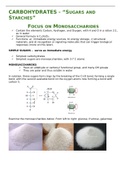
Examine the monosaccharides below. From left to right: glucose, fructose, galactose
, Can you discern any difference between these three substances? no- all three are solid,
white crystalline
Look carefully at these monosaccharides and answer the following.
a. What does mono and saccharide refer to? mono- means one; saccharide
means sugar
b. Are these three monosaccharides isomers? Yes. All three have different
structures but the same chemical formula C6H12O6
c. What functional groups are present? hydroxyl groups
d. Are these monosaccharides water soluble? Yes. The multiple -OH groups will
form H bonds with water. (O pulls electrons from H, setting up localized
polarity.)
e. How are the carbon atoms numbered? Number them. Start from the C to the
right of the O in the ring.
f.
f. List four
functions of
carbohydrates. Sugars
provide a quick energy source; plant starch and animal glycogen
are insoluble, compact storage molecules providing stored energy; cellulose provides
structure to plants; a lesser known function is to provide a C skeleton for the production
of other organic compounds.
STARCHES”
FOCUS ON MONOSACCHARIDES
✓ Contain the elements Carbon, Hydrogen, and Oxygen, with H and O in a ration 2:1,
as in water
✓ General formula is Cx(H2O)y
✓ Functions: a) immediate energy sources, b) energy storage, c) structural
materials, and d) recognition or signaling molecules that can trigger biological
responses (more on this later).
SIMPLE SUGARS – serve as immediate energy
✓ Simplest carbohydrates
✓ Simplest sugars are monosaccharides, with 3-7 C atoms
MONOSACCHARIDES
✓ Have an aldehyde or carbonyl functional group, and many OH groups
✓ They are polar and thus soluble in water
In solution, these sugars form rings by the breaking of the C=O bond, forming a single
bond, with the second available bond on the oxygen atoms now forming a bond with
carbon 5.
Examine the monosaccharides below. From left to right: glucose, fructose, galactose
, Can you discern any difference between these three substances? no- all three are solid,
white crystalline
Look carefully at these monosaccharides and answer the following.
a. What does mono and saccharide refer to? mono- means one; saccharide
means sugar
b. Are these three monosaccharides isomers? Yes. All three have different
structures but the same chemical formula C6H12O6
c. What functional groups are present? hydroxyl groups
d. Are these monosaccharides water soluble? Yes. The multiple -OH groups will
form H bonds with water. (O pulls electrons from H, setting up localized
polarity.)
e. How are the carbon atoms numbered? Number them. Start from the C to the
right of the O in the ring.
f.
f. List four
functions of
carbohydrates. Sugars
provide a quick energy source; plant starch and animal glycogen
are insoluble, compact storage molecules providing stored energy; cellulose provides
structure to plants; a lesser known function is to provide a C skeleton for the production
of other organic compounds.


