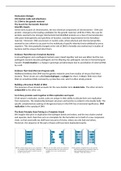
Moleculaire Biologie
H16 Nucleic Acids and Inheritance
16.1 DNA is the genetic material
The Search for the Genetic Material:
Scientific Inquiry
Genes exist as parts of chromosomes, the two chemical components of chromosomes – DNA and
protein- emerged as the leading candidates for the genetic material. Until the 1940s, the case for
proteins seemed to be stronger: Biochemists had identified proteins as a class of macromolecules
with great heterogeneity and specificity of function, essential requirements for the hereditary
material. Moreover, little was known on nucleic acids, whose physical and chemical properties
seemed far too uniform to account for the multitude of specific inherited traits exhibited by every
organism. This view gradually changed as the role of DNA in heredity was worked out in studies of
bacteria and the viruses that infect them.
Evidence That DNA Can Transform Bacteria
A non-pathogenic and a pathogenic bacteria were mixed together and one was killed, but the non-
pathogenic bacteria became pathogenic and its offspring was pathogenic too due to horizontal gene
transfer. Transformation is a change in genotype and phenotype due to assimilation of external DNA
by a cell.
Evidence That Viral DNA Can Program Cells
Additional evidence that DNA was the genetic material came from studies of viruses that infect
bacteria. These viruses are called bacteriophages, or phages for short. A virus is little more than
DNA (or sometimes RNA) enclosed by a protective coat, which is often simply protein
Building a Structural Model of DNA
The presence of two strands accounts for the now-familiar term double helix. The other strand is
antiparallel to the other one.
16.2 Many proteins work together in DNA replication and repair
Of all nature’s molecules, nucleic acids are unique in their ability to dictate their own replication
from monomers. The relationship between structure and function is evident in the double helix: The
specific complementary pairing of nitrogenous bases in the DNA has a functional significance. DNA
replication is the copying of DNA.
The Basic Principle: Base Pairing to a Template Strand
We imagine that prior to duplication the hydrogen bonds are broken, and the two chains unwind
and separate. Each chain then acts as a template for the formation on to itself of a new companion
chain, so that eventually we shall have two pairs of chains, where we only had one before.
Moreover, the sequence of the pairs of bases will have been duplicated exactly.
, The two strands are complementary; each stores
the information necessary to reconstruct the other.
When a cell copies a DNA molecule, each strand
serves as a template for ordering nucleotides into a
new, complementary strand. Nucleotides line up
along the template strand according to the base-
pairing rules and are linked to form the new
strands. This model of DNA replication remained
untested for several years following the publication
of the DNA structure. The necessary experiments
were simple in concept but difficult to perform.
Watson and Crick’s model predicts that when a
double helix replicates, each of the two daughter
molecules will have one old strand, from the
parental molecule, and one newly made strand.
This semiconservative model can be distinguished
from a conservative model of replication, in which
the two parental strands somehow come back
together after the process. In yet a third model,
called the dispersive model, all four strands of DNA
following replication have a mixture of old and new
DNA.
DNA Replication: A Closer Look
More than a dozen enzymes and other proteins
participate in DNA replication. Much more is known about how this replication machine works in
bacteria than in eukaryotes, and we will describe the basic steps for E. coli, except noted otherwise.
Getting Started
The replication of the chromosomal DNA begins at particular sites called origins of replication, short
stretches of DNA that have a specific sequence of nucleotides. Proteins that initiate DNA replication
recognize this sequence and attach to the DNA, separating the strands and opening up a replication
bubble. Replication of DNA then proceeds in both directions until the entire molecule is copied. In
contrast to a bacterial chromosome, a eukaryotic chromosome may have hundreds or even a few
thousand of replication origins. Multiple replication bubbles form and eventually fuse, thus speeding
up the copying of the very long DNA molecules. As in bacteria, eukaryotic DNA replication proceeds
in both directions from each origin. At each end of a replication bubble is a replication fork, a Y-
shaped region where the parental strands of DNA are being unwound. Several kinds of proteins
participate in the unwinding. Helicases are
enzymes that untwist the double helix at the
replication forks, separating the two
parental strands and making them available
as template strands. After the parental
strands separate, single-strand binding
proteins bind to the unpaired DNA strands,
keeping them from re-pairing. The
untwisting of the double helix causes tighter
twisting and strain ahead of the replication
fork. Topoisomerase is an enzyme that helps
relieve this strain by breaking, swivelling,
and rejoining DNA strands.
H16 Nucleic Acids and Inheritance
16.1 DNA is the genetic material
The Search for the Genetic Material:
Scientific Inquiry
Genes exist as parts of chromosomes, the two chemical components of chromosomes – DNA and
protein- emerged as the leading candidates for the genetic material. Until the 1940s, the case for
proteins seemed to be stronger: Biochemists had identified proteins as a class of macromolecules
with great heterogeneity and specificity of function, essential requirements for the hereditary
material. Moreover, little was known on nucleic acids, whose physical and chemical properties
seemed far too uniform to account for the multitude of specific inherited traits exhibited by every
organism. This view gradually changed as the role of DNA in heredity was worked out in studies of
bacteria and the viruses that infect them.
Evidence That DNA Can Transform Bacteria
A non-pathogenic and a pathogenic bacteria were mixed together and one was killed, but the non-
pathogenic bacteria became pathogenic and its offspring was pathogenic too due to horizontal gene
transfer. Transformation is a change in genotype and phenotype due to assimilation of external DNA
by a cell.
Evidence That Viral DNA Can Program Cells
Additional evidence that DNA was the genetic material came from studies of viruses that infect
bacteria. These viruses are called bacteriophages, or phages for short. A virus is little more than
DNA (or sometimes RNA) enclosed by a protective coat, which is often simply protein
Building a Structural Model of DNA
The presence of two strands accounts for the now-familiar term double helix. The other strand is
antiparallel to the other one.
16.2 Many proteins work together in DNA replication and repair
Of all nature’s molecules, nucleic acids are unique in their ability to dictate their own replication
from monomers. The relationship between structure and function is evident in the double helix: The
specific complementary pairing of nitrogenous bases in the DNA has a functional significance. DNA
replication is the copying of DNA.
The Basic Principle: Base Pairing to a Template Strand
We imagine that prior to duplication the hydrogen bonds are broken, and the two chains unwind
and separate. Each chain then acts as a template for the formation on to itself of a new companion
chain, so that eventually we shall have two pairs of chains, where we only had one before.
Moreover, the sequence of the pairs of bases will have been duplicated exactly.
, The two strands are complementary; each stores
the information necessary to reconstruct the other.
When a cell copies a DNA molecule, each strand
serves as a template for ordering nucleotides into a
new, complementary strand. Nucleotides line up
along the template strand according to the base-
pairing rules and are linked to form the new
strands. This model of DNA replication remained
untested for several years following the publication
of the DNA structure. The necessary experiments
were simple in concept but difficult to perform.
Watson and Crick’s model predicts that when a
double helix replicates, each of the two daughter
molecules will have one old strand, from the
parental molecule, and one newly made strand.
This semiconservative model can be distinguished
from a conservative model of replication, in which
the two parental strands somehow come back
together after the process. In yet a third model,
called the dispersive model, all four strands of DNA
following replication have a mixture of old and new
DNA.
DNA Replication: A Closer Look
More than a dozen enzymes and other proteins
participate in DNA replication. Much more is known about how this replication machine works in
bacteria than in eukaryotes, and we will describe the basic steps for E. coli, except noted otherwise.
Getting Started
The replication of the chromosomal DNA begins at particular sites called origins of replication, short
stretches of DNA that have a specific sequence of nucleotides. Proteins that initiate DNA replication
recognize this sequence and attach to the DNA, separating the strands and opening up a replication
bubble. Replication of DNA then proceeds in both directions until the entire molecule is copied. In
contrast to a bacterial chromosome, a eukaryotic chromosome may have hundreds or even a few
thousand of replication origins. Multiple replication bubbles form and eventually fuse, thus speeding
up the copying of the very long DNA molecules. As in bacteria, eukaryotic DNA replication proceeds
in both directions from each origin. At each end of a replication bubble is a replication fork, a Y-
shaped region where the parental strands of DNA are being unwound. Several kinds of proteins
participate in the unwinding. Helicases are
enzymes that untwist the double helix at the
replication forks, separating the two
parental strands and making them available
as template strands. After the parental
strands separate, single-strand binding
proteins bind to the unpaired DNA strands,
keeping them from re-pairing. The
untwisting of the double helix causes tighter
twisting and strain ahead of the replication
fork. Topoisomerase is an enzyme that helps
relieve this strain by breaking, swivelling,
and rejoining DNA strands.