

Assessment (Latest 2026/2027) Advanced Pathophysiology for the Advanced Practice Nurse Exam| Actual Questions and Verified Answers| 100% Correct| Already Graded A 2026/2027 | Page 1 |
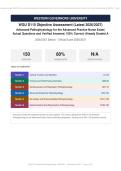
WESTERN GOVERNORS UNIVERSITY
WGU D115 Objective Assessment (Latest 2026/2027)
Advanced Pathophysiology for the Advanced Practice Nurse Exam|
Actual Questions and Verified Answers| 100% Correct| Already Graded A
2026/2027 Edition - Official Exam 2026/2027
150 80% N/A
QUESTIONS PASSING SCORE RECERTIFICATION
TABLE OF CONTENTS
Section 1 Cellular Function and Genetics Q1-25
Section 2 Immune and Inflammatory Disorders Q26-50
Section 3 Cardiovascular and Respiratory Pathophysiology Q51-75
Section 4 Renal and Endocrine Pathophysiology Q76-100
Section 5 Neurologic and Musculoskeletal Pathophysiology Q101-125
Section 6 Gastrointestinal and Reproductive Pathophysiology Q126-150
Instructions: Select the single best answer for each question. This exam is designed for WGU D115 Advanced
Pathophysiology for the Advanced Practice Nurse certification preparation. Passing score: 80% (120 questions correct).
WGU D115 Advanced Pathophysiology - 2026/2027 | Passing Score: 80% | Page 1 of 57
,SECTION 1 | Cellular Function and Genetics | Q1-Q25 | WGU D115 Advanced Pathophysiology 2026/2027
Q1 Question 1 of 150
A 42-year-old female presents with chronic fatigue and pallor. Laboratory studies reveal a
hemoglobin of 8.2 g/dL and elevated levels of free protoporphyrin in erythrocytes. This patient's
condition is most likely caused by impaired activity of which cellular enzyme?
A. Uroporphyrinogen decarboxylase
B. Aminolevulinic acid synthase
C. Porphobilinogen deaminase
D. Ferrochelatase
Correct Answer: D
Rationale:
Ferrochelatase inserts iron into protoporphyrin to form heme; its impairment leads to iron-free
protoporphyrin accumulation. Aminolevulinic acid synthase is the rate-limiting enzyme of heme synthesis
but its deficiency would not cause free protoporphyrin elevation.
Q2 Question 2 of 150
A researcher is studying a cell line that has lost the ability to undergo apoptosis after DNA damage.
Western blot analysis shows absent p53 protein expression. Loss of p53 function most directly
affects which cellular process?
A. Ras protein GTPase activity
B. Cyclin D-CDK4 complex formation
C. Activation of pro-apoptotic Bax and Bak proteins
D. Telomerase reverse transcriptase expression
Correct Answer: C
Rationale:
p53 activates the intrinsic apoptotic pathway by upregulating pro-apoptotic Bax and Bak while suppressing
Bcl-2. Cyclin D-CDK4 complex formation is regulated by growth factor signaling, not directly by p53.
Q3 Question 3 of 150
A 3-month-old infant is brought to the clinic with severe developmental delay, seizures, and a
cherry-red spot on the macula. Enzyme analysis reveals deficient hexosaminidase A activity. This
disorder results from accumulation of which substance in neuronal lysosomes?
A. GM2 ganglioside
B. Glucocerebroside
C. Sphingomyelin
D. Heparan sulfate
WGU D115 Advanced Pathophysiology - 2026/2027 | Passing Score: 80% | Page 2 of 57
,Correct Answer: A
Rationale:
Hexosaminidase A deficiency causes Tay-Sachs disease, in which GM2 ganglioside accumulates in
lysosomes of neurons. Glucocerebroside accumulates in Gaucher disease due to glucocerebrosidase
deficiency.
Q4 Question 4 of 150
A 55-year-old male with a 30-pack-year smoking history develops a lung mass. Biopsy reveals
squamous cell carcinoma. The transition from normal respiratory epithelium to squamous cell
carcinoma best exemplifies which cellular adaptation?
A. Anaplasia progressing to metaplasia
B. Hyperplasia progressing to hypertrophy
C. Atrophy progressing to aplasia
D. Metaplasia progressing to dysplasia
Correct Answer: D
Rationale:
Chronic smoking causes squamous metaplasia of respiratory epithelium, which can progress to dysplasia
and carcinoma. Hyperplasia and hypertrophy are increases in cell number and size respectively, not the
pattern seen in this metaplasia-dysplasia sequence.
Q5 Question 5 of 150
A 28-year-old male of Mediterranean descent develops severe hemolytic anemia after eating fava
beans. His peripheral blood smear shows bite cells and Heinz bodies. This condition results from a
deficiency in which enzyme of the pentose phosphate pathway?
A. Transketolase
B. 6-Phosphogluconate dehydrogenase
C. Glucose-6-phosphate dehydrogenase
D. Ribulose-5-phosphate epimerase
Correct Answer: C
Rationale:
G6PD deficiency impairs the hexose monophosphate shunt, reducing NADPH production needed to
maintain reduced glutathione. Oxidant stress from fava beans causes hemoglobin denaturation, forming
Heinz bodies. The other enzymes listed are downstream in the pathway and not classically associated with
hemolysis.
Q6 Question 6 of 150
WGU D115 Advanced Pathophysiology - 2026/2027 | Passing Score: 80% | Page 3 of 57
, A 14-year-old boy presents with progressive muscle weakness, calf pseudohypertrophy, and a
Gowers sign. Genetic testing reveals a deletion in the dystrophin gene. The absence of dystrophin
most directly disrupts which cellular structure?
A. Sodium channel inactivation gate in the sarcolemma
B. Dystroglycan complex linking cytoskeleton to extracellular matrix
C. Myosin head ATPase activity in thick filaments
D. Sarcoplasmic reticulum calcium release channel
Correct Answer: B
Rationale:
Dystrophin connects the intracellular actin cytoskeleton to the dystroglycan complex at the cell membrane,
stabilizing muscle fibers during contraction. Its absence leads to membrane tearing and progressive fiber
degeneration. The other structures are not directly dependent on dystrophin.
Q7 Question 7 of 150
A 35-year-old woman presents with multiple café-au-lait spots, axillary freckling, and bilateral
acoustic neuromas. Genetic testing identifies a mutation in NF2 on chromosome 22. The protein
product of NF2 (merlin) normally functions as a:
A. Tumor suppressor regulating cell contact inhibition and membrane cytoskeletal signaling
B. Receptor tyrosine kinase activating the RAS-MAPK pathway
C. Transcription factor controlling cell cycle checkpoint genes
D. DNA mismatch repair protein correcting base-pair errors
Correct Answer: A
Rationale:
Merlin (schwannomin) is a tumor suppressor that links the cell membrane to the actin cytoskeleton and
regulates contact inhibition. NF2-related tumors arise from loss of this growth-regulatory function. RAS
pathway activation is associated with NF1, not NF2.
Q8 Question 8 of 150
A newborn infant has hypotonia, feeding difficulties, and undescended testes. Chromosomal
analysis reveals a deletion on chromosome 15q11-q13 inherited from the father. This inheritance
pattern is best described as:
A. Genomic imprinting with paternal deletion causing Prader-Willi syndrome
B. Genomic imprinting with maternal deletion causing Angelman syndrome
C. Mitochondrial inheritance with variable expression
D. Autosomal recessive inheritance with incomplete penetrance
Correct Answer: A
WGU D115 Advanced Pathophysiology - 2026/2027 | Passing Score: 80% | Page 4 of 57
WESTERN GOVERNORS UNIVERSITY
WGU D115 Objective Assessment (Latest 2026/2027)
Advanced Pathophysiology for the Advanced Practice Nurse Exam|
Actual Questions and Verified Answers| 100% Correct| Already Graded A
2026/2027 Edition - Official Exam 2026/2027
150 80% N/A
QUESTIONS PASSING SCORE RECERTIFICATION
TABLE OF CONTENTS
Section 1 Cellular Function and Genetics Q1-25
Section 2 Immune and Inflammatory Disorders Q26-50
Section 3 Cardiovascular and Respiratory Pathophysiology Q51-75
Section 4 Renal and Endocrine Pathophysiology Q76-100
Section 5 Neurologic and Musculoskeletal Pathophysiology Q101-125
Section 6 Gastrointestinal and Reproductive Pathophysiology Q126-150
Instructions: Select the single best answer for each question. This exam is designed for WGU D115 Advanced
Pathophysiology for the Advanced Practice Nurse certification preparation. Passing score: 80% (120 questions correct).
WGU D115 Advanced Pathophysiology - 2026/2027 | Passing Score: 80% | Page 1 of 57
,SECTION 1 | Cellular Function and Genetics | Q1-Q25 | WGU D115 Advanced Pathophysiology 2026/2027
Q1 Question 1 of 150
A 42-year-old female presents with chronic fatigue and pallor. Laboratory studies reveal a
hemoglobin of 8.2 g/dL and elevated levels of free protoporphyrin in erythrocytes. This patient's
condition is most likely caused by impaired activity of which cellular enzyme?
A. Uroporphyrinogen decarboxylase
B. Aminolevulinic acid synthase
C. Porphobilinogen deaminase
D. Ferrochelatase
Correct Answer: D
Rationale:
Ferrochelatase inserts iron into protoporphyrin to form heme; its impairment leads to iron-free
protoporphyrin accumulation. Aminolevulinic acid synthase is the rate-limiting enzyme of heme synthesis
but its deficiency would not cause free protoporphyrin elevation.
Q2 Question 2 of 150
A researcher is studying a cell line that has lost the ability to undergo apoptosis after DNA damage.
Western blot analysis shows absent p53 protein expression. Loss of p53 function most directly
affects which cellular process?
A. Ras protein GTPase activity
B. Cyclin D-CDK4 complex formation
C. Activation of pro-apoptotic Bax and Bak proteins
D. Telomerase reverse transcriptase expression
Correct Answer: C
Rationale:
p53 activates the intrinsic apoptotic pathway by upregulating pro-apoptotic Bax and Bak while suppressing
Bcl-2. Cyclin D-CDK4 complex formation is regulated by growth factor signaling, not directly by p53.
Q3 Question 3 of 150
A 3-month-old infant is brought to the clinic with severe developmental delay, seizures, and a
cherry-red spot on the macula. Enzyme analysis reveals deficient hexosaminidase A activity. This
disorder results from accumulation of which substance in neuronal lysosomes?
A. GM2 ganglioside
B. Glucocerebroside
C. Sphingomyelin
D. Heparan sulfate
WGU D115 Advanced Pathophysiology - 2026/2027 | Passing Score: 80% | Page 2 of 57
,Correct Answer: A
Rationale:
Hexosaminidase A deficiency causes Tay-Sachs disease, in which GM2 ganglioside accumulates in
lysosomes of neurons. Glucocerebroside accumulates in Gaucher disease due to glucocerebrosidase
deficiency.
Q4 Question 4 of 150
A 55-year-old male with a 30-pack-year smoking history develops a lung mass. Biopsy reveals
squamous cell carcinoma. The transition from normal respiratory epithelium to squamous cell
carcinoma best exemplifies which cellular adaptation?
A. Anaplasia progressing to metaplasia
B. Hyperplasia progressing to hypertrophy
C. Atrophy progressing to aplasia
D. Metaplasia progressing to dysplasia
Correct Answer: D
Rationale:
Chronic smoking causes squamous metaplasia of respiratory epithelium, which can progress to dysplasia
and carcinoma. Hyperplasia and hypertrophy are increases in cell number and size respectively, not the
pattern seen in this metaplasia-dysplasia sequence.
Q5 Question 5 of 150
A 28-year-old male of Mediterranean descent develops severe hemolytic anemia after eating fava
beans. His peripheral blood smear shows bite cells and Heinz bodies. This condition results from a
deficiency in which enzyme of the pentose phosphate pathway?
A. Transketolase
B. 6-Phosphogluconate dehydrogenase
C. Glucose-6-phosphate dehydrogenase
D. Ribulose-5-phosphate epimerase
Correct Answer: C
Rationale:
G6PD deficiency impairs the hexose monophosphate shunt, reducing NADPH production needed to
maintain reduced glutathione. Oxidant stress from fava beans causes hemoglobin denaturation, forming
Heinz bodies. The other enzymes listed are downstream in the pathway and not classically associated with
hemolysis.
Q6 Question 6 of 150
WGU D115 Advanced Pathophysiology - 2026/2027 | Passing Score: 80% | Page 3 of 57
, A 14-year-old boy presents with progressive muscle weakness, calf pseudohypertrophy, and a
Gowers sign. Genetic testing reveals a deletion in the dystrophin gene. The absence of dystrophin
most directly disrupts which cellular structure?
A. Sodium channel inactivation gate in the sarcolemma
B. Dystroglycan complex linking cytoskeleton to extracellular matrix
C. Myosin head ATPase activity in thick filaments
D. Sarcoplasmic reticulum calcium release channel
Correct Answer: B
Rationale:
Dystrophin connects the intracellular actin cytoskeleton to the dystroglycan complex at the cell membrane,
stabilizing muscle fibers during contraction. Its absence leads to membrane tearing and progressive fiber
degeneration. The other structures are not directly dependent on dystrophin.
Q7 Question 7 of 150
A 35-year-old woman presents with multiple café-au-lait spots, axillary freckling, and bilateral
acoustic neuromas. Genetic testing identifies a mutation in NF2 on chromosome 22. The protein
product of NF2 (merlin) normally functions as a:
A. Tumor suppressor regulating cell contact inhibition and membrane cytoskeletal signaling
B. Receptor tyrosine kinase activating the RAS-MAPK pathway
C. Transcription factor controlling cell cycle checkpoint genes
D. DNA mismatch repair protein correcting base-pair errors
Correct Answer: A
Rationale:
Merlin (schwannomin) is a tumor suppressor that links the cell membrane to the actin cytoskeleton and
regulates contact inhibition. NF2-related tumors arise from loss of this growth-regulatory function. RAS
pathway activation is associated with NF1, not NF2.
Q8 Question 8 of 150
A newborn infant has hypotonia, feeding difficulties, and undescended testes. Chromosomal
analysis reveals a deletion on chromosome 15q11-q13 inherited from the father. This inheritance
pattern is best described as:
A. Genomic imprinting with paternal deletion causing Prader-Willi syndrome
B. Genomic imprinting with maternal deletion causing Angelman syndrome
C. Mitochondrial inheritance with variable expression
D. Autosomal recessive inheritance with incomplete penetrance
Correct Answer: A
WGU D115 Advanced Pathophysiology - 2026/2027 | Passing Score: 80% | Page 4 of 57


