Unit 3 – Finance and Accounts
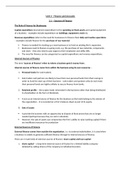
3.1 – Sources of Finance
The Role of Finance for Businesses
Capital expenditure (investment expenditure) is the spending on fixed assets and capital equipment
of a business – examples include expenditure on buildings, equipment, tools etc.
Revenue expenditure refers to the need for businesses to finance their daily and routine operations
– examples include finance for the purchase of raw material.
Finance is needed for starting up a new business or to fund an existing firm’s expansion.
Businesses need to finance on-going costs, e.g. the purchase of raw materials, components
and stock – they also need to pay wages to their employees and utility bills.
The need for finance can be categorized as capital expenditure and revenue expenditure.
Internal Sources of Finance
The term ‘sources of finance’ refers to where a business gets it money from.
Internal sources of finance come from within the business using its own resources –
1. Personal funds (for sole traders)
Sole traders and partners are likely to have their own personal funds from their savings in
order to fund the start-up of their business – sole traders and partners who do not invest
their personal funds are highly unlikely to secure finance from banks.
2. Retained profits – the surplus funds reinvested in the business rather than being distributed
to shareholders in the form of dividends.
It acts as an internal source of finance for the business as the funds belong to the owners of
the organization – it is recorded on a firm’s balance sheet as part of its equity.
3. Sale of assets
It provide the business with an opportunity to dispose of fixed assets that are no longer
needed (perhaps because they are old or obsolete).
However, the sale of assets can compromise the firm’s ability to raise working capital if there
are insufficient resources for production
External Sources of Finance
External finance comes from outside the organization, i.e. via external stakeholders. It is used when
a business is unable to generate sufficient finance through its internal sources of finance.
There are 2 main kinds of external sources of finance: share capital and loan capital:
1. share capital – a long-term external source of finance for a limited liability company
obtained by selling shares of the company to individual investors.
, An initial public offering (IPO) occurs when shares in a limited liability company are sold for
the very first time (public limited companies).
A stock market is a place for buying and selling shares in public limited companies – it
oversees the IPO of new companies and subsequent share issues of existing firms.
As an alternative to loan capital, a limited liability company can raise finance by selling
additional share capital – this however does dilute ownership and control.
2. loan capital – borrowing funds from a financier (lender) such as a commercial bank.
The lender charges interest on the loan amount – the interest rate can either be fixed or
variable depending on the requirements of the lender.
i. Mortgage – a long-term source of loan capital which involves the financier demanding the
borrower has collateral (a fixed asset such as property that provides financial security in the
case the borrower fails to repay the loan).
ii. Debenture – a source of long-term loan capital, secured against a specific asset; debenture
holders do not have any ownership rights but usually get some interest on their investment
and are paid dividends (if awarded) before shareholders receive them.
iii. Overdrafts – a financial service that enables a business to withdraw more money than the
available amount in its bank account; it is essentially a type of short-term loan.
The loan period is negotiable, but tends to be short-term because the interest charges on
overdrafts are usually very high.
Overdrafts enable a business to have emergency access to finance during times of short-
term liquidity problems when cash flow is poor.
iv. Trade credit – a common source of external finance that enables a business to obtain goods
and services from a supplier without having to pay for them immediately.
The usual trade credit period is between one and two months – some suppliers offer a price
discount for customers who pay their invoices earlier.
Examples of trade credit include the use of credit card and store cards which provide
interest-free credit if the outstanding balance is paid on time.
Hire purchase is an example of trade credit – this involves paying for fixed assets in regular
instalments over a predetermined period. The lender retains ownership of the fixed asset
until the business pays the final instalment.
v. Grants – a form of financial assistance from the government, given to qualifying businesses
to aid their operations, e.g. business start-ups and R&D. (often given to small firms)
Grants are often provided to reduce production costs for businesses and to encourage
employment opportunities in less economically developed regions.
vi. Subsidies – are provided in order to encourage output, e.g. public transport operators are
subsidized in many countries to reduce prices.
3.1 – Sources of Finance
The Role of Finance for Businesses
Capital expenditure (investment expenditure) is the spending on fixed assets and capital equipment
of a business – examples include expenditure on buildings, equipment, tools etc.
Revenue expenditure refers to the need for businesses to finance their daily and routine operations
– examples include finance for the purchase of raw material.
Finance is needed for starting up a new business or to fund an existing firm’s expansion.
Businesses need to finance on-going costs, e.g. the purchase of raw materials, components
and stock – they also need to pay wages to their employees and utility bills.
The need for finance can be categorized as capital expenditure and revenue expenditure.
Internal Sources of Finance
The term ‘sources of finance’ refers to where a business gets it money from.
Internal sources of finance come from within the business using its own resources –
1. Personal funds (for sole traders)
Sole traders and partners are likely to have their own personal funds from their savings in
order to fund the start-up of their business – sole traders and partners who do not invest
their personal funds are highly unlikely to secure finance from banks.
2. Retained profits – the surplus funds reinvested in the business rather than being distributed
to shareholders in the form of dividends.
It acts as an internal source of finance for the business as the funds belong to the owners of
the organization – it is recorded on a firm’s balance sheet as part of its equity.
3. Sale of assets
It provide the business with an opportunity to dispose of fixed assets that are no longer
needed (perhaps because they are old or obsolete).
However, the sale of assets can compromise the firm’s ability to raise working capital if there
are insufficient resources for production
External Sources of Finance
External finance comes from outside the organization, i.e. via external stakeholders. It is used when
a business is unable to generate sufficient finance through its internal sources of finance.
There are 2 main kinds of external sources of finance: share capital and loan capital:
1. share capital – a long-term external source of finance for a limited liability company
obtained by selling shares of the company to individual investors.
, An initial public offering (IPO) occurs when shares in a limited liability company are sold for
the very first time (public limited companies).
A stock market is a place for buying and selling shares in public limited companies – it
oversees the IPO of new companies and subsequent share issues of existing firms.
As an alternative to loan capital, a limited liability company can raise finance by selling
additional share capital – this however does dilute ownership and control.
2. loan capital – borrowing funds from a financier (lender) such as a commercial bank.
The lender charges interest on the loan amount – the interest rate can either be fixed or
variable depending on the requirements of the lender.
i. Mortgage – a long-term source of loan capital which involves the financier demanding the
borrower has collateral (a fixed asset such as property that provides financial security in the
case the borrower fails to repay the loan).
ii. Debenture – a source of long-term loan capital, secured against a specific asset; debenture
holders do not have any ownership rights but usually get some interest on their investment
and are paid dividends (if awarded) before shareholders receive them.
iii. Overdrafts – a financial service that enables a business to withdraw more money than the
available amount in its bank account; it is essentially a type of short-term loan.
The loan period is negotiable, but tends to be short-term because the interest charges on
overdrafts are usually very high.
Overdrafts enable a business to have emergency access to finance during times of short-
term liquidity problems when cash flow is poor.
iv. Trade credit – a common source of external finance that enables a business to obtain goods
and services from a supplier without having to pay for them immediately.
The usual trade credit period is between one and two months – some suppliers offer a price
discount for customers who pay their invoices earlier.
Examples of trade credit include the use of credit card and store cards which provide
interest-free credit if the outstanding balance is paid on time.
Hire purchase is an example of trade credit – this involves paying for fixed assets in regular
instalments over a predetermined period. The lender retains ownership of the fixed asset
until the business pays the final instalment.
v. Grants – a form of financial assistance from the government, given to qualifying businesses
to aid their operations, e.g. business start-ups and R&D. (often given to small firms)
Grants are often provided to reduce production costs for businesses and to encourage
employment opportunities in less economically developed regions.
vi. Subsidies – are provided in order to encourage output, e.g. public transport operators are
subsidized in many countries to reduce prices.