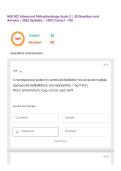
NUR 502 Advanced Pathophysiology Exam 5 – Questions and Answers |
2026 - St. Thomas University.
Correct
100%
Incorrect
Questions and answers
1 of 48
Term
A primary care NP sees a 3-year-old patient who has been vomiting for
several days. The child has had fewer episodes of vomiting the past day
and is now able to take sips of fluids without vomiting. The child has dry
oral mucous membranes, 2-second capillary refill, and pale but warm
skin. The child's blood pressure is 88/46 mm Hg, the heart rate is 110
beats per minute, and the temperature is 37.2° C. The NP should:
Give this one a try later!
begin oral rehydration therapy
The use of antiemetics in children is discouraged for cases of uncomplicated
vomiting. The child has compensated, mild dehydration and is now able to
tolerate fluids, so oral rehydration is indicated.
, Levothyroxine
daily treatment with a PPI.
tell the patient that changing brands of the medication should be avoided.
Patients should be told not to change brands of the medication; there is potential
variability in the bioequivalence between manufacturers. The medication should be
taken at approximately the same time each day before breakfast or on an empty
stomach. Patients should be instructed to contact the provider if signs of
thyrotoxicosis are present. Thyroid replacement medications are usually given for
life.
Don't know?
2 of 48
Term
A primary care NP orders thyroid function tests. The patient's TSH is 1.2
microunits/mL, and T4 is 1.7 ng/mL. The NP should:
Give this one a try later!
lower the dose of the antispasmodic medication.
begin oral rehydration therapy
The use of antiemetics in children is discouraged for cases of uncomplicated
, vomiting. The child has compensated, mild dehydration and is now able to tolerate
fluids, so oral rehydration is indicated.
tell the patient that the results most likely indicate hypothyroidism.
Primary hypothyroidism is the most common form of hypothyroidism. Use of
certain drugs, such as lithium, and diseases such as Hashimoto's thyroiditis can
cause hypothyroidism but are less likely. The patient does not have signs of
hyperthyroidism.
tell the patient that changing brands of the medication should be avoided.
Patients should be told not to change brands of the medication; there is potential
variability in the bioequivalence between manufacturers. The medication should be
taken at approximately the same time each day before breakfast or on an empty
stomach. Patients should be instructed to contact the provider if signs of
thyrotoxicosis are present. Thyroid replacement medications are usually given for
life.
Don't know?
3 of 48
Term
A 12-year-old patient has acute diarrhea and an upper respiratory
infection. Other family members have had similar symptoms, which
have resolved. The primary care NP should recommend:
Give this one a try later!
, an electrolyte solution
diphenoxylate (lomotil).
(Pedialyte).
daily treatment with a ppi. attapulgite (kaopectate).
Don't know?
4 of 48
Term
A woman has severe IBS and takes hyoscyamine sulfate (Levsin),
simethicone (Phazyme), and a TCA. She reports having continued
severe diarrhea. The primary care NP should:
Give this one a try later!
refer her to a gastroenterologist
prescribe an antibiotic for gut health.
for endoscopy.
increase her dosage of hyoscyamine recommend a high-fiber diet and
sulfate. probiotics.
Don't know?
2026 - St. Thomas University.
Correct
100%
Incorrect
Questions and answers
1 of 48
Term
A primary care NP sees a 3-year-old patient who has been vomiting for
several days. The child has had fewer episodes of vomiting the past day
and is now able to take sips of fluids without vomiting. The child has dry
oral mucous membranes, 2-second capillary refill, and pale but warm
skin. The child's blood pressure is 88/46 mm Hg, the heart rate is 110
beats per minute, and the temperature is 37.2° C. The NP should:
Give this one a try later!
begin oral rehydration therapy
The use of antiemetics in children is discouraged for cases of uncomplicated
vomiting. The child has compensated, mild dehydration and is now able to
tolerate fluids, so oral rehydration is indicated.
, Levothyroxine
daily treatment with a PPI.
tell the patient that changing brands of the medication should be avoided.
Patients should be told not to change brands of the medication; there is potential
variability in the bioequivalence between manufacturers. The medication should be
taken at approximately the same time each day before breakfast or on an empty
stomach. Patients should be instructed to contact the provider if signs of
thyrotoxicosis are present. Thyroid replacement medications are usually given for
life.
Don't know?
2 of 48
Term
A primary care NP orders thyroid function tests. The patient's TSH is 1.2
microunits/mL, and T4 is 1.7 ng/mL. The NP should:
Give this one a try later!
lower the dose of the antispasmodic medication.
begin oral rehydration therapy
The use of antiemetics in children is discouraged for cases of uncomplicated
, vomiting. The child has compensated, mild dehydration and is now able to tolerate
fluids, so oral rehydration is indicated.
tell the patient that the results most likely indicate hypothyroidism.
Primary hypothyroidism is the most common form of hypothyroidism. Use of
certain drugs, such as lithium, and diseases such as Hashimoto's thyroiditis can
cause hypothyroidism but are less likely. The patient does not have signs of
hyperthyroidism.
tell the patient that changing brands of the medication should be avoided.
Patients should be told not to change brands of the medication; there is potential
variability in the bioequivalence between manufacturers. The medication should be
taken at approximately the same time each day before breakfast or on an empty
stomach. Patients should be instructed to contact the provider if signs of
thyrotoxicosis are present. Thyroid replacement medications are usually given for
life.
Don't know?
3 of 48
Term
A 12-year-old patient has acute diarrhea and an upper respiratory
infection. Other family members have had similar symptoms, which
have resolved. The primary care NP should recommend:
Give this one a try later!
, an electrolyte solution
diphenoxylate (lomotil).
(Pedialyte).
daily treatment with a ppi. attapulgite (kaopectate).
Don't know?
4 of 48
Term
A woman has severe IBS and takes hyoscyamine sulfate (Levsin),
simethicone (Phazyme), and a TCA. She reports having continued
severe diarrhea. The primary care NP should:
Give this one a try later!
refer her to a gastroenterologist
prescribe an antibiotic for gut health.
for endoscopy.
increase her dosage of hyoscyamine recommend a high-fiber diet and
sulfate. probiotics.
Don't know?