

Species and Speciation Lecture (Part 1)
Textbook Reference: Chapter 22 in Biology How Life Works (2nd ed.)
Sections 22.1 – 22.2; pp.446 to 450
What is a species?
Why can it be difficult to define species?
- Fundamental evolutionary unit
What is the “species problem”
- The species as an evolutionary unit must by definition be fluid and capable of
changing, giving rise to new species
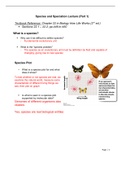
Species Plot
• What is a species plot for and what
does it show?
To test whether or not species are real, we
examine the natural world, measure some
characteristic of different living things we
see, then plot on graph
Is what is seen in a species plot
supported by molecular data?
Genomes of different organisms also
clusters
Yes, species are real biological entities
Page | 1
, Distinguishing Species
• How do you distinguish one species from another?
Two criteria for determining if two individuals are members of the same species:
1. They can exchange genetic material
2. Produce fertile offspring
Different Definitions of Species:
• Morphospecies Concept: States that members of the same species usually look
alike
• Advantages:
• Quick and easy
• Limitations:
• Not perfect
• There are members of same species that look very different and members
of different species that look alike
• Examples:
• Peacock and peahen (same species)
• Female and male cardinal (same species)
• Biological Species Concept (BSC)
o Definition: Species are groups of actually or potentially interbreeding
populations that are reproductively isolated from other such groups
o Important parts of this concept:
- Reproductive compatibility/reproductive isolation
- Fertile offspring produced
o What is meant by actually or potentially interbreeding population?
Reproductively isolated from other groups
Example:
- Asian and Indian elephants are geographically isolated (same species)
Page | 2
Textbook Reference: Chapter 22 in Biology How Life Works (2nd ed.)
Sections 22.1 – 22.2; pp.446 to 450
What is a species?
Why can it be difficult to define species?
- Fundamental evolutionary unit
What is the “species problem”
- The species as an evolutionary unit must by definition be fluid and capable of
changing, giving rise to new species
Species Plot
• What is a species plot for and what
does it show?
To test whether or not species are real, we
examine the natural world, measure some
characteristic of different living things we
see, then plot on graph
Is what is seen in a species plot
supported by molecular data?
Genomes of different organisms also
clusters
Yes, species are real biological entities
Page | 1
, Distinguishing Species
• How do you distinguish one species from another?
Two criteria for determining if two individuals are members of the same species:
1. They can exchange genetic material
2. Produce fertile offspring
Different Definitions of Species:
• Morphospecies Concept: States that members of the same species usually look
alike
• Advantages:
• Quick and easy
• Limitations:
• Not perfect
• There are members of same species that look very different and members
of different species that look alike
• Examples:
• Peacock and peahen (same species)
• Female and male cardinal (same species)
• Biological Species Concept (BSC)
o Definition: Species are groups of actually or potentially interbreeding
populations that are reproductively isolated from other such groups
o Important parts of this concept:
- Reproductive compatibility/reproductive isolation
- Fertile offspring produced
o What is meant by actually or potentially interbreeding population?
Reproductively isolated from other groups
Example:
- Asian and Indian elephants are geographically isolated (same species)
Page | 2


