WGU C207 Data Driven Decision Making Module 1
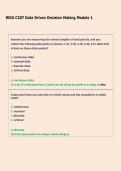
Assume you are measuring the various lengths of used pencils, and you
collect the following data points (in inches): 1.37, 2.65, 2.78, 3.46, 3.91. What kind
of data are these data points?
a) continuous data
b) nominal data
c) discrete data
d) ordinal data
a) continuous data
In a set of continuous data, a point can lay along any point in a range of data.
A data point that can only take on whole values and has boundaries is called
what?
a) continuous
b) nominal
c) discrete
d) ordinal
c) discrete
Discrete data points are always whole integers.
,If a measure is consistent and repeatable it is said to be _.
a) good
b) correct
c) valid
d) reliable
d) reliable
To be considered reliable, a measure must be repeatable in multiple locations
under diverse conditions.
A small group from which you make an inference about an entire population is
called a
__________.
a) sample
b) representation
c) model
d) medium
a) sample
If chosen properly, a sample can make predictions about an entire population.
Cleaning and organizing data that has been collected is known as _.
a) data cleanup
b) data entry
c) data management
d) data mining
c) data management
Managing your data is as important as your analysis.
, The first step in the Davenport-Kim three-stage model is to frame the
problem by recognizing what the problem is and then reviewing
previous findings to begin to structure the analysis. T/F
T. Stage #1 is to frame the problem by recognizing what the problem is and
then reviewing previous findings to begin to structure the analysis. Stage #2 is
to solve the problem. Stage #3 is the communicate your findings.
The stage that involves the most intense statistics and data work is stage 3,
communicating results. T/F
F. The stage that involves the most intense statistics and data work is stage 2,
solving the problem. This step includes data modeling, data collection, and data
analysis.
The following are examples of nominal data: T/F
male/female
red/blue
living/deceased
T. Nominal data, sometimes called categorical data, places objects into a
category.
Interval data has an order and all the objects are an equal interval apart. T/F
T. Interval data has an order and all the objects are an equal interval apart. You
cannot have a natural zero point in interval data.
Observational studies are often used when a surveyor wants to adjust different
variables and take note of the effects. T/F
F. Observational studies are used when it is impractical or impossible to control
the conditions of the experiment.
Assume you are measuring the various lengths of used pencils, and you
collect the following data points (in inches): 1.37, 2.65, 2.78, 3.46, 3.91. What kind
of data are these data points?
a) continuous data
b) nominal data
c) discrete data
d) ordinal data
a) continuous data
In a set of continuous data, a point can lay along any point in a range of data.
A data point that can only take on whole values and has boundaries is called
what?
a) continuous
b) nominal
c) discrete
d) ordinal
c) discrete
Discrete data points are always whole integers.
,If a measure is consistent and repeatable it is said to be _.
a) good
b) correct
c) valid
d) reliable
d) reliable
To be considered reliable, a measure must be repeatable in multiple locations
under diverse conditions.
A small group from which you make an inference about an entire population is
called a
__________.
a) sample
b) representation
c) model
d) medium
a) sample
If chosen properly, a sample can make predictions about an entire population.
Cleaning and organizing data that has been collected is known as _.
a) data cleanup
b) data entry
c) data management
d) data mining
c) data management
Managing your data is as important as your analysis.
, The first step in the Davenport-Kim three-stage model is to frame the
problem by recognizing what the problem is and then reviewing
previous findings to begin to structure the analysis. T/F
T. Stage #1 is to frame the problem by recognizing what the problem is and
then reviewing previous findings to begin to structure the analysis. Stage #2 is
to solve the problem. Stage #3 is the communicate your findings.
The stage that involves the most intense statistics and data work is stage 3,
communicating results. T/F
F. The stage that involves the most intense statistics and data work is stage 2,
solving the problem. This step includes data modeling, data collection, and data
analysis.
The following are examples of nominal data: T/F
male/female
red/blue
living/deceased
T. Nominal data, sometimes called categorical data, places objects into a
category.
Interval data has an order and all the objects are an equal interval apart. T/F
T. Interval data has an order and all the objects are an equal interval apart. You
cannot have a natural zero point in interval data.
Observational studies are often used when a surveyor wants to adjust different
variables and take note of the effects. T/F
F. Observational studies are used when it is impractical or impossible to control
the conditions of the experiment.