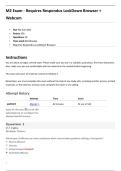
M5: Module 5 Exam- Requires Respondus LockDown Browser
Due No due date Points 100 Questions 29 Time Limit 60 Minutes
Requires Respondus LockDown Browser
This quiz is currently locked.
A empt History
Attempt Time Score
LATEST Attempt 1 53 minutes 83 out of 100
Score for this quiz:83 out of 100
Submitted Mar 14, 2021 at
4:35pm
This attempt took 53 minutes.
Question 1 pts
Define the concept of universal precautions.
Your Answer:
Any and all samples, known or unknown, that are to be treated as potentially hazardous materials
Universal precautions means any and all samples, whether known or unknown, are to be
treated as potentially hazardous (or pathogenic) materials.
Question 2 pts
List at least 3 observations a researcher would be sure to note while assessing an unknown microbial
sample.
Your Answer:
While assessing an unknown microbial sample, a reasearcher should note the size and shape, observable
motility and the presence of any chemical reactions along with gram status.
A lab researcher would be certain to note:
1. Size and shape
2. Any observable motility
3. Gram status (positive or negative)
4. The presence of any chemical reactions
5. Changes in color localized to the organism or the surrounding media
6. Capture (or draw) images of any of the characteristics described above
Question 3 pts
.1/11
, While observing an unknown sample of limited amounts, a researcher must determine the following
observations: (1) the presence of any motility and (2) its Gram status
samesample—the
using the liquid
sample cannot be divided. Which would you determine first and why?
Your Answer:
First, I would determine the motility because by properly documenting observations, it helps to identify
causative agents and selecting appropriate treatments against foreign microbes.
You must determine motility
beforedetermining the Gram status. Motility requires a wet
mount, while Gram staining requires heat fixing the sample. If one were to begin with the Gram
stain the heat fixation process would kill the organism, making any observations regarding
motility impossible. The correct approach would be to place the liquid culture on a glass slide
and determine its motility status. Next, the same liquid culture can be heat fixed and Gram
stained.
3/
Question 4 3
pts
A facultative anaerobe is a microorganism capable of growth under what conditions?
Your Answer:
It is capable of growth in both the presence or absence of oxygen.
A facultative anaerobe is capable of growth under aerobic (with oxygen) and anaerobic
(without oxygen) conditions.
Question 5 pts
As Streptococcus is catalase negative would it thrive or die in the presence of peroxides? Why?
Your Answer:
It dies in the presence of peroxides because it cannot break down peroxides and needs to be cultured on BAP.
Streptococcus would not survive in the presence of peroxides—it is unable to breakdown
peroxides (catalase negative). Left unchecked, peroxides would damage the cellular integrity
of Strep causing lysis/cell death.
2/2
Question 6
pts
Streptococcus is most often streaked onto:
.2/11
Due No due date Points 100 Questions 29 Time Limit 60 Minutes
Requires Respondus LockDown Browser
This quiz is currently locked.
A empt History
Attempt Time Score
LATEST Attempt 1 53 minutes 83 out of 100
Score for this quiz:83 out of 100
Submitted Mar 14, 2021 at
4:35pm
This attempt took 53 minutes.
Question 1 pts
Define the concept of universal precautions.
Your Answer:
Any and all samples, known or unknown, that are to be treated as potentially hazardous materials
Universal precautions means any and all samples, whether known or unknown, are to be
treated as potentially hazardous (or pathogenic) materials.
Question 2 pts
List at least 3 observations a researcher would be sure to note while assessing an unknown microbial
sample.
Your Answer:
While assessing an unknown microbial sample, a reasearcher should note the size and shape, observable
motility and the presence of any chemical reactions along with gram status.
A lab researcher would be certain to note:
1. Size and shape
2. Any observable motility
3. Gram status (positive or negative)
4. The presence of any chemical reactions
5. Changes in color localized to the organism or the surrounding media
6. Capture (or draw) images of any of the characteristics described above
Question 3 pts
.1/11
, While observing an unknown sample of limited amounts, a researcher must determine the following
observations: (1) the presence of any motility and (2) its Gram status
samesample—the
using the liquid
sample cannot be divided. Which would you determine first and why?
Your Answer:
First, I would determine the motility because by properly documenting observations, it helps to identify
causative agents and selecting appropriate treatments against foreign microbes.
You must determine motility
beforedetermining the Gram status. Motility requires a wet
mount, while Gram staining requires heat fixing the sample. If one were to begin with the Gram
stain the heat fixation process would kill the organism, making any observations regarding
motility impossible. The correct approach would be to place the liquid culture on a glass slide
and determine its motility status. Next, the same liquid culture can be heat fixed and Gram
stained.
3/
Question 4 3
pts
A facultative anaerobe is a microorganism capable of growth under what conditions?
Your Answer:
It is capable of growth in both the presence or absence of oxygen.
A facultative anaerobe is capable of growth under aerobic (with oxygen) and anaerobic
(without oxygen) conditions.
Question 5 pts
As Streptococcus is catalase negative would it thrive or die in the presence of peroxides? Why?
Your Answer:
It dies in the presence of peroxides because it cannot break down peroxides and needs to be cultured on BAP.
Streptococcus would not survive in the presence of peroxides—it is unable to breakdown
peroxides (catalase negative). Left unchecked, peroxides would damage the cellular integrity
of Strep causing lysis/cell death.
2/2
Question 6
pts
Streptococcus is most often streaked onto:
.2/11