Quantitative Relationships Practice
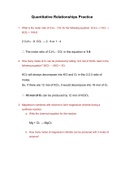
1. What is the molar ratio of C₄H₁₀ : CO₂ for the following equation: 2C₄H₁₀ + 13O₂ →
8CO₂ + 10H₂O
2 C₄H₁₀ : 8 CO₂ → 2 : 8 or 1 : 4
∴ The molar ratio of C₄H₁₀ : CO₂ in this equation is 1:4.
2. How many moles of O₂ can be produced by letting 12.0 mol of KClO₃ react in the
following equation? 2KCl₃ → 2KCl + 3O₂
KCl₃ will always decompose into KCl and O₂ in this 2:2:3 ratio of
moles.
So, if there are 12 mol of KCl₃, it would decompose into 18 mol of O₂.
∴ 18 mol of O₂ can be produced by 12 mol of KClO₃.
3. Magnesium combines with chlorine to form magnesium chloride during a
synthesis reaction.
a. Write the chemical equation for this reaction
Mg + Cl₂ → MgCl₂
b. How many moles of magnesium chloride can be produced with 3 moles of
chlorine?
1. What is the molar ratio of C₄H₁₀ : CO₂ for the following equation: 2C₄H₁₀ + 13O₂ →
8CO₂ + 10H₂O
2 C₄H₁₀ : 8 CO₂ → 2 : 8 or 1 : 4
∴ The molar ratio of C₄H₁₀ : CO₂ in this equation is 1:4.
2. How many moles of O₂ can be produced by letting 12.0 mol of KClO₃ react in the
following equation? 2KCl₃ → 2KCl + 3O₂
KCl₃ will always decompose into KCl and O₂ in this 2:2:3 ratio of
moles.
So, if there are 12 mol of KCl₃, it would decompose into 18 mol of O₂.
∴ 18 mol of O₂ can be produced by 12 mol of KClO₃.
3. Magnesium combines with chlorine to form magnesium chloride during a
synthesis reaction.
a. Write the chemical equation for this reaction
Mg + Cl₂ → MgCl₂
b. How many moles of magnesium chloride can be produced with 3 moles of
chlorine?