odulCognitive psychology
Book: Cognition By Mark H.
Inhoud
Summary of Chapter 9 (chapter 1 book).......................................................................................................1
Key Terms and Definitions........................................................................................................................1
Lecture Notes:.........................................................................................................................................3
Summary of Chapter 10 (chapter 3 book).....................................................................................................4
Key Terms and Definitions........................................................................................................................4
Lecture Notes:.........................................................................................................................................5
Summary of Chapter 11 (chapter 4 book).....................................................................................................6
Key Terms and Definitions........................................................................................................................6
Lecture notes..........................................................................................................................................8
Chapter 12 (chapter 5 book)..........................................................................................................................13
Key terms & definitions..........................................................................................................................13
Lecture Notes:.......................................................................................................................................14
Chapter 13 (chapter 6 book)..........................................................................................................................16
Key terms and definitions:......................................................................................................................16
Lecture notes:.......................................................................................................................................19
Chapter 14 (chapter 7 book)..........................................................................................................................21
Key terms and definitions:......................................................................................................................21
Lecture Notes:.......................................................................................................................................22
Chapter 15 ( chapter 8 book).........................................................................................................................25
Key terms and definitions:......................................................................................................................25
Lecture Notes:.......................................................................................................................................26
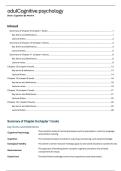
Summary of Chapter 9 (chapter 1 book)
Key Terms and Definitions
The scientific study of mental processes such as perception, memory, language,
Cognitive Psychology
and problem-solving.
Cognition The mental processes involved in acquiring, processing, and using knowledge.
Ecological Validity The extent to which research findings apply to real-world situations outside the lab.
The approach of breaking down complex cognitive processes into simpler
Reductionism
components for study.
Empiricism The belief that knowledge comes from experience and observation.
,Tabula Rasa The idea that the mind is a blank slate at birth and is shaped entirely by experience.
Wilhelm Wundt, the founder of experimental psychology and the first psychology
Wundt
laboratory.
A method used by Wundt in which participants report their thoughts and
Introspection
experiences.
A student of Wundt who developed structuralism, focusing on breaking mental
Titchener
processes into basic elements.
An early psychological approach that analyzed the structure of the mind through
Structuralism
introspection.
Von Ebbinghaus A psychologist known for his research on memory and the forgetting curve.
Forgetting Curve A graph showing how information is lost over time if not reinforced.
James William James, an influential psychologist who developed functionalism.
Darwin Charles Darwin, whose theory of evolution influenced functionalist psychology.
A psychological perspective that focuses on how mental processes help
Functionalism
individuals adapt to their environment.
John Watson, the founder of behaviorism, which emphasizes observable behavior
Watson
over mental processes.
A psychological approach that focuses on external behaviors rather than internal
Behaviorism
thoughts.
A theory that emphasizes that people perceive whole patterns rather than
Gestalt Psychology
individual components.
A branch of behaviorism that incorporates cognitive and physiological processes
Neobehaviorism
into learning theories.
B.F. Skinner, a behaviorist known for operant conditioning and research on verbal
Skinner
behavior.
Verbal Behavior Skinner’s theory that language is learned through reinforcement and conditioning.
Noam Chomsky, who challenged behaviorist views on language and argued for an
Chomsky
innate language faculty.
The shift in psychology during the 1950s-60s from behaviorism to studying mental
The Cognitive Revolution
processes.
Crucial Events Around the Events that contributed to cognitive psychology, such as advances in artificial
1960s intelligence and neuroscience.
The idea that the human brain can only process a limited amount of information at
Channel Capacity
once.
The comparison of the mind to a computer that processes, stores, and retrieves
Computer Analogy
information.
The time it takes for a person to respond to a stimulus, often used to study
Response (Reaction) Time
cognition.
The correctness of responses in cognitive tasks, used to measure cognitive
Accuracy
processing efficiency.
The Atkinson & Shiffrin Model A model proposing that memory consists of sensory memory, short-term memory,
of Memory and long-term memory.
Encoding The process of converting information into a form that can be stored in memory.
A representation of cognitive processes that occur in a sequence to complete a
Process Model
task.
A task where participants decide whether a given string of letters is a real word or a
Lexical Decision Task
non-word.
Word Frequency Effect The phenomenon where common words are recognized faster than rare words.
, Sequential Processing Stages A model where cognitive processes occur one after another in a fixed order.
When different cognitive processes overlap rather than occurring strictly in
Stage Overlap
sequence.
Parallel processing handles multiple tasks at once, while serial processing
Parallel vs. Serial Processing
completes tasks one at a time.
How the surrounding environment and prior knowledge influence perception and
Context Effects
cognition.
Top-down processing is guided by prior knowledge and expectations, while
Top-Down vs. Bottom-Up
bottom-up processing is driven by raw sensory data.
A method where participants describe their thought processes while performing a
Verbal Protocol
task.
Lecture Notes:
What is Cognitive Psychology?: Cognitive psychology is the scientific study of mental processes, focusing
on how people perceive, remember, think, and understand. It explains human behavior based on internal
mental processes rather than external behaviors alone.
Key Concepts
Memory – The process of acquiring, storing, and retrieving information.
Cognition – The collection of mental activities used in perception, memory, problem-solving, and
language.
Ecological Validity – The extent to which cognitive research applies to real-world situations.
Reductionism – The approach of breaking complex processes into smaller components for study.
Historical Background
Plato & Aristotle – Compared memory to a wax tablet, introducing the idea of the tabula rasa (blank slate).
René Descartes (1596-1650) – Argued that thinking proves existence (“I think, therefore I am”).
Wilhelm Wundt (1832-1920) – Founded the first psychology lab in 1879 and used introspection to study
mental processes.
Edward Titchener – Developed structuralism, analyzing mental processes into basic elements.
Hermann von Ebbinghaus (1850-1909) – Pioneered memory research, introducing the forgetting curve.
William James (1842-1910) – Introduced functionalism, focusing on how mental processes help
individuals adapt.
John B. Watson (1878-1958) – Founded behaviorism, arguing psychology should focus only on observable
behavior.
B.F. Skinner (1904-1990) – Expanded behaviorism with operant conditioning and verbal behavior.
The Cognitive Revolution
In the 1950s and 1960s, cognitive psychology emerged as a response to behaviorism’s limitations.
World War II – Research on attention, vigilance, and decision-making influenced cognitive psychology.
Verbal Learning – Showed that people organize words based on associations, suggesting underlying
memory structures.
Noam Chomsky (1959) – Criticized Skinner’s behavioral model of language, arguing for an innate language
ability.
Key Theories & Models
The Computer Analogy – The mind is like a computer, processing and storing information.
The Standard Theory of Memory (Atkinson & Shiffrin, 1968) – Proposes sensory memory, short-term
memory, and long-term memory.
Process Models – Used to analyze cognitive tasks like the lexical decision task, measuring response time
and accuracy.
Conclusion
Cognitive psychology has developed as a response to behaviorism, integrating methods from neuroscience,
computer science, and linguistics to study human thought scientifically. It remains central to modern
psychology, influencing fields such as artificial intelligence, education, and mental health.
Book: Cognition By Mark H.
Inhoud
Summary of Chapter 9 (chapter 1 book).......................................................................................................1
Key Terms and Definitions........................................................................................................................1
Lecture Notes:.........................................................................................................................................3
Summary of Chapter 10 (chapter 3 book).....................................................................................................4
Key Terms and Definitions........................................................................................................................4
Lecture Notes:.........................................................................................................................................5
Summary of Chapter 11 (chapter 4 book).....................................................................................................6
Key Terms and Definitions........................................................................................................................6
Lecture notes..........................................................................................................................................8
Chapter 12 (chapter 5 book)..........................................................................................................................13
Key terms & definitions..........................................................................................................................13
Lecture Notes:.......................................................................................................................................14
Chapter 13 (chapter 6 book)..........................................................................................................................16
Key terms and definitions:......................................................................................................................16
Lecture notes:.......................................................................................................................................19
Chapter 14 (chapter 7 book)..........................................................................................................................21
Key terms and definitions:......................................................................................................................21
Lecture Notes:.......................................................................................................................................22
Chapter 15 ( chapter 8 book).........................................................................................................................25
Key terms and definitions:......................................................................................................................25
Lecture Notes:.......................................................................................................................................26
Summary of Chapter 9 (chapter 1 book)
Key Terms and Definitions
The scientific study of mental processes such as perception, memory, language,
Cognitive Psychology
and problem-solving.
Cognition The mental processes involved in acquiring, processing, and using knowledge.
Ecological Validity The extent to which research findings apply to real-world situations outside the lab.
The approach of breaking down complex cognitive processes into simpler
Reductionism
components for study.
Empiricism The belief that knowledge comes from experience and observation.
,Tabula Rasa The idea that the mind is a blank slate at birth and is shaped entirely by experience.
Wilhelm Wundt, the founder of experimental psychology and the first psychology
Wundt
laboratory.
A method used by Wundt in which participants report their thoughts and
Introspection
experiences.
A student of Wundt who developed structuralism, focusing on breaking mental
Titchener
processes into basic elements.
An early psychological approach that analyzed the structure of the mind through
Structuralism
introspection.
Von Ebbinghaus A psychologist known for his research on memory and the forgetting curve.
Forgetting Curve A graph showing how information is lost over time if not reinforced.
James William James, an influential psychologist who developed functionalism.
Darwin Charles Darwin, whose theory of evolution influenced functionalist psychology.
A psychological perspective that focuses on how mental processes help
Functionalism
individuals adapt to their environment.
John Watson, the founder of behaviorism, which emphasizes observable behavior
Watson
over mental processes.
A psychological approach that focuses on external behaviors rather than internal
Behaviorism
thoughts.
A theory that emphasizes that people perceive whole patterns rather than
Gestalt Psychology
individual components.
A branch of behaviorism that incorporates cognitive and physiological processes
Neobehaviorism
into learning theories.
B.F. Skinner, a behaviorist known for operant conditioning and research on verbal
Skinner
behavior.
Verbal Behavior Skinner’s theory that language is learned through reinforcement and conditioning.
Noam Chomsky, who challenged behaviorist views on language and argued for an
Chomsky
innate language faculty.
The shift in psychology during the 1950s-60s from behaviorism to studying mental
The Cognitive Revolution
processes.
Crucial Events Around the Events that contributed to cognitive psychology, such as advances in artificial
1960s intelligence and neuroscience.
The idea that the human brain can only process a limited amount of information at
Channel Capacity
once.
The comparison of the mind to a computer that processes, stores, and retrieves
Computer Analogy
information.
The time it takes for a person to respond to a stimulus, often used to study
Response (Reaction) Time
cognition.
The correctness of responses in cognitive tasks, used to measure cognitive
Accuracy
processing efficiency.
The Atkinson & Shiffrin Model A model proposing that memory consists of sensory memory, short-term memory,
of Memory and long-term memory.
Encoding The process of converting information into a form that can be stored in memory.
A representation of cognitive processes that occur in a sequence to complete a
Process Model
task.
A task where participants decide whether a given string of letters is a real word or a
Lexical Decision Task
non-word.
Word Frequency Effect The phenomenon where common words are recognized faster than rare words.
, Sequential Processing Stages A model where cognitive processes occur one after another in a fixed order.
When different cognitive processes overlap rather than occurring strictly in
Stage Overlap
sequence.
Parallel processing handles multiple tasks at once, while serial processing
Parallel vs. Serial Processing
completes tasks one at a time.
How the surrounding environment and prior knowledge influence perception and
Context Effects
cognition.
Top-down processing is guided by prior knowledge and expectations, while
Top-Down vs. Bottom-Up
bottom-up processing is driven by raw sensory data.
A method where participants describe their thought processes while performing a
Verbal Protocol
task.
Lecture Notes:
What is Cognitive Psychology?: Cognitive psychology is the scientific study of mental processes, focusing
on how people perceive, remember, think, and understand. It explains human behavior based on internal
mental processes rather than external behaviors alone.
Key Concepts
Memory – The process of acquiring, storing, and retrieving information.
Cognition – The collection of mental activities used in perception, memory, problem-solving, and
language.
Ecological Validity – The extent to which cognitive research applies to real-world situations.
Reductionism – The approach of breaking complex processes into smaller components for study.
Historical Background
Plato & Aristotle – Compared memory to a wax tablet, introducing the idea of the tabula rasa (blank slate).
René Descartes (1596-1650) – Argued that thinking proves existence (“I think, therefore I am”).
Wilhelm Wundt (1832-1920) – Founded the first psychology lab in 1879 and used introspection to study
mental processes.
Edward Titchener – Developed structuralism, analyzing mental processes into basic elements.
Hermann von Ebbinghaus (1850-1909) – Pioneered memory research, introducing the forgetting curve.
William James (1842-1910) – Introduced functionalism, focusing on how mental processes help
individuals adapt.
John B. Watson (1878-1958) – Founded behaviorism, arguing psychology should focus only on observable
behavior.
B.F. Skinner (1904-1990) – Expanded behaviorism with operant conditioning and verbal behavior.
The Cognitive Revolution
In the 1950s and 1960s, cognitive psychology emerged as a response to behaviorism’s limitations.
World War II – Research on attention, vigilance, and decision-making influenced cognitive psychology.
Verbal Learning – Showed that people organize words based on associations, suggesting underlying
memory structures.
Noam Chomsky (1959) – Criticized Skinner’s behavioral model of language, arguing for an innate language
ability.
Key Theories & Models
The Computer Analogy – The mind is like a computer, processing and storing information.
The Standard Theory of Memory (Atkinson & Shiffrin, 1968) – Proposes sensory memory, short-term
memory, and long-term memory.
Process Models – Used to analyze cognitive tasks like the lexical decision task, measuring response time
and accuracy.
Conclusion
Cognitive psychology has developed as a response to behaviorism, integrating methods from neuroscience,
computer science, and linguistics to study human thought scientifically. It remains central to modern
psychology, influencing fields such as artificial intelligence, education, and mental health.