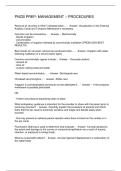
PSCI 1024 FINAL EXAM STUDY GUIDE
1. Comparative Politics- Answers - One of the major subfields of political science, in which the primary
focus is on comparing power and decision making across countries
2. Modern State- Answers - An ongoing administrative apparatus that develops and administers laws as well as
generates and implements public policies in a specific sovereign territory
3. Territory- Answers - an area with clearly defined borders to which a state lays claim
4. External Sovereignty- Answers - sovereignty relative to outside powers that is legally recognized in
international law
5. Internal Sovereignty- Answers - the sole authority within a territory capable of making and enforcing
laws and policies
6. Legitimacy- Answers - the recognized right to rule
7. Bureaucracy- Answers - A large set of appointed oflcials whose function is to implement the laws of the state, as
directed by the executive
8. Identity groups- Answers - groups based on the social identities of members
9. Nation- Answers - a group that proclaims itself a nation and has or seeks control of a state
10. Ethnic group- Answers - a group of people who see themselves as united by one or more cultural attributes
or a sense of common history but do not see themselves as a nation seeking its own state
11. Racial group- Answers - a group of people socially defined primarily on the basis of one or more
perceived common physical characteristics
12. Regime- Answers - a set of formal and informal political institutions that defines a type of government
13. Liberal democracy- Answers - A system of government that provides eight key guarantees, including
freedoms to enable citizen participation in the political process and institutions that make government policies depend
on votes and other forms of citizen preferences
14. Modernizing authoritarianism- Answers - A claim to legitimacy based the need to "develop" the country
, via the
rule of a modernizing elite
15. Personalist regime- Answers - System of government in which a central leader comes to dominate a state,
typically not only eliminating all opposition but also weakening the state's institutions to centralize power in his own
hands
16. Neopatrimonial authority- Answers - Power based on a combination of the trappings of modern,
bureaucratic states with underlying informal institutions of clientelism that work behind the scenes; most common in
Africa
17. Electoral authoritarianism- Answers - Type of hybrid regime in which formal opposition and some open
political debate exist and elections are held; these processes are so flawed, however, that the regime cannot be considered
truly democratic
18. Contentious politics- Answers - political activity that is at least in part beyond institutional bounds, involving
ex-
tra-institutional activity such as petitions, protests, riots, violence, civil war, and revolution
, 19. Social movements- Answers - part of civil society; they have a loosely defined organizational structure and
represent people who perceive themselves to be outside formal institutions, seek major socioeconomic or political
changes, or employ non institutional forms of collective action
20. Regime change- Answers - the process through which one regime is transformed into another
21. Coup- Answers - when the military forcibly removes an existing regime and establishes a new one
22. Pact- Answers - in a transition to democracy, a conscious agreement among the most important political
actors in the authoritarian regime and those in civil society to establish a new form of government
23. Revolution- Answers - a form of contentious politics where a mobilized group demands the overthrow of a
regime and sometimes an entire social order; the factors motivating them tend to be similar to other forms of contentious
politics, but their ettects often are ditterent
24. Authoritarianization- Answers - The creation of an authoritarian regime via the undermining of democratic
institu-
tions by elected incumbents; has become more common
25. Transition to democracy- Answers - a regime change typically involving a negotiated process that
removes an authoritarian regime and concludes with a founding election of a new, democratic regime
26. Democratic consolidation- Answers - The widespread acceptance of democracy as the
permanent form of political activity; all significant political elites and their followers accept democratic rules and are
confident everyone else does as well
27. Democratic breakdown- Answers - the rise of a new authoritarian regime in place of a democratic one
28. Coup-proofing- Answers - when executive leaders co-opt major armed factions, counterbalance armed
factions by creating multiple military institutions or groups (e.g., army, intelligence, presidential guard, etc.), and/or
establish informal ties of loyalty within the military (e.g., ethnic or religious aflliations)
29. Norms- Answers - rules and expectations by which a society guides the behavior of its members
30. Populism- Answers - the belief that traditional political elites are unpatriotic and corrupt and as such, the country
faces a crisis, the media and experts cannot be trusted, and only a strong leader can save the country
31. Political accountability- Answers - the ability of the citizenry, directly or indirectly, to control political
1. Comparative Politics- Answers - One of the major subfields of political science, in which the primary
focus is on comparing power and decision making across countries
2. Modern State- Answers - An ongoing administrative apparatus that develops and administers laws as well as
generates and implements public policies in a specific sovereign territory
3. Territory- Answers - an area with clearly defined borders to which a state lays claim
4. External Sovereignty- Answers - sovereignty relative to outside powers that is legally recognized in
international law
5. Internal Sovereignty- Answers - the sole authority within a territory capable of making and enforcing
laws and policies
6. Legitimacy- Answers - the recognized right to rule
7. Bureaucracy- Answers - A large set of appointed oflcials whose function is to implement the laws of the state, as
directed by the executive
8. Identity groups- Answers - groups based on the social identities of members
9. Nation- Answers - a group that proclaims itself a nation and has or seeks control of a state
10. Ethnic group- Answers - a group of people who see themselves as united by one or more cultural attributes
or a sense of common history but do not see themselves as a nation seeking its own state
11. Racial group- Answers - a group of people socially defined primarily on the basis of one or more
perceived common physical characteristics
12. Regime- Answers - a set of formal and informal political institutions that defines a type of government
13. Liberal democracy- Answers - A system of government that provides eight key guarantees, including
freedoms to enable citizen participation in the political process and institutions that make government policies depend
on votes and other forms of citizen preferences
14. Modernizing authoritarianism- Answers - A claim to legitimacy based the need to "develop" the country
, via the
rule of a modernizing elite
15. Personalist regime- Answers - System of government in which a central leader comes to dominate a state,
typically not only eliminating all opposition but also weakening the state's institutions to centralize power in his own
hands
16. Neopatrimonial authority- Answers - Power based on a combination of the trappings of modern,
bureaucratic states with underlying informal institutions of clientelism that work behind the scenes; most common in
Africa
17. Electoral authoritarianism- Answers - Type of hybrid regime in which formal opposition and some open
political debate exist and elections are held; these processes are so flawed, however, that the regime cannot be considered
truly democratic
18. Contentious politics- Answers - political activity that is at least in part beyond institutional bounds, involving
ex-
tra-institutional activity such as petitions, protests, riots, violence, civil war, and revolution
, 19. Social movements- Answers - part of civil society; they have a loosely defined organizational structure and
represent people who perceive themselves to be outside formal institutions, seek major socioeconomic or political
changes, or employ non institutional forms of collective action
20. Regime change- Answers - the process through which one regime is transformed into another
21. Coup- Answers - when the military forcibly removes an existing regime and establishes a new one
22. Pact- Answers - in a transition to democracy, a conscious agreement among the most important political
actors in the authoritarian regime and those in civil society to establish a new form of government
23. Revolution- Answers - a form of contentious politics where a mobilized group demands the overthrow of a
regime and sometimes an entire social order; the factors motivating them tend to be similar to other forms of contentious
politics, but their ettects often are ditterent
24. Authoritarianization- Answers - The creation of an authoritarian regime via the undermining of democratic
institu-
tions by elected incumbents; has become more common
25. Transition to democracy- Answers - a regime change typically involving a negotiated process that
removes an authoritarian regime and concludes with a founding election of a new, democratic regime
26. Democratic consolidation- Answers - The widespread acceptance of democracy as the
permanent form of political activity; all significant political elites and their followers accept democratic rules and are
confident everyone else does as well
27. Democratic breakdown- Answers - the rise of a new authoritarian regime in place of a democratic one
28. Coup-proofing- Answers - when executive leaders co-opt major armed factions, counterbalance armed
factions by creating multiple military institutions or groups (e.g., army, intelligence, presidential guard, etc.), and/or
establish informal ties of loyalty within the military (e.g., ethnic or religious aflliations)
29. Norms- Answers - rules and expectations by which a society guides the behavior of its members
30. Populism- Answers - the belief that traditional political elites are unpatriotic and corrupt and as such, the country
faces a crisis, the media and experts cannot be trusted, and only a strong leader can save the country
31. Political accountability- Answers - the ability of the citizenry, directly or indirectly, to control political