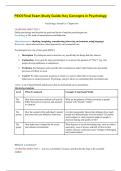
PS101 Final Exam Study Guide: Key Concepts in Psychology
Psychology Around Us– Chapter two
LEARNING OBJECTIVE 1
Define psychology and describe the goals and levels of analysis psychologists use.
Psychology is The study of mental process and behaviour
Mental processes- thinking, imagining, remembering (observing environment, using language)
Behaviour- observable activities, often impacted by environmental cues
Psychologists have one of four goals (DEPC)
1. Description. Psychologists seek to describe very specifically the things that they observe
2. Explanation. A key goal for many psychologists is to answer the question of “Why?” (eg: why
people develop addictions to substances)
3. Prediction. Psychologists seek to predict the circumstances under which behaviours and mental
processes are likely to occur
4. Control. We often encounter situations in which we want to either limit or increase certain
behaviours or mental processes. Psychology can give advice on controlling their own behaviours
culture a set of shared beliefs and practices that are transmitted across generations.
The levels of analysis
Level What Is Analyzed Example: Using Social Media
The How brain structure and brain cell activity What are the patterns of brain activation as people
brain differ from person to person and situation interact with “friends” online?
to situation
The How the content of the individual’s mental Are there personality factors that influence how much
person processes form and influence behaviour people use different types of social media? Can online
social support or crisis resources improve people’s
decision making and quality of life?
The How behaviour is shaped by the social What features of social networking sites, such as relative
group and cultural environments anonymity, ease of access, and lack of face-to-face
contact, increase or decrease users’ feelings of belonging
and connectedness?
What is a science?
LEARNING OBJECTIVE 1– List two core beliefs of science, and describe the steps in the scientific
method.
,Is psychology a science?
LEARNING OBJECTIVE 2– Compare and contrast psychology with other natural sciences, such as
biology, chemistry, and physics, and with pseudosciences, such as astrology.
Designing research to discover truths
● The Universe
● Which laws are discoverable/testable
Science is a verb.
How do psychologists conduct research?
LEARNING OBJECTIVE 3–List steps in the research process and key characteristics of descriptive and
experimental psychological research methods.
How do we discover laws?
(step one)
- Identify questions
(step two)
- Design hypothesis
(step three)
- Select a method
(step four)
- Analyze data
- Scientists are not trying to prove anything
- The point is to come up with a hypothesis and test it
-
(step five)
- Review and publish
(step sic)
- Build a theory
State a Hypothesis
Variables
Example
We want to know if alcohol level consumption impacts reaction time
Two things (variables)
, ● Alcohol/beer (independent variable; IV) - the variable that you manipulate
● Simulator/reaction time (dependant variable: DV) - the variable that you measure– depends on the
IV
(IV) independent variable condition or event that is thought to be a factor in changing another condition
or event.
(DV) dependent variable condition or event that you expect to change as a result of variations in the
independent variable.
Operational definition – is how we the researcher decide to measure our variables
Questions to ask – how did they operationalize the intelligence?
Example: aggression levels in children
Observe: Langauge, behaviour, desensitization the violence, bodily reaction (heart rate, blood pressure,
pupil dilation), self-report,
Choose Participants
Population- a group that is of interest
Sample:- a portion selected for the study (when a specific percent is derived from a statistic it's from a
sample)
Random selection- choosing a sample from a population
Sampling bias- choosing a sample that does not represent your population accurately
LEARNING OBJECTIVE 4– Describe what information is conveyed by statistics, including correlation
coefficients, means, and standard deviations, and explain how psychologists draw conclusions about
cause and effect.
The scientific reasonings
Inductive reasoning starts with an observation that leads to a theory
Eg: tall people who go out with tall people;
relationships involve height
Downloaded by youn sam ()
, Deductive reasoning starts with a theory and leads to predictions
Eg: matchmaking; dating apps/websites
Hypothetical deductive reasoning tests hypotheses
Eg: matchmaking based on theory; test it
Pick a Research Method
Two basic types of research
Descriptive
● Research method used to observe
● Used to determine the existence of a relationship between variables
1. Case study
- Focused on a single person
- Ex: biography
- Unique experience
Pitfall– research bias
★ Advantages
- Only if the behaviour is rare
- Very detailed
★ Disadvantages
2. Naturalistic observation
- Observe people behave as they normally do. Eg: Jane Goodall with gorillas
Pitfall– Hawhrtorne effect; people change their behaviour when they know they
are being observed Eg: men and women behave in more traditional gender styles
when they know they are being observed (stereotypical)
★ Advantages
- Study of things too unethical to conduct an experiment
★ Disadvantage
- Time-consuming
- Can't determine cause and effect
3. Surveys
- Use of a questionnaire for interview
Pitfall– participant bias Eg: social desirable bias; 8 ball, trail mix, wagon wheels
★ Advantages
- Data collection is quick
- Cheap
Psychology Around Us– Chapter two
LEARNING OBJECTIVE 1
Define psychology and describe the goals and levels of analysis psychologists use.
Psychology is The study of mental process and behaviour
Mental processes- thinking, imagining, remembering (observing environment, using language)
Behaviour- observable activities, often impacted by environmental cues
Psychologists have one of four goals (DEPC)
1. Description. Psychologists seek to describe very specifically the things that they observe
2. Explanation. A key goal for many psychologists is to answer the question of “Why?” (eg: why
people develop addictions to substances)
3. Prediction. Psychologists seek to predict the circumstances under which behaviours and mental
processes are likely to occur
4. Control. We often encounter situations in which we want to either limit or increase certain
behaviours or mental processes. Psychology can give advice on controlling their own behaviours
culture a set of shared beliefs and practices that are transmitted across generations.
The levels of analysis
Level What Is Analyzed Example: Using Social Media
The How brain structure and brain cell activity What are the patterns of brain activation as people
brain differ from person to person and situation interact with “friends” online?
to situation
The How the content of the individual’s mental Are there personality factors that influence how much
person processes form and influence behaviour people use different types of social media? Can online
social support or crisis resources improve people’s
decision making and quality of life?
The How behaviour is shaped by the social What features of social networking sites, such as relative
group and cultural environments anonymity, ease of access, and lack of face-to-face
contact, increase or decrease users’ feelings of belonging
and connectedness?
What is a science?
LEARNING OBJECTIVE 1– List two core beliefs of science, and describe the steps in the scientific
method.
,Is psychology a science?
LEARNING OBJECTIVE 2– Compare and contrast psychology with other natural sciences, such as
biology, chemistry, and physics, and with pseudosciences, such as astrology.
Designing research to discover truths
● The Universe
● Which laws are discoverable/testable
Science is a verb.
How do psychologists conduct research?
LEARNING OBJECTIVE 3–List steps in the research process and key characteristics of descriptive and
experimental psychological research methods.
How do we discover laws?
(step one)
- Identify questions
(step two)
- Design hypothesis
(step three)
- Select a method
(step four)
- Analyze data
- Scientists are not trying to prove anything
- The point is to come up with a hypothesis and test it
-
(step five)
- Review and publish
(step sic)
- Build a theory
State a Hypothesis
Variables
Example
We want to know if alcohol level consumption impacts reaction time
Two things (variables)
, ● Alcohol/beer (independent variable; IV) - the variable that you manipulate
● Simulator/reaction time (dependant variable: DV) - the variable that you measure– depends on the
IV
(IV) independent variable condition or event that is thought to be a factor in changing another condition
or event.
(DV) dependent variable condition or event that you expect to change as a result of variations in the
independent variable.
Operational definition – is how we the researcher decide to measure our variables
Questions to ask – how did they operationalize the intelligence?
Example: aggression levels in children
Observe: Langauge, behaviour, desensitization the violence, bodily reaction (heart rate, blood pressure,
pupil dilation), self-report,
Choose Participants
Population- a group that is of interest
Sample:- a portion selected for the study (when a specific percent is derived from a statistic it's from a
sample)
Random selection- choosing a sample from a population
Sampling bias- choosing a sample that does not represent your population accurately
LEARNING OBJECTIVE 4– Describe what information is conveyed by statistics, including correlation
coefficients, means, and standard deviations, and explain how psychologists draw conclusions about
cause and effect.
The scientific reasonings
Inductive reasoning starts with an observation that leads to a theory
Eg: tall people who go out with tall people;
relationships involve height
Downloaded by youn sam ()
, Deductive reasoning starts with a theory and leads to predictions
Eg: matchmaking; dating apps/websites
Hypothetical deductive reasoning tests hypotheses
Eg: matchmaking based on theory; test it
Pick a Research Method
Two basic types of research
Descriptive
● Research method used to observe
● Used to determine the existence of a relationship between variables
1. Case study
- Focused on a single person
- Ex: biography
- Unique experience
Pitfall– research bias
★ Advantages
- Only if the behaviour is rare
- Very detailed
★ Disadvantages
2. Naturalistic observation
- Observe people behave as they normally do. Eg: Jane Goodall with gorillas
Pitfall– Hawhrtorne effect; people change their behaviour when they know they
are being observed Eg: men and women behave in more traditional gender styles
when they know they are being observed (stereotypical)
★ Advantages
- Study of things too unethical to conduct an experiment
★ Disadvantage
- Time-consuming
- Can't determine cause and effect
3. Surveys
- Use of a questionnaire for interview
Pitfall– participant bias Eg: social desirable bias; 8 ball, trail mix, wagon wheels
★ Advantages
- Data collection is quick
- Cheap