

ENGG 204 Fundamentals of Engineering Materials - Fall 2025
Mock Final Examination - December 3-5
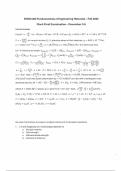
List of Formulas
Force F = —Z—Z. 1Tm=106um=10°nm=10"A=10"2pm. N, = 6.022 X 10²³, k = 1.38 x 10723 J/K.
V= fl of +ve and -ve ions; Z;, Z, absolute values of their valences, g, = 8.85 X 10712 F/m,
ATTEGT I
e=1.602x10"1°C.p = m. a = 2RV2 FCC. a = 4R /v/3 BCC. PD = # of atoms per area.
LD = # of atoms per length. docta,FCC = 2(\/7 - 1)Rhos . dtetr,FCC = (\/g - 2)Rhost- docta,BCC =
4 5
( —_——
7 ’
2) R host+ . Atetr.BcC =2 = =1 1B host- o 1(Wt %) - (at%) 0f) == —mi
———
; _ Ci4p &l Ay — A ' _mgtmy, 1 ClA1+CA,
€= CoAstCA, 1= cla+cla, - Aanoy = €141 + C3Az. Pattoy = ViV, G482 T clan Gap
P1 P2 p1 P2
F -1 € € F I
c=—. =2 g=Ee. E=26(14+v). v=—=2=—-2 g, =—= o(1+¢). 6T=ln(—‘).
Ao lo GZ (3 Al lo
or = Kel'. %EL = (lfl°) X 100. %RA = (%) x 100. K; = Yo/ma . Flexural strength ¢ =
0
3FL/(2bd?) and max elastic deformation Ay = FL3/(4Ebd?) of a bar with a rectangular cross
sectionalarea bd. AV = (V) — V) — 1 {Z}H} F =eNy. R = kN4. CPR (mm/yr) = KW /pAt,
where K = 3650; [W] = glyear; [p]= g/lcm?; [A] =cm?; [t] =days. r (— s) l(—)/(nT)
K.k, =K. T(K) =T (°C)+273.15. V=1IR. p=RA/L. 6 =p~L. | = oE. E =V /I p; = py +aT.
o =nlelpe + plelun. € =Q/V. C = g A/l. & = g/ey. € =dQ/dT. (L —1y)/ly = (T — Tp).
AV/Vy = ayAT. q = =k dT /dx. 0 = Eaq;AT.
You have 120 minutes to answer 5 multiple choice and 4 calculation questions.
1. (1 mark) Toughness of a metal largely depends on
a. Young’s modulus.
b. Yield strength.
c. Ultimate tensile strength.
d. Interatomic distance.
, (1 mark) A family of cyrstallographic planes with indices 100 is denoted by the following
brackets:
a. {100}.
b. (100).
c. [100].
d. <100>.
(1 mark) One of these statements is correct.
a. Weakinteratomic bond is indicated by a positive bond energy.
b. Metallic bond is stronger than covalent bond.
c. Engineering stress is smaller than true stress.
d. Ultimate tensile strength of ceramics can be smaller than its yield strength.
(1 mark) Determine the planar density of (111) of an FCC crystal with a lattice constant a.
a. 2/(a*V3).
b. 4/(a*V3).
c. 1/(a*V2).
d. 2/(3a?).
(1 mark) One of the statements below about ceramics is not correct.
a. Ceramics rely onionic bond that does not allow for large plastic deformation.
b. Ceramics have crystal structures that depend on the atomic radius difference.
c. Ceramics have high melting points due to the strong ionic bond.
d. Ceramics have tightly-packed crystal structures due to its high atomic packing fraction.
a) (2 marks) Rhodium has an atomic radius of 0.1345 nm, atomic weight 102.9 g/mol, of and a
density of 12.41 g/cm?®. Determine whether it has an FCC or BCC crystal structure.
b) (1 mark) Density of rhodium was measured in the lab and reported to be 12.39 g/cm?®. What do
you think is most likely responsible for the discrepancy?
c) (2 marks) For an FCC structure, on the (101) plane, determine which directions: [010], [T1Q],
and [111], that can be contained within the (101) plane.
a) (2 mark) A galvanic cell uses pure zinc and pure copper electrodes in their divalent-ion
solutions at 25 °C. The relevant standard reduction potentials are:
Cu®**+2e™>Cu, E=+0.340V
Zn*+2e>7Zn, E°=-0.763V
Which of the plates will be the anode, and which is the cathode in the reaction?
b) (2 mark) The cell is arranged as
Zn(s) | Zn?*(?) || Cu?*(0.120 M) | Cu(s)
The cell potentialis measured at 1.090 V. Determine the molar concentration of Zn?*.
c) (1 mark) Show that the formula CPR = KW /pAt willyield K = 3650 if [W], [p], [4], [t], [CPR]
arein g, g/cm?, cm?, days, and mm/year, respectively.
Mock Final Examination - December 3-5
List of Formulas
Force F = —Z—Z. 1Tm=106um=10°nm=10"A=10"2pm. N, = 6.022 X 10²³, k = 1.38 x 10723 J/K.
V= fl of +ve and -ve ions; Z;, Z, absolute values of their valences, g, = 8.85 X 10712 F/m,
ATTEGT I
e=1.602x10"1°C.p = m. a = 2RV2 FCC. a = 4R /v/3 BCC. PD = # of atoms per area.
LD = # of atoms per length. docta,FCC = 2(\/7 - 1)Rhos . dtetr,FCC = (\/g - 2)Rhost- docta,BCC =
4 5
( —_——
7 ’
2) R host+ . Atetr.BcC =2 = =1 1B host- o 1(Wt %) - (at%) 0f) == —mi
———
; _ Ci4p &l Ay — A ' _mgtmy, 1 ClA1+CA,
€= CoAstCA, 1= cla+cla, - Aanoy = €141 + C3Az. Pattoy = ViV, G482 T clan Gap
P1 P2 p1 P2
F -1 € € F I
c=—. =2 g=Ee. E=26(14+v). v=—=2=—-2 g, =—= o(1+¢). 6T=ln(—‘).
Ao lo GZ (3 Al lo
or = Kel'. %EL = (lfl°) X 100. %RA = (%) x 100. K; = Yo/ma . Flexural strength ¢ =
0
3FL/(2bd?) and max elastic deformation Ay = FL3/(4Ebd?) of a bar with a rectangular cross
sectionalarea bd. AV = (V) — V) — 1 {Z}H} F =eNy. R = kN4. CPR (mm/yr) = KW /pAt,
where K = 3650; [W] = glyear; [p]= g/lcm?; [A] =cm?; [t] =days. r (— s) l(—)/(nT)
K.k, =K. T(K) =T (°C)+273.15. V=1IR. p=RA/L. 6 =p~L. | = oE. E =V /I p; = py +aT.
o =nlelpe + plelun. € =Q/V. C = g A/l. & = g/ey. € =dQ/dT. (L —1y)/ly = (T — Tp).
AV/Vy = ayAT. q = =k dT /dx. 0 = Eaq;AT.
You have 120 minutes to answer 5 multiple choice and 4 calculation questions.
1. (1 mark) Toughness of a metal largely depends on
a. Young’s modulus.
b. Yield strength.
c. Ultimate tensile strength.
d. Interatomic distance.
, (1 mark) A family of cyrstallographic planes with indices 100 is denoted by the following
brackets:
a. {100}.
b. (100).
c. [100].
d. <100>.
(1 mark) One of these statements is correct.
a. Weakinteratomic bond is indicated by a positive bond energy.
b. Metallic bond is stronger than covalent bond.
c. Engineering stress is smaller than true stress.
d. Ultimate tensile strength of ceramics can be smaller than its yield strength.
(1 mark) Determine the planar density of (111) of an FCC crystal with a lattice constant a.
a. 2/(a*V3).
b. 4/(a*V3).
c. 1/(a*V2).
d. 2/(3a?).
(1 mark) One of the statements below about ceramics is not correct.
a. Ceramics rely onionic bond that does not allow for large plastic deformation.
b. Ceramics have crystal structures that depend on the atomic radius difference.
c. Ceramics have high melting points due to the strong ionic bond.
d. Ceramics have tightly-packed crystal structures due to its high atomic packing fraction.
a) (2 marks) Rhodium has an atomic radius of 0.1345 nm, atomic weight 102.9 g/mol, of and a
density of 12.41 g/cm?®. Determine whether it has an FCC or BCC crystal structure.
b) (1 mark) Density of rhodium was measured in the lab and reported to be 12.39 g/cm?®. What do
you think is most likely responsible for the discrepancy?
c) (2 marks) For an FCC structure, on the (101) plane, determine which directions: [010], [T1Q],
and [111], that can be contained within the (101) plane.
a) (2 mark) A galvanic cell uses pure zinc and pure copper electrodes in their divalent-ion
solutions at 25 °C. The relevant standard reduction potentials are:
Cu®**+2e™>Cu, E=+0.340V
Zn*+2e>7Zn, E°=-0.763V
Which of the plates will be the anode, and which is the cathode in the reaction?
b) (2 mark) The cell is arranged as
Zn(s) | Zn?*(?) || Cu?*(0.120 M) | Cu(s)
The cell potentialis measured at 1.090 V. Determine the molar concentration of Zn?*.
c) (1 mark) Show that the formula CPR = KW /pAt willyield K = 3650 if [W], [p], [4], [t], [CPR]
arein g, g/cm?, cm?, days, and mm/year, respectively.


