Social Science Psychology
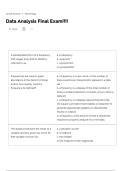
Data Analysis Final Exam!!!!
Save
A standardized form of a frequency a. a frequency
that ranges from 0.00 to 100.00 is b. a percent *
referred to as... c. a proportion
d. a proposition
Frequencies are used in great a. a frequency is a raw count, or the number of
abundance in the field of criminal times a particular characteristic appears in a data
justice, how exactly would a set. *
frequency be defined? b. a frequency is a display of the total number of
times a certain proportion of events occurs within a
data set.
c. a frequency is a display representing the total
chi-square summative that enables a researcher to
generate appropriate graphics to disseminate
results or outputs
d. a frequency is the amount of time a researcher
requires to properly analyze his or her data.
The distance between the mean of a a. a deviation score*
variable and any given raw score for b. a midpoint
that variable is known as: c. the median
d. the midpoint of the magnitude
, Which of the following is the simplest a. median
measure of central tendency? b. mode*
c. mean
d. midpoint of the magnitude
In a negatively skewed distribution, a. true*
the mean will be less than the b. false
median.
The variance is one measure of a. ordinal
dispersion that is suitable to use with b. nominal
which of the following level(s) of c. ratio *
measurement? d. all of the above choices
The null hypothesis is: a. a statement regarding the probability that the
level of measurement of the independent variable
is appropriate for the desired bivariate analysis
b. a statement predicting that any relationship
existing between two variables is due tot he level
of measurement of the dependent variable c. a
statement predicting that there is a relationship
between the independent and dependent variable
d. a statement predicting that there is no
relationship between the independent and
dependent variable*
A means comparison is conducted a. true
with a categorical dependent b. false*
variable
What type of bivariate analysis is a. correlation
used when the dependent variable is b. means comparison*
continuous and the independent c. contingency table
variable is categorical? d. crosstab
Data Analysis Final Exam!!!!
Save
A standardized form of a frequency a. a frequency
that ranges from 0.00 to 100.00 is b. a percent *
referred to as... c. a proportion
d. a proposition
Frequencies are used in great a. a frequency is a raw count, or the number of
abundance in the field of criminal times a particular characteristic appears in a data
justice, how exactly would a set. *
frequency be defined? b. a frequency is a display of the total number of
times a certain proportion of events occurs within a
data set.
c. a frequency is a display representing the total
chi-square summative that enables a researcher to
generate appropriate graphics to disseminate
results or outputs
d. a frequency is the amount of time a researcher
requires to properly analyze his or her data.
The distance between the mean of a a. a deviation score*
variable and any given raw score for b. a midpoint
that variable is known as: c. the median
d. the midpoint of the magnitude
, Which of the following is the simplest a. median
measure of central tendency? b. mode*
c. mean
d. midpoint of the magnitude
In a negatively skewed distribution, a. true*
the mean will be less than the b. false
median.
The variance is one measure of a. ordinal
dispersion that is suitable to use with b. nominal
which of the following level(s) of c. ratio *
measurement? d. all of the above choices
The null hypothesis is: a. a statement regarding the probability that the
level of measurement of the independent variable
is appropriate for the desired bivariate analysis
b. a statement predicting that any relationship
existing between two variables is due tot he level
of measurement of the dependent variable c. a
statement predicting that there is a relationship
between the independent and dependent variable
d. a statement predicting that there is no
relationship between the independent and
dependent variable*
A means comparison is conducted a. true
with a categorical dependent b. false*
variable
What type of bivariate analysis is a. correlation
used when the dependent variable is b. means comparison*
continuous and the independent c. contingency table
variable is categorical? d. crosstab