Psychology 100 Final Exam
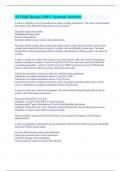
3 components of attitude 1. cognitive= judgement you make about the attitude object
2. affective= emotional response to the attitude object
3. behavioral= how you behave in the presence of the attitude
3 types of memory sensory, short term/working memory, and long term memory
3 types of validity (how well it measures what it's -construct validity= do IQ tests measure general intelligence? (
supposed to measure) tests)
-content validity= does the test test on the material learned? (a
tests)
-criteria validity= does the SAT predict how well students will d
(aptitude tests)
absolute threshold the lowest intensity at which a stimulus can be detected
accuracy (of remembering something) does NOT depend on confidence or detail
, Psychology 100 Final Exam
acetylcholine exhibitory neurotransmitter (nicotine bonds to ACH receptors)
-associated with memory and movement
-too little is associated with alzheimer's
achievement measures what you've already learned (class exams)
acquisition the acquiring of the conditioned stimulus (must be new, unexp
your attention)
agonist drug that increases activity of neurotransmitters
antagonist drug that decreases the activity of neurotransmitters
aptitude how well you will perform in any given domain, given the oppo
the area of the retina with only cones the fovea
, Psychology 100 Final Exam
attitude-behavior inconsistency can be described by LaPiere's study, where he toured 251 resta
America with a Chinese couple during a time of racial discrimin
of the 251 provided service to the couple, while in letters they
deny Asians service
The Big Five OCEAN- openness, conscientiousness, extraversion, agreeable
neuroticism
binocular disparity binocular depth cue that is the basis for 3D movies
bottom-up processing external world, the environment (aka data)
the bridge phobia -conditioned stimulus= the bridge
-conditioned response= child's fear in response to the bridge
-unconditioned stimulus= fear-inducing talk of the father
-unconditioned response= fear as a general emotion
case studies -therapist on patient
-preconceived ideas of therapists determine outcome
3 components of attitude 1. cognitive= judgement you make about the attitude object
2. affective= emotional response to the attitude object
3. behavioral= how you behave in the presence of the attitude
3 types of memory sensory, short term/working memory, and long term memory
3 types of validity (how well it measures what it's -construct validity= do IQ tests measure general intelligence? (
supposed to measure) tests)
-content validity= does the test test on the material learned? (a
tests)
-criteria validity= does the SAT predict how well students will d
(aptitude tests)
absolute threshold the lowest intensity at which a stimulus can be detected
accuracy (of remembering something) does NOT depend on confidence or detail
, Psychology 100 Final Exam
acetylcholine exhibitory neurotransmitter (nicotine bonds to ACH receptors)
-associated with memory and movement
-too little is associated with alzheimer's
achievement measures what you've already learned (class exams)
acquisition the acquiring of the conditioned stimulus (must be new, unexp
your attention)
agonist drug that increases activity of neurotransmitters
antagonist drug that decreases the activity of neurotransmitters
aptitude how well you will perform in any given domain, given the oppo
the area of the retina with only cones the fovea
, Psychology 100 Final Exam
attitude-behavior inconsistency can be described by LaPiere's study, where he toured 251 resta
America with a Chinese couple during a time of racial discrimin
of the 251 provided service to the couple, while in letters they
deny Asians service
The Big Five OCEAN- openness, conscientiousness, extraversion, agreeable
neuroticism
binocular disparity binocular depth cue that is the basis for 3D movies
bottom-up processing external world, the environment (aka data)
the bridge phobia -conditioned stimulus= the bridge
-conditioned response= child's fear in response to the bridge
-unconditioned stimulus= fear-inducing talk of the father
-unconditioned response= fear as a general emotion
case studies -therapist on patient
-preconceived ideas of therapists determine outcome