SPCM 200 FINAL EXAM PREP STUDY GUIDE
public speaking is - Answer -speech in, by, and for the public
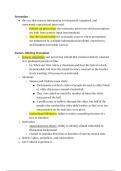
standard model of communication (look at pic) - Answer -a holistic attempt to account
for the major attributes that are at work in most communication interactions.
Intrapersonal communication - Answer -communication that takes place within a
person's own mind, primarily through thinking and internal dialogue.
Interpersonal communication - Answer -communication that takes places between two
or three people and typically concerns the creation, maintenance, or disillusion of
personal relationships.
Group communication - Answer -communication that takes place among a small group
of people-particularly teams- and is often focused on the completion of a task.
Organizational communication - Answer -communication that takes place within and
between large institutions and their members.
Mass communication - Answer -communication that takes place through media of any
kind, including television, film, and social or print media, and is transmitted to large
audiences.
Public communication - Answer -communication that takes place between a speaker
(or speakers) and an audience with the aim of engaging that audience on a topic of
shared concern about the public interest. Public communication is always done within a
public setting.
We see public speaking as - Answer -primarily being a form of public communication.
Always goal-oriented; primary goal and minor goals - Answer -We define primary goals
as the single, focused, overarching achievement the speaker hopes to attain with her
audience by the end of the speech in order to be successful.
By minor goals we mean small, targeted tasks that the speaker hopes to achieve over
the course of a speech on order to improve its effectiveness.
The dominant paradigm of public speaking - Answer -the belief that effective public
speaking should ONLY be formal, be rational, emphasize Western values, and be
practiced almost exclusively by white men.
, Multicultural paradigm of public speaking - Answer -acknowledges that there are many
speaking traditions and ways in which those traditions can be integrated or used
independently in order to do effective and confident public speaking.
free expression - Answer -an exercise of the human right to share ideas and opinions
with others without interference from governments or other forms of authority.
morals - Answer -the personal and consistent principles that individuals use to
determine what is good and bad.
ethics - Answer -the socially-defined expectation of good and bad behavior, which are
almost always variable by context.
Values of speaking: - Answer -Accuracy, Honesty, Transparency, Empathy,
Vulnerability, Accountability, Authenticity, Consistency
political correctness - Answer -the belief that language and behaviors that offend
marginalized communities in a given society should be curtailed and replaced with
statements and acts that affirm these communities' place in that society.
safe spaces - Answer -locations, places, and sites in the world in which individuals and
communities can take refuge from opinions, expectations, and assumptions other
people make about them.
brave spaces - Answer -sites in which "we emphasize the need for courage rather than
the illusion of safety" in public discourse.
Ground rules for creating a brave space - Answer -1. Controversy with Civility
2. Own your Intentions and Impact
3. Challenge by choice.
4. Respect.
5. No Ad Hominem attacks.
Mistakes in speaking across difference - Answer -generalizing our experience
bias
stereotyping
ethnocentrism
speaking for others
only seeing one side of a person
disengagement
Disengagement - Answer -avert eye contact, stop listening, look at their phones, walk
away, or simply freeze
Strategies for speaking across diffference - Answer -Listen to criticism, admit mistakes,
and grow.
public speaking is - Answer -speech in, by, and for the public
standard model of communication (look at pic) - Answer -a holistic attempt to account
for the major attributes that are at work in most communication interactions.
Intrapersonal communication - Answer -communication that takes place within a
person's own mind, primarily through thinking and internal dialogue.
Interpersonal communication - Answer -communication that takes places between two
or three people and typically concerns the creation, maintenance, or disillusion of
personal relationships.
Group communication - Answer -communication that takes place among a small group
of people-particularly teams- and is often focused on the completion of a task.
Organizational communication - Answer -communication that takes place within and
between large institutions and their members.
Mass communication - Answer -communication that takes place through media of any
kind, including television, film, and social or print media, and is transmitted to large
audiences.
Public communication - Answer -communication that takes place between a speaker
(or speakers) and an audience with the aim of engaging that audience on a topic of
shared concern about the public interest. Public communication is always done within a
public setting.
We see public speaking as - Answer -primarily being a form of public communication.
Always goal-oriented; primary goal and minor goals - Answer -We define primary goals
as the single, focused, overarching achievement the speaker hopes to attain with her
audience by the end of the speech in order to be successful.
By minor goals we mean small, targeted tasks that the speaker hopes to achieve over
the course of a speech on order to improve its effectiveness.
The dominant paradigm of public speaking - Answer -the belief that effective public
speaking should ONLY be formal, be rational, emphasize Western values, and be
practiced almost exclusively by white men.
, Multicultural paradigm of public speaking - Answer -acknowledges that there are many
speaking traditions and ways in which those traditions can be integrated or used
independently in order to do effective and confident public speaking.
free expression - Answer -an exercise of the human right to share ideas and opinions
with others without interference from governments or other forms of authority.
morals - Answer -the personal and consistent principles that individuals use to
determine what is good and bad.
ethics - Answer -the socially-defined expectation of good and bad behavior, which are
almost always variable by context.
Values of speaking: - Answer -Accuracy, Honesty, Transparency, Empathy,
Vulnerability, Accountability, Authenticity, Consistency
political correctness - Answer -the belief that language and behaviors that offend
marginalized communities in a given society should be curtailed and replaced with
statements and acts that affirm these communities' place in that society.
safe spaces - Answer -locations, places, and sites in the world in which individuals and
communities can take refuge from opinions, expectations, and assumptions other
people make about them.
brave spaces - Answer -sites in which "we emphasize the need for courage rather than
the illusion of safety" in public discourse.
Ground rules for creating a brave space - Answer -1. Controversy with Civility
2. Own your Intentions and Impact
3. Challenge by choice.
4. Respect.
5. No Ad Hominem attacks.
Mistakes in speaking across difference - Answer -generalizing our experience
bias
stereotyping
ethnocentrism
speaking for others
only seeing one side of a person
disengagement
Disengagement - Answer -avert eye contact, stop listening, look at their phones, walk
away, or simply freeze
Strategies for speaking across diffference - Answer -Listen to criticism, admit mistakes,
and grow.