Maternity N144-Exam 3: CH 21 Postpartum
Complications (PART 1)
Save
Students also studied
Childbirth and Culture - Final Exam ... 211 final exam OB content Exam 5 study guide maternal NURS2
271 terms 53 terms 62 terms 34 terms
garbasyd Preview Kylie_Payne52 Preview Jmallen3 Preview tay
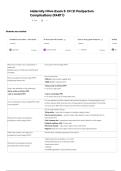
What is the number one complication in Post partum hemorrhage (PPH)
maternity?
(leading cause of maternal morbidity and
mortality)
loss of more than:
What is postpartum hemorrhage (PPH)
■500 ml of blood after vaginal birth
traditionally defined as?
■1000 ml after cesarean birth
⚬Early, acute or primary PPH
what is the definition of the following? ■< 24 hours after birth
-Early, acute or primary PPH
-Late or secondary PPH ⚬Late or secondary PPH
■> 24 hours and up to 12 weeks after birth
It is not apparent until the mother has profound symptoms. During pregnancy, the
why is postpartum hemorrhage (PPH) often
mother acquires 20% more blood to compensate for the growing fetus. The mother
unrecognized?
can lose up to 30%-40% of blood volume before symptoms present.
S/S of Hypovolemic Shock:
Tachycardia – heart rate increases to maintain cardiac output
Narrow pulse pressure – systolic drops while diastolic may be maintained due to
What are the signs and symptoms vasoconstriction
postpartum hemorrhage (PPH)? Cool, clammy skin – peripheral vasoconstriction shunts blood to vital organs
Delayed capillary refill (>2 seconds)
Thirst and anxiety – early neuro signs of poor perfusion
Oliguria-reduced urine output (<30 mL/hr) due to renal hypoperfusion
what is the number one reason for Uterine Atony-marked hypotonia of the uterus
postpartum hemorrhage (PPH)?
⚬High parity (mucho babies; 4 or more)
⚬Polyhydramnios (a lot of amniotic fluid)
What are the etiology/risk factors
⚬Macrosomic fetus
associated with uterine atony?
⚬Obesity
⚬Multifetal gestation (usually delivers early)
Complications (PART 1)
Save
Students also studied
Childbirth and Culture - Final Exam ... 211 final exam OB content Exam 5 study guide maternal NURS2
271 terms 53 terms 62 terms 34 terms
garbasyd Preview Kylie_Payne52 Preview Jmallen3 Preview tay
What is the number one complication in Post partum hemorrhage (PPH)
maternity?
(leading cause of maternal morbidity and
mortality)
loss of more than:
What is postpartum hemorrhage (PPH)
■500 ml of blood after vaginal birth
traditionally defined as?
■1000 ml after cesarean birth
⚬Early, acute or primary PPH
what is the definition of the following? ■< 24 hours after birth
-Early, acute or primary PPH
-Late or secondary PPH ⚬Late or secondary PPH
■> 24 hours and up to 12 weeks after birth
It is not apparent until the mother has profound symptoms. During pregnancy, the
why is postpartum hemorrhage (PPH) often
mother acquires 20% more blood to compensate for the growing fetus. The mother
unrecognized?
can lose up to 30%-40% of blood volume before symptoms present.
S/S of Hypovolemic Shock:
Tachycardia – heart rate increases to maintain cardiac output
Narrow pulse pressure – systolic drops while diastolic may be maintained due to
What are the signs and symptoms vasoconstriction
postpartum hemorrhage (PPH)? Cool, clammy skin – peripheral vasoconstriction shunts blood to vital organs
Delayed capillary refill (>2 seconds)
Thirst and anxiety – early neuro signs of poor perfusion
Oliguria-reduced urine output (<30 mL/hr) due to renal hypoperfusion
what is the number one reason for Uterine Atony-marked hypotonia of the uterus
postpartum hemorrhage (PPH)?
⚬High parity (mucho babies; 4 or more)
⚬Polyhydramnios (a lot of amniotic fluid)
What are the etiology/risk factors
⚬Macrosomic fetus
associated with uterine atony?
⚬Obesity
⚬Multifetal gestation (usually delivers early)