
NUR2063 Pathophysiology Exam 1 Study Guide
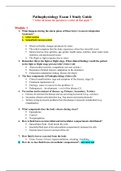
Pathophysiology Exam 1 Study Guide ** Select all means the question is a select all that apply ** Module 1 1. What happens during the alarm phase of Hans Selye’s General Adaptation Syndrome? a. Initial reaction b. Sympathetic nervous system • Observed bodily changes produced by stress • The initial symptom that the body experience when face stressful event • Natural reserve, time, genetics, age, gender, health status, nutrition, sleep–wake cycles, hardiness, and psychosocial factors • The flight or fight response due to stress 2. Remember this is the fight or flight stage. What clinical findings would the patient in the fight or flight stage present with? (Select All) • Alarm (initial reaction, sympathetic nervous system ) • Resistance (limited stressor, adaptation to the situation) • Exhaustion (adaptation failing, disease develops) 3. The four components of Pathophysiology (Select all) • Clinical manifestation: sign and symptom of the disease, stage (3) • Treatment implication (4) • Etiology: cause or reason for the problem (1) • Pathogenesis – development + evol of the disease (2) 4. Prevention and treatment of disease- eg. Primary, Secondary, Tertiary a. Primary: do not have the disease and you are trying to prevent it (e.g., vaccines) b. Secondary: disease early detection (e.g., Pap smears and yearly physicals) c. Tertiary: trying to prevent problems from the disease or (prevent complication) (e.g., rehabilitation) 5. What compounds does the body release during stress? • Epinephrine • Cortisol • Norepinephrine 6. How is fluid between interstitial and intracellular compartments distributed? • Intracellular fluid : fluid inside the cells • Interstitial fluid (part of the extracellular compartment): between the cells • Osmosis how it moves in and out of the cell 7. How fluid is lost or excreted from the body • Urine. Fesses, Gi tract, hyperventilation, sweating , breathing 8. How do we lose fluid from extracellular compartment? ( not sure) not • Urine fesses, gi tract, sweat,
Información del documento
- Subido en
- 21 de febrero de 2021
- Número de páginas
- 8
- Escrito en
- 2020/2021
- Tipo
- Examen
- Contiene
- Preguntas y respuestas

