
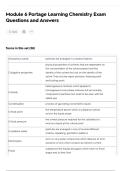
Module 6 Portage Learning Chemistry Exam
Questions and Answers
Save
Terms in this set (38)
Amorphous solids particles are arranged in a random fashion
physical properties of solvents that are dependent on
the concentration of the solute present and the
Colligative properties identity of the solvent but not on the identity of the
solute. They include vapor pressure, freezing point
and boiling point
heterogeneous mixtures which appear to
homogeneous one-phase mixtures but are actually
Colloids
composed of particles too small to be seen with the
naked eye
Condensation process of gas being converted to liquid
the temperature above which a substance cannot
Critical point
exist in the liquid phase
the lowest pressure required for the substance to
Critical pressure
exist as a liquid at the critical point
particles are arranged in one of several different
Crystalline solids
orderly, repeating, geometric patterns
ionic or very polar compounds which dissolve to form
Electrolytes
solutions of ions which conduct an electric current
substances like liquids and gases which have no fixed
Fluids
shape and so they flow
, Ionization the splitting of molecules to form ions
the number of moles of solute present per kilogram
Molality
of solvent
the number of moles of solute present per liter of
Molarity
solution
compounds which dissolve to form solutions of
Nonelectrolytes
molecules which do not conduct an electric current
Phase any state of matter such as solid, liquid or gas
Strong electrolytes solutes that ionize completely
Sublimation the conversion of a solid directly to the gas state
the force that causes a liquid which is in contact with a
gas like air to assume a shape that has the least
Surface tension
amount of surface area causing the surface to act like
a thin elastic sheet
the temperature and pressure at which the solid, liquid
Triple point
and gas phases can coexist
Vapor pressure pressure exerted by vapor molecules above a liquid
Weak electrolytes solutes that only partially ionize
Why are liquids the least they can exist only within a relatively narrow range of
common state of matter? temperatures and pressures
Vaporization is the conversion of liquid particles to
vapor at the boiling point temperature of the material.
Differentiate between
The process of liquid converting to vapor molecules
evaporation and
can also take place in a very limited manner at
vaporization
temperatures lower than the boiling point and is
called evaporation
A crystal lattice is the orderly, repeating geometric
Differentiate between a
pattern in which the particles of a crystalline solid are
crystal lattice and a unit
arranged. The unit cell is the smallest section of the
cell
crystal lattice having that arrangement of particles

