Med-surg. ANCC certification Questions and
Answers
Save
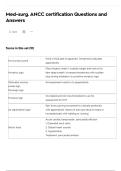
Terms in this set (91)
Point in RLQ abd of appendix. Tenderness indicates
Mc burney's point
appendicitis
Place fingers under rt coastal margin and instruct to
Murphy's sign take deep breath. Increased tenderness with sudden
stop during inhalation is a positive murphy's sign
Obturator muscle, All assessment used to r/o appendicitis
psoas sign,
Rovsing's sign
Out dated and not recommended to use for
Homan's sign
assessment for DVT
Pain from a jarring movement to indicate peritonitis
Jar sign(markle sign) with appendicitis. Stand on toes and drop to heals or
increaded pain with walking or running
Acute cardiac tamponade- pericardial effusion
1. Disended neck vein's
Beck's triad 2. Distant heart sounds
3. Hypotention
Treatment- pericardiocentesis
, 1. Nystagmas- repetitive uncontrolled movements of
the eyes
2. Intention tremor- tremor that worsens as
Charcot's triad for MS
approaches end of intended movement
3. Scanning or staccato speech- broken speech and
each syllable pronounced separately
Inf. of bile duct caused by bacteria ascending from
junction with duodenum
Charcot's triad for
1.Jaundice
ascending cholangitis
2. Fever, usually with rigors
3. RUQ ABD pain
Signs of increased ICP
1. HTN- widened pulse pressure
Cushing's triad 2. Bradycardia
3. Irregular respirations- cheyne- stokes( slow, fast,
slow period of apnea then slow,fast,slow
Deep and labored. Presents in severe metabolic
Kaussmaul breathing
acidosis- DKA and kidney failure
Signs of fat embolism
1. Mental status changes
Bergman's triad
2. Petechiae-late sign
3. Dyspnea
Sign of meningitis- supine flex neck will cause
Brudzinski sign
involuntary flexion of hips and knees
Sign of meningitis- lift flexed knee and slowly extend
Kernig's sign
will cause back pain if positive
Nerve hyperexcitability (tetany) seen with
hypocalemia
Chvostek's sign
Abnormal reaction to stimulation of facial nerve
Trousseau' sign
Inflate bp cuff to greater than systolic and hand and
wrist with involuntarly curl inward
, is positive when a patient is holding a clenched fist
Levine sign over his chest to describe dull, pressing chest pain
consistent with the discomfort of angina pectoris.
A patient is diagnosed B: Choice B would show a lateral wall MI.
with a lateral wall ST Choice A would show an anterior MI.
segment elevation Choice C would show an inferior wall MI.
myocardial infarction Choice D would show a posterior wall MI.
(STEMI). What do you
expect the EKG to show?
a. ST elevation in leads V1 -
V6
b. ST elevation in leads I,
aVL, V5, V6
c. ST elevation in leads II,
III, aVF
d. ST elevation in leads V7,
V8, V9
commonly caused by E.coli in elderly males and/or
those who are not sexually active and have normal
immune function. In sexually active males with a
history of unprotected sex, the causative organisms
Epididymitis are likely gonorrhea and/or chlamydia. Cases of
epididymitis caused by Staph aureus are rare.
Epididymitis caused by cytomegalovirus (CMV) is
incredibly rare unless the patient is
immunocompromised.
Nimodipine or Nimotop is a calcium channel blocker
which causes vasodilation of the blood vessels. is
Triple H therapy for
hypervolemia, hypertension, and hemodilution. These
Subarachnoid
three factors will maintain the patency of the vessels,
Hemorrhage- induced
making it difficult for them to vasoconstrict.
Vasospasm
Vasospasm left unchecked can cause stroke,
neurological compromise, and death.
Iatrogenic Adverse effects caused by dx procedure or treatment
Answers
Save
Terms in this set (91)
Point in RLQ abd of appendix. Tenderness indicates
Mc burney's point
appendicitis
Place fingers under rt coastal margin and instruct to
Murphy's sign take deep breath. Increased tenderness with sudden
stop during inhalation is a positive murphy's sign
Obturator muscle, All assessment used to r/o appendicitis
psoas sign,
Rovsing's sign
Out dated and not recommended to use for
Homan's sign
assessment for DVT
Pain from a jarring movement to indicate peritonitis
Jar sign(markle sign) with appendicitis. Stand on toes and drop to heals or
increaded pain with walking or running
Acute cardiac tamponade- pericardial effusion
1. Disended neck vein's
Beck's triad 2. Distant heart sounds
3. Hypotention
Treatment- pericardiocentesis
, 1. Nystagmas- repetitive uncontrolled movements of
the eyes
2. Intention tremor- tremor that worsens as
Charcot's triad for MS
approaches end of intended movement
3. Scanning or staccato speech- broken speech and
each syllable pronounced separately
Inf. of bile duct caused by bacteria ascending from
junction with duodenum
Charcot's triad for
1.Jaundice
ascending cholangitis
2. Fever, usually with rigors
3. RUQ ABD pain
Signs of increased ICP
1. HTN- widened pulse pressure
Cushing's triad 2. Bradycardia
3. Irregular respirations- cheyne- stokes( slow, fast,
slow period of apnea then slow,fast,slow
Deep and labored. Presents in severe metabolic
Kaussmaul breathing
acidosis- DKA and kidney failure
Signs of fat embolism
1. Mental status changes
Bergman's triad
2. Petechiae-late sign
3. Dyspnea
Sign of meningitis- supine flex neck will cause
Brudzinski sign
involuntary flexion of hips and knees
Sign of meningitis- lift flexed knee and slowly extend
Kernig's sign
will cause back pain if positive
Nerve hyperexcitability (tetany) seen with
hypocalemia
Chvostek's sign
Abnormal reaction to stimulation of facial nerve
Trousseau' sign
Inflate bp cuff to greater than systolic and hand and
wrist with involuntarly curl inward
, is positive when a patient is holding a clenched fist
Levine sign over his chest to describe dull, pressing chest pain
consistent with the discomfort of angina pectoris.
A patient is diagnosed B: Choice B would show a lateral wall MI.
with a lateral wall ST Choice A would show an anterior MI.
segment elevation Choice C would show an inferior wall MI.
myocardial infarction Choice D would show a posterior wall MI.
(STEMI). What do you
expect the EKG to show?
a. ST elevation in leads V1 -
V6
b. ST elevation in leads I,
aVL, V5, V6
c. ST elevation in leads II,
III, aVF
d. ST elevation in leads V7,
V8, V9
commonly caused by E.coli in elderly males and/or
those who are not sexually active and have normal
immune function. In sexually active males with a
history of unprotected sex, the causative organisms
Epididymitis are likely gonorrhea and/or chlamydia. Cases of
epididymitis caused by Staph aureus are rare.
Epididymitis caused by cytomegalovirus (CMV) is
incredibly rare unless the patient is
immunocompromised.
Nimodipine or Nimotop is a calcium channel blocker
which causes vasodilation of the blood vessels. is
Triple H therapy for
hypervolemia, hypertension, and hemodilution. These
Subarachnoid
three factors will maintain the patency of the vessels,
Hemorrhage- induced
making it difficult for them to vasoconstrict.
Vasospasm
Vasospasm left unchecked can cause stroke,
neurological compromise, and death.
Iatrogenic Adverse effects caused by dx procedure or treatment