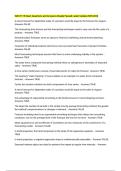
ISDS 3115 TEST 2 MC
A quality loss function includes all of the following costs EXCEPT:
a) costs to society
b) the cost of customer dissatisfaction.
c) the cost of scrap and repair.
d) inspection, warranty, and service costs.
e) sales costs - ANSWERS-e) sales costs
When sample measurements falls inside the control limits, it means
that:
a) if there is no other pattern in the samples, the process is in control
b) the process limits cannot be determined statistically.
the process output does not fulfill the requirements
d) the process output exceeds the requirements.
d) each unit manufactured is good enough to sell. - ANSWERS-a) if
there is no other pattern in the samples, the process is in control
*What is benchmarking?* - ANSWERS-*Selecting the best practices
to use as a standard for performance*
- determine what to benchmark
- form a benchmark team
- collect and analyse benchmarking information
- take action to match or exceed the benchmark
,Use internal benchmarking "if you're big enough"
*What is Taguchi concept?* - ANSWERS-The Taguchi Method
considers the design to be more important than the manufacturing
process in quality control and tries to eliminate variances in
production before they can occur.
*- quality robustness*
*- quality loss function*
*- target oriented function*
*What is the purpose of an x-chart?* - ANSWERS-1. x-charts are to
control the central tendency of the process
2. detects shift and central tendency
3. does NOT detect increase in dispersion
*What is another name for Process Layout?* - ANSWERS-*Job
Shop*
*A common measure of queuing system's performance include:* -
ANSWERS-1. Average time that each customer or object spends in
the queue
2. Average queue length
3. Average time each customer spends in the system
4. Average number of customers in the system
5. Probability that the service facility will be idle
6. Utilization factor for the system
,7. Probability of a specific number of customers in the system
*What are the strategies of improving service productivity?* -
ANSWERS-1. self service
2. automation
3. scheduling
4. separation
5. postponment
6. focus
7. modules
8. training
*What are the different types of processes and examples?* -
ANSWERS-1. *Process focus* (job-shop, machine, print, carpentry)
2. *Repetitive focus* (automobiles, motorcycles, Harley Davidson)
3. *Mass-customization* (difficult to achieve, but huge rewards, Dell
Computers) *high-volume, high-variety*
4. *Product Focus* (commercial baked goods, steel, glass)
*Which types of companies that use high utilization?* - ANSWERS-
Product focuses
*Which types of companies that use low utilization?* - ANSWERS-
Process focuses
, *What is design capacity?* - ANSWERS-The maximum theoretical
output of a system
Normally expressed as a rate
*What are the four approaches to capacity expansion?* - ANSWERS-
1. leading demand with incremental expansion
2. leading demand with one-step expansion
3. capacity lags demand with incremental expansion
4. attempts to have an average capacity with incremental expansion
*What are the four principles of bottleneck management?* -
ANSWERS-1. release work orders to the system at the pace of set by
the bottleneck
2. Lost time at the bottleneck represents lost time for the whole
system
3. increasing the capacity of a non-bottleneck system is a mirage (not
real; can't do it)
4. increasing the capacity of a bottleneck increases the capacity of the
whole system
*What are the types and examples of different queuing systems and
characteristics?* - ANSWERS-*Model A* - Single channel system
(M/M/1); information counter at department store; exponential service
time pattern
*Model B* - Multichannel system (M/M/S); airline ticket counter;
exponential service time pattern
A quality loss function includes all of the following costs EXCEPT:
a) costs to society
b) the cost of customer dissatisfaction.
c) the cost of scrap and repair.
d) inspection, warranty, and service costs.
e) sales costs - ANSWERS-e) sales costs
When sample measurements falls inside the control limits, it means
that:
a) if there is no other pattern in the samples, the process is in control
b) the process limits cannot be determined statistically.
the process output does not fulfill the requirements
d) the process output exceeds the requirements.
d) each unit manufactured is good enough to sell. - ANSWERS-a) if
there is no other pattern in the samples, the process is in control
*What is benchmarking?* - ANSWERS-*Selecting the best practices
to use as a standard for performance*
- determine what to benchmark
- form a benchmark team
- collect and analyse benchmarking information
- take action to match or exceed the benchmark
,Use internal benchmarking "if you're big enough"
*What is Taguchi concept?* - ANSWERS-The Taguchi Method
considers the design to be more important than the manufacturing
process in quality control and tries to eliminate variances in
production before they can occur.
*- quality robustness*
*- quality loss function*
*- target oriented function*
*What is the purpose of an x-chart?* - ANSWERS-1. x-charts are to
control the central tendency of the process
2. detects shift and central tendency
3. does NOT detect increase in dispersion
*What is another name for Process Layout?* - ANSWERS-*Job
Shop*
*A common measure of queuing system's performance include:* -
ANSWERS-1. Average time that each customer or object spends in
the queue
2. Average queue length
3. Average time each customer spends in the system
4. Average number of customers in the system
5. Probability that the service facility will be idle
6. Utilization factor for the system
,7. Probability of a specific number of customers in the system
*What are the strategies of improving service productivity?* -
ANSWERS-1. self service
2. automation
3. scheduling
4. separation
5. postponment
6. focus
7. modules
8. training
*What are the different types of processes and examples?* -
ANSWERS-1. *Process focus* (job-shop, machine, print, carpentry)
2. *Repetitive focus* (automobiles, motorcycles, Harley Davidson)
3. *Mass-customization* (difficult to achieve, but huge rewards, Dell
Computers) *high-volume, high-variety*
4. *Product Focus* (commercial baked goods, steel, glass)
*Which types of companies that use high utilization?* - ANSWERS-
Product focuses
*Which types of companies that use low utilization?* - ANSWERS-
Process focuses
, *What is design capacity?* - ANSWERS-The maximum theoretical
output of a system
Normally expressed as a rate
*What are the four approaches to capacity expansion?* - ANSWERS-
1. leading demand with incremental expansion
2. leading demand with one-step expansion
3. capacity lags demand with incremental expansion
4. attempts to have an average capacity with incremental expansion
*What are the four principles of bottleneck management?* -
ANSWERS-1. release work orders to the system at the pace of set by
the bottleneck
2. Lost time at the bottleneck represents lost time for the whole
system
3. increasing the capacity of a non-bottleneck system is a mirage (not
real; can't do it)
4. increasing the capacity of a bottleneck increases the capacity of the
whole system
*What are the types and examples of different queuing systems and
characteristics?* - ANSWERS-*Model A* - Single channel system
(M/M/1); information counter at department store; exponential service
time pattern
*Model B* - Multichannel system (M/M/S); airline ticket counter;
exponential service time pattern