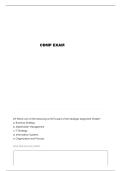
29. Which one of the following is NOT a part of the Strategic Alignment Model?
a. Business Strategy
b. Stakeholder Management
c. IT Strategy
d. Information Systems
e. Organization and Process
Give this one a try later!
, b. Stakeholder Management
Topic: Data Management
Explanation: Stakeholder Management is not a part of the Strategic
Alignment Model. Data Strategy should include
business strategy, IT strategy, Information Systems, Organization and
Process in order to best use organizational
information to achieve competitive advantage (ch. 1, section 3.1 Strategic
Alignment Model, p. 34).
29. Which of the following is a valid description of Data Management?
a. Data Management is lifecycle management
b. Data Management is cross-functional
c. Data Management is the development, execution, and supervision of plans.
d. All of the above
e. None of the above
Give this one a try later!
d. All of the above
Topic: Data Management
Explanation: Data Management refers to the development, execution, and
supervision of plans, policies, programs, and
practices that deliver, control, protect, and enhance the value of data and
information assets throughout their life
cycles. Data Management is cross-functional (meaning that it requires a
range of skills and expertise) (ch. 1, section
2.4 Data Management Principles, p. 22).
39. What does data represent?
a. Granularity
b. Lifecycle
c. Structured information
a. Business Strategy
b. Stakeholder Management
c. IT Strategy
d. Information Systems
e. Organization and Process
Give this one a try later!
, b. Stakeholder Management
Topic: Data Management
Explanation: Stakeholder Management is not a part of the Strategic
Alignment Model. Data Strategy should include
business strategy, IT strategy, Information Systems, Organization and
Process in order to best use organizational
information to achieve competitive advantage (ch. 1, section 3.1 Strategic
Alignment Model, p. 34).
29. Which of the following is a valid description of Data Management?
a. Data Management is lifecycle management
b. Data Management is cross-functional
c. Data Management is the development, execution, and supervision of plans.
d. All of the above
e. None of the above
Give this one a try later!
d. All of the above
Topic: Data Management
Explanation: Data Management refers to the development, execution, and
supervision of plans, policies, programs, and
practices that deliver, control, protect, and enhance the value of data and
information assets throughout their life
cycles. Data Management is cross-functional (meaning that it requires a
range of skills and expertise) (ch. 1, section
2.4 Data Management Principles, p. 22).
39. What does data represent?
a. Granularity
b. Lifecycle
c. Structured information