
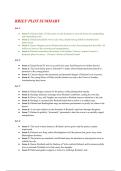
BRIEF PLOT SUMMARY
Act 1:
● Scene 1: Richard, Duke of Gloucester, reveals his plans to seize the throne by manipulating
and eliminating rivals.
● Scene 2: Richard deceitfully woos Lady Anne, despite having killed her husband and
father-in-law.
● Scene 3: Queen Margaret curses Richard and others at court, forewarning their downfall. All
nobles are aware of the scheming and manipulations.
● Scene 4: Richard orchestrates the murder of his brother, Clarence, despite Clarence’s
desperate pleas for mercy. - Clarence’s blood on Richard’s hands
Act 2:
● Scene 1: King Edward IV tries to reconcile his court, but Richard sows further discord.
● Scene 2: The royal family grieves Edward IV’s death, while Richard positions himself as
protector of the young princes.
● Scene 3: Citizens discuss the uncertainty and potential dangers of Richard’s rise to power.
● Scene 4: The young Prince of Wales and his brother are sent to the Tower of London,
foreshadowing their doom.
Act 3:
● Scene 1: Richard feigns concern for the princes while plotting their murder.
● Scene 2: Hastings dismisses warnings about Richard’s ambitions, sealing his own fate.
● Scene 3: Rivers, Grey, and Vaughan are executed as Richard removes obstacles to his rule.
● Scene 4: Hastings is executed after Richard brands him a traitor in a sudden coup.
● Scene 5: Richard and Buckingham stage an elaborate performance to justify his claim to the
throne.
● Scene 6: A scrivener reflects on the absurdity of Richard’s rapid rise through deception.
● Scene 7: Richard is publicly “reluctantly” persuaded to take the crown in a carefully staged
manipulation.
Act 4:
● Scene 1: The royal women lament as Richard’s power grows and the princes remain
imprisoned.
● Scene 2: Richard, now king, orders Buckingham to kill the princes but grows wary when
Buckingham hesitates.
● Scene 3: The princes are murdered, and Richard turns his attention to marrying his niece to
solidify his rule.
● Scene 4: Queen Elizabeth and the Duchess of York confront Richard, and he unsuccessfully
tries to persuade Elizabeth to let him marry her daughter.
● Scene 5: Richmond gathers support in France to challenge Richard’s rule.
,Act 5:
● Scene 1: Buckingham is executed after reflecting on his misplaced loyalty to Richard.
● Scene 2: Richmond rallies his forces and prepares to defeat Richard.
● Scene 3: Richard and Richmond camp before battle, where Richard is haunted by the ghosts
of his victims.
● Scene 4: Richard, desperate and fighting to the end, seeks a horse amid the chaos of battle.
● Scene 5: Richmond kills Richard, takes the throne as Henry VII, and promises peace by
uniting the warring houses of York and Lancaster.
Background Context
Historical/Religious/Philosophical Context
- 13th century, 1400s
- Based on real-life historical figures
The War of the Roses - Lancaster (red rose) vs. York (white rose)
- Civil conflict between the two houses
- Richard’s from the House of York
Great Chain of Being
- God set out the natural order of things
- Common element in medieval Christianity
- Richard disrupts the natural order of things by attempting to ascend from his position
- The order must be restored
Divine Right of Kings
- political/religious doctrine of royal legitimacy
- Kings derive their authority from God
- To kill a king is sinful
Wheel of Fortune
- Medieval philosophy - wheel belonged to Fortuna, etc.
- determinism/Providentialism vs. humanism
- Everything and everyone is controlled by God
- He is trying to disrupt what God’s plan is - his corrupted pursuit of power
- Richard’s hunchback nature, if he looks like a villain he has to act like a villain - God
made him that way → Richard might be using this as an excuse – he has a jealousy
that he does not reach the throne
Tudor Myth - promotion of this idea that the Tudor reign is good, whereas the previous era (War of
the Roses) was bad
- Historical idea about Richard
- That richard was villainous and he deserved his death
- This helps reinforce Elizabeth’s reign because she was a member of the house of
Tudor
Machiavellianism
- Machiavelli’s The Prince (manifesto) about how to lead, and saying that it’s okay to
act immorally as long as the result is good
, - Machiavellian people act immorally, manipulatively, etc. to achieve their goals
Women
- Not very strong, not very big
- Women born into royalty enjoy some privileges
- Disempowered
Providence
- History was not written by human actions but by God
Dystanic society
- Power is always passed within one family from generation to generation
Cosmic forces
- Always external forces that shape people’s fates -
Medieval World View (firmly entrenched): Great Chain of Being, Divine Right of Kings (Kings are
seen as ‘gods’ on earth, if you mess with who is on the throne, you are messing with God), tudor myth
(the tudors were seen as good and saviours of England and you have to be in support of them, they
created this myth of themselves that they are so good - the way richard III is written is seen as Tudor
propaganda - tudor was amazing, richard {the character} was the villain - richard is challenging
everything of what a king should be) , Providence (humans don’t have control of their fate, god does),
Dystanic society, rigidly hierarchical, Theocratic (God is the centre of universe and god/government
are not separate), cosmic forces (fate was not determined by god or supernatural force but external
forces)
- LEVITICAL DOCTRINE (comes from the bible as by Leviticus - justified by theocratic
society) → your outward appearance determines the inner nature. E.g. we don’t know for sure
if Richard III was a hunchback but essentially what made him like a villain
Renaissance Humanism (more recent and has a strong effect on the perspectives around the
topic): Humanism (contrasts to GCB, as humans at the centre, GCB you can’t change position but in
humanism you have your fate in your own hands), centrality of humanity, agency of the individual,
free will, actions can determine your fate instead of God, erasmus (piconian vs montaigne)
- Pico dell Mirandola believed humans had godlike dignity and unlimited potential. He
believed that through the exercise of reason, human beings move upwards in the GCB being
toward union with the divine (POSITIVE VIEW!) → the power of personal agency and the
strength humans have
- He ultimately said at our base level, humans are both grubs but we have the power to create
ourselves into something greater. ---> Humanism as humans have great potential. This
contrasts to the medieval view as they believe everything is fate and predetermined while this
perspective and humanism believes in the power of
Richard embodies both of these
- DO NOT USE WORD ‘UPHEAVAL’ - find synonyms
- Can you justify ‘god’s plan’ and ‘fate’ in order to get the throne????
, Further interesting questions and ideas discussed in class:
- How can you justify Richmond killing Richard III but not Richard III killing others to get the
throne - reveals how complex and messed up the Divine Right of Kings is!!
Act 1:
● Scene 1: Richard, Duke of Gloucester, reveals his plans to seize the throne by manipulating
and eliminating rivals.
● Scene 2: Richard deceitfully woos Lady Anne, despite having killed her husband and
father-in-law.
● Scene 3: Queen Margaret curses Richard and others at court, forewarning their downfall. All
nobles are aware of the scheming and manipulations.
● Scene 4: Richard orchestrates the murder of his brother, Clarence, despite Clarence’s
desperate pleas for mercy. - Clarence’s blood on Richard’s hands
Act 2:
● Scene 1: King Edward IV tries to reconcile his court, but Richard sows further discord.
● Scene 2: The royal family grieves Edward IV’s death, while Richard positions himself as
protector of the young princes.
● Scene 3: Citizens discuss the uncertainty and potential dangers of Richard’s rise to power.
● Scene 4: The young Prince of Wales and his brother are sent to the Tower of London,
foreshadowing their doom.
Act 3:
● Scene 1: Richard feigns concern for the princes while plotting their murder.
● Scene 2: Hastings dismisses warnings about Richard’s ambitions, sealing his own fate.
● Scene 3: Rivers, Grey, and Vaughan are executed as Richard removes obstacles to his rule.
● Scene 4: Hastings is executed after Richard brands him a traitor in a sudden coup.
● Scene 5: Richard and Buckingham stage an elaborate performance to justify his claim to the
throne.
● Scene 6: A scrivener reflects on the absurdity of Richard’s rapid rise through deception.
● Scene 7: Richard is publicly “reluctantly” persuaded to take the crown in a carefully staged
manipulation.
Act 4:
● Scene 1: The royal women lament as Richard’s power grows and the princes remain
imprisoned.
● Scene 2: Richard, now king, orders Buckingham to kill the princes but grows wary when
Buckingham hesitates.
● Scene 3: The princes are murdered, and Richard turns his attention to marrying his niece to
solidify his rule.
● Scene 4: Queen Elizabeth and the Duchess of York confront Richard, and he unsuccessfully
tries to persuade Elizabeth to let him marry her daughter.
● Scene 5: Richmond gathers support in France to challenge Richard’s rule.
,Act 5:
● Scene 1: Buckingham is executed after reflecting on his misplaced loyalty to Richard.
● Scene 2: Richmond rallies his forces and prepares to defeat Richard.
● Scene 3: Richard and Richmond camp before battle, where Richard is haunted by the ghosts
of his victims.
● Scene 4: Richard, desperate and fighting to the end, seeks a horse amid the chaos of battle.
● Scene 5: Richmond kills Richard, takes the throne as Henry VII, and promises peace by
uniting the warring houses of York and Lancaster.
Background Context
Historical/Religious/Philosophical Context
- 13th century, 1400s
- Based on real-life historical figures
The War of the Roses - Lancaster (red rose) vs. York (white rose)
- Civil conflict between the two houses
- Richard’s from the House of York
Great Chain of Being
- God set out the natural order of things
- Common element in medieval Christianity
- Richard disrupts the natural order of things by attempting to ascend from his position
- The order must be restored
Divine Right of Kings
- political/religious doctrine of royal legitimacy
- Kings derive their authority from God
- To kill a king is sinful
Wheel of Fortune
- Medieval philosophy - wheel belonged to Fortuna, etc.
- determinism/Providentialism vs. humanism
- Everything and everyone is controlled by God
- He is trying to disrupt what God’s plan is - his corrupted pursuit of power
- Richard’s hunchback nature, if he looks like a villain he has to act like a villain - God
made him that way → Richard might be using this as an excuse – he has a jealousy
that he does not reach the throne
Tudor Myth - promotion of this idea that the Tudor reign is good, whereas the previous era (War of
the Roses) was bad
- Historical idea about Richard
- That richard was villainous and he deserved his death
- This helps reinforce Elizabeth’s reign because she was a member of the house of
Tudor
Machiavellianism
- Machiavelli’s The Prince (manifesto) about how to lead, and saying that it’s okay to
act immorally as long as the result is good
, - Machiavellian people act immorally, manipulatively, etc. to achieve their goals
Women
- Not very strong, not very big
- Women born into royalty enjoy some privileges
- Disempowered
Providence
- History was not written by human actions but by God
Dystanic society
- Power is always passed within one family from generation to generation
Cosmic forces
- Always external forces that shape people’s fates -
Medieval World View (firmly entrenched): Great Chain of Being, Divine Right of Kings (Kings are
seen as ‘gods’ on earth, if you mess with who is on the throne, you are messing with God), tudor myth
(the tudors were seen as good and saviours of England and you have to be in support of them, they
created this myth of themselves that they are so good - the way richard III is written is seen as Tudor
propaganda - tudor was amazing, richard {the character} was the villain - richard is challenging
everything of what a king should be) , Providence (humans don’t have control of their fate, god does),
Dystanic society, rigidly hierarchical, Theocratic (God is the centre of universe and god/government
are not separate), cosmic forces (fate was not determined by god or supernatural force but external
forces)
- LEVITICAL DOCTRINE (comes from the bible as by Leviticus - justified by theocratic
society) → your outward appearance determines the inner nature. E.g. we don’t know for sure
if Richard III was a hunchback but essentially what made him like a villain
Renaissance Humanism (more recent and has a strong effect on the perspectives around the
topic): Humanism (contrasts to GCB, as humans at the centre, GCB you can’t change position but in
humanism you have your fate in your own hands), centrality of humanity, agency of the individual,
free will, actions can determine your fate instead of God, erasmus (piconian vs montaigne)
- Pico dell Mirandola believed humans had godlike dignity and unlimited potential. He
believed that through the exercise of reason, human beings move upwards in the GCB being
toward union with the divine (POSITIVE VIEW!) → the power of personal agency and the
strength humans have
- He ultimately said at our base level, humans are both grubs but we have the power to create
ourselves into something greater. ---> Humanism as humans have great potential. This
contrasts to the medieval view as they believe everything is fate and predetermined while this
perspective and humanism believes in the power of
Richard embodies both of these
- DO NOT USE WORD ‘UPHEAVAL’ - find synonyms
- Can you justify ‘god’s plan’ and ‘fate’ in order to get the throne????
, Further interesting questions and ideas discussed in class:
- How can you justify Richmond killing Richard III but not Richard III killing others to get the
throne - reveals how complex and messed up the Divine Right of Kings is!!


