

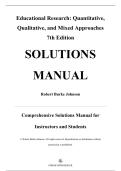
Educational Research: Quantitative,
Qualitative, and Mixed Approaches
ST
7th Edition
UV
SOLUTIONS
IA
MANUAL
?_
AP
Robert Burke Johnson
PR
OV
Comprehensive Solutions Manual for
Instructors and Students
ED
© Robert Burke Johnson. All rights reserved. Reproduction or distribution without
??
permission is prohibited.
©MEDCONNOISSEUR
, Table of Contents
Solutions Manual for Educational Research: Quantitative, Qualitative, and Mixed
Approaches (7th Edition)
Author: Robert Burke Johnson
ST
ISBN: 978-1544337838
Part I: Introduction
UV
Chapter 1: Introduction to Educational Research
Chapter 2: Quantitative, Qualitative, and Mixed Research
Chapter 3: Action Research for Lifelong Learning
Part II: Planning the Research Study
IA
Chapter 4: How to Critically Review the Literature and Develop Good Research
Questions
Chapter 5: How to Write a Research Proposal
Chapter 6: Research Ethics
?_
Part III: Foundations of Research
Chapter 7: Standardized Measurement and Assessment
Chapter 8: Methods of Data Collection in Quantitative, Qualitative, and Mixed
Research
AP
Chapter 9: How to Construct a Questionnaire
Chapter 10: Sampling in Quantitative, Qualitative, and Mixed Research
Chapter 11: Validity of Research Results in Quantitative, Qualitative, and Mixed
Research
PR
Part IV: Selecting a Research Method
Section A: Quantitative Research Methods
Chapter 12: Experimental Research: Weak and Strong Designs
Chapter 13: Experimental Research: Quasi and Single-Case Designs
OV
Chapter 14: Nonexperimental Quantitative Research
Section B: Qualitative Research Methods
Chapter 15: Narrative Inquiry and Case Study Research
Chapter 16: Phenomenology, Ethnography, and Grounded Theory
ED
Section C: Mixed Methods Research
Chapter 17: Mixed Research
Part V: Analyzing the Data
Chapter 18: Descriptive Statistics
??
Chapter 19: Inferential Statistics
Chapter 20: Data Analysis in Qualitative and Mixed Research
Part VI: Writing the Research Report
Chapter 21: How to Prepare a Research Report and Use APA Style Guidelines
©MEDCONNOISSEUR
, Johnson, Educational Research, 7e
SAGE Publishing, 2020
Suggested Answers to Review Questions
ST
Solution Manual & Test Bank for
Educational Research Quantitative,
Qualitative, and Mixed Approaches 7th
Edition by Robert Burke Johnson
UV
Chapter 1: Introduction to Educational Research
IA
1.1. Why should we study educational research?
To become “research literate.”
Because we live in a society that is driven by research.
?_
To improve critical thinking skills.
To become better students
To become better professionals
AP
To learn how to critically evaluate published research.
To learn how to conduct research in case the need arises one day.
1.2. What are the definitions of the five general kinds of research?
PR
The five general kinds of research are basic research, applied research, evaluation research,
action research, and orientational research. Here are the definitions:
(a) Basic research: Research aimed at generating fundamental knowledge and theoretical
understanding about basic human and other natural processes
OV
(b) Applied research: Research focused on answering practical questions to provide relatively
immediate solutions
(c) Evaluation: Determining the worth, merit, or quality of an evaluation object
(d) Action research: Applied research focused on solving practitioners’ local problems
ED
(e) Orientational research: Research done for the purpose of advancing an ideological
position
1.3. Why is it important that both basic and applied research be done?
??
Basic research helps provide a solid foundation of reliable knowledge on which future
research can be built, and applied research helps answer “real world” or practical questions.
Basic and applied research inform each other. Obviously, both of these are important.
1.4. What is the difference between formative and summative evaluation?
They have a different purpose. Formative evaluation is used for the purpose of improving an
, Johnson, Educational Research, 7e
SAGE Publishing, 2020
ST
evaluation object. Summative evaluation is used for the purpose of making judgments about
UV
IA
?_
AP
PR
OV
ED
??
Qualitative, and Mixed Approaches
ST
7th Edition
UV
SOLUTIONS
IA
MANUAL
?_
AP
Robert Burke Johnson
PR
OV
Comprehensive Solutions Manual for
Instructors and Students
ED
© Robert Burke Johnson. All rights reserved. Reproduction or distribution without
??
permission is prohibited.
©MEDCONNOISSEUR
, Table of Contents
Solutions Manual for Educational Research: Quantitative, Qualitative, and Mixed
Approaches (7th Edition)
Author: Robert Burke Johnson
ST
ISBN: 978-1544337838
Part I: Introduction
UV
Chapter 1: Introduction to Educational Research
Chapter 2: Quantitative, Qualitative, and Mixed Research
Chapter 3: Action Research for Lifelong Learning
Part II: Planning the Research Study
IA
Chapter 4: How to Critically Review the Literature and Develop Good Research
Questions
Chapter 5: How to Write a Research Proposal
Chapter 6: Research Ethics
?_
Part III: Foundations of Research
Chapter 7: Standardized Measurement and Assessment
Chapter 8: Methods of Data Collection in Quantitative, Qualitative, and Mixed
Research
AP
Chapter 9: How to Construct a Questionnaire
Chapter 10: Sampling in Quantitative, Qualitative, and Mixed Research
Chapter 11: Validity of Research Results in Quantitative, Qualitative, and Mixed
Research
PR
Part IV: Selecting a Research Method
Section A: Quantitative Research Methods
Chapter 12: Experimental Research: Weak and Strong Designs
Chapter 13: Experimental Research: Quasi and Single-Case Designs
OV
Chapter 14: Nonexperimental Quantitative Research
Section B: Qualitative Research Methods
Chapter 15: Narrative Inquiry and Case Study Research
Chapter 16: Phenomenology, Ethnography, and Grounded Theory
ED
Section C: Mixed Methods Research
Chapter 17: Mixed Research
Part V: Analyzing the Data
Chapter 18: Descriptive Statistics
??
Chapter 19: Inferential Statistics
Chapter 20: Data Analysis in Qualitative and Mixed Research
Part VI: Writing the Research Report
Chapter 21: How to Prepare a Research Report and Use APA Style Guidelines
©MEDCONNOISSEUR
, Johnson, Educational Research, 7e
SAGE Publishing, 2020
Suggested Answers to Review Questions
ST
Solution Manual & Test Bank for
Educational Research Quantitative,
Qualitative, and Mixed Approaches 7th
Edition by Robert Burke Johnson
UV
Chapter 1: Introduction to Educational Research
IA
1.1. Why should we study educational research?
To become “research literate.”
Because we live in a society that is driven by research.
?_
To improve critical thinking skills.
To become better students
To become better professionals
AP
To learn how to critically evaluate published research.
To learn how to conduct research in case the need arises one day.
1.2. What are the definitions of the five general kinds of research?
PR
The five general kinds of research are basic research, applied research, evaluation research,
action research, and orientational research. Here are the definitions:
(a) Basic research: Research aimed at generating fundamental knowledge and theoretical
understanding about basic human and other natural processes
OV
(b) Applied research: Research focused on answering practical questions to provide relatively
immediate solutions
(c) Evaluation: Determining the worth, merit, or quality of an evaluation object
(d) Action research: Applied research focused on solving practitioners’ local problems
ED
(e) Orientational research: Research done for the purpose of advancing an ideological
position
1.3. Why is it important that both basic and applied research be done?
??
Basic research helps provide a solid foundation of reliable knowledge on which future
research can be built, and applied research helps answer “real world” or practical questions.
Basic and applied research inform each other. Obviously, both of these are important.
1.4. What is the difference between formative and summative evaluation?
They have a different purpose. Formative evaluation is used for the purpose of improving an
, Johnson, Educational Research, 7e
SAGE Publishing, 2020
ST
evaluation object. Summative evaluation is used for the purpose of making judgments about
UV
IA
?_
AP
PR
OV
ED
??

