

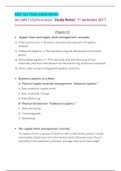
MGT 322 FINAL EXAM NOTES SEU-MGT 322/Final Exam “Study Notes ” 1st semester 2017 Chapter (1) • Supply chain and supply chain management concepts; 1) Total system cost >> Remains an important element of logistics analysis. 2) Outbound logistics >> The warehousing and distribution of finished goods. 3) Inbounding logistics >> The receiving and warehousing of raw materials, and their distribution to manufacturing as they are required. 4) Value chain analysis integrated logistics activities. • Business Logistics in a farm; A- Physical supply materials management “Inbound Logistics ” 1- Raw materials supply point. 2- Raw materials storage. 3- Manufacturing. B- Physical distribution “Outbound Logistics ” 1- Manufacturing. 2- Finished goods. 3- Marketing. • The supply chain management concept; “A supply chain is a group of partners who collectively convert a basic commodity (Upstream) into finished product (Downstream) that is valued by end-customers, and who manage returns at each stage ”. 2 • The definition of supply chain management; “Planning and controlling all the processes that link partners in supply chain together in order to serve needs of the end-customer ”. • The definition of logistics concept; “The task of coordinating materials flow and information flow across the supply chain ”. • What is the relationship between materials and information flow? “It is a cross -functional discipline that addresses management processes of plan, source, make, deliver and return. These processes are repeated across the supply chain to meet end customer needs ”. Simply , Material flow is to keep material flow to end-customer, and information flow is the end -customer demand information across supply chain. • Creating logistics advantages to meet target; Meeting end-customer demand through supplying what is needed in; 1- The form it is needed “Quality ”. 2- When it is needed “Time”. 3- At a competitive cost “Cost”. • Order winners and Order qualifiers; They have different logistics performance objectives, 1- Order Winners >> are factors that directly and significantly help products to win order in the marketplace. Customer regard such factors as key reasons for buying the product or services. 2- Order Qualifiers >> are factors that are regarded by the market as an “entry ticket ”. Unless the product or services meets basic performance standards, and it will not be taken seriously. 3 • How to achieving the strategic fit? By understanding the customer; 1- Lot size. 2- Response time. 3- Service level. 4- Product variety. 5- Price. 6- Innovation. • The drives of supply chain performance; A- Competitive Strategy = Drivers + Efficiency Vs. Responsiveness . B- Supply Chain Strategy and Structure “Drivers ” are; Drivers = Inventory + Transportation + Facility + Information • Consideration for Supply Chain Drivers; 1) Driver = Inventory + Effic ..Cost of holding Vs. Respon ..Availability. 2) Driver = Transportation + Effic ..Consolidation Vs. Respon ..Speed. 3) Driver = Facility + Effic ..Consolidation or Dedication Vs. Respon ..Proximity or Flexibility. 4) Driver = Information + What information is best suited for each objective. 4 Chap ter (2) • The Marketing Perspective Definition; Is a philosophy that integrates the disparate activities and functions that take a place within the network. Satisfied the end customers are seen as the only source of profit, growth and security. • The marketing perspective challenges; 1- Strong brand >> Increased sales and market shares. 2- Short lead time >> Increased Productivity. • The marketing perspective Two Pairs Concepts; 1 Business customer Vs. End Customer. - Usually refer to; A- Business customer who represent the focal firm’s immediate trading environment. B- End Customer who represent the ultimate customer for the network as a whole. 2 Consumer Vs, Customer. - Usually refer to; A- Consumers are people who use or consume the products. B- Customers are individuals or businesses who buy the products which means th at they acquire products and pay for it. • Marketing segmentation; - Market can be segmented in many ways such as; 1- Demographic >> age, gender, and education. 2- Geographic >> urban Vs. Country, types of house, region. 3- Technical >> the use that customers are going to make of a product. 4- Behavioral >> spending pattern, and frequency purchasing.
Preview 4 out of 41 pages
Exam (elaborations)
MGT 322 FINAL EXAM NOTES | VERIFIED GUIDE
Preview 4 out of 41 pages
MGT 322 FINAL EXAM NOTES
Content preview
Document information
- Uploaded on
- February 15, 2021
- Number of pages
- 41
- Written in
- 2020/2021
- Type
- Exam (elaborations)
- Contains
- Questions & answers
$12.99
Wrong document? Swap it for free
Within 14 days of purchase and before downloading, you can choose a different document. You can simply spend the amount again.
Written by students who passed
Immediately available after payment
Read online or as PDF

Reputation scores are based on the amount of documents a seller has sold for a fee and the reviews they have received for those documents. There are three levels: Bronze, Silver and Gold. The better the reputation, the more your can rely on the quality of the sellers work.

