

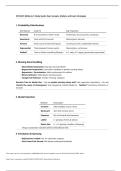
ISYE 6501 Midterm 2 Study Guide: Key Concepts, Models, and Exam Strategies
1. Probability Distributions
Distribution Used For Key Properties
Binomial # of successes in fixed n trials Fixed trials, two outcomes, constant p
Geometric Trials until first success Memoryless, discrete
Poisson Event count in fixed time/space Continuous time, independent events
Exponential Time between Poisson events Memoryless, continuous
Weibull Time to failure (modeling lifespan) k<1 early, k>1 aging, generalizes exponential
2. Missing Data Handling
• Mean/Mode Imputation: Easy but assumes MCAR.
• Regression Imputation: Uses other variables to predict missing values.
• Regression + Perturbation: Adds randomness for realism.
• Binary Indicator: Adds flag for missing values.
• Categorical Indicator: Creates 'missing' category.
Decision Tree for Model Use: - Can we predict missing values well? Use regression imputation. - Can we
classify the cause of missingness? Use categorical models (Model 5). - Neither? Use binary indicators or
exclude.
3. Model Selection
Method Description
Forward Add variables one at a time
Backward Start full, remove worst
Stepwise Mix of forward and backward
LASSO L1 penalty, shrinks & selects
Elastic Net L1 + L2 penalty, handles collinearity
Always standardize variables before LASSO/Elastic Net.
4. Simulation & Queuing
• Replications needed: Yes, for stochastic outputs.
• First-Come-First-Served: Not always used (priority-based).
1
This study source was downloaded by 100000900412927 from CourseHero.com on 12-08-2025 09:56:58 GMT -06:00
https://www.coursehero.com/file/250482435/ISYE-6501-Exam-Study-Guidedocx/
1. Probability Distributions
Distribution Used For Key Properties
Binomial # of successes in fixed n trials Fixed trials, two outcomes, constant p
Geometric Trials until first success Memoryless, discrete
Poisson Event count in fixed time/space Continuous time, independent events
Exponential Time between Poisson events Memoryless, continuous
Weibull Time to failure (modeling lifespan) k<1 early, k>1 aging, generalizes exponential
2. Missing Data Handling
• Mean/Mode Imputation: Easy but assumes MCAR.
• Regression Imputation: Uses other variables to predict missing values.
• Regression + Perturbation: Adds randomness for realism.
• Binary Indicator: Adds flag for missing values.
• Categorical Indicator: Creates 'missing' category.
Decision Tree for Model Use: - Can we predict missing values well? Use regression imputation. - Can we
classify the cause of missingness? Use categorical models (Model 5). - Neither? Use binary indicators or
exclude.
3. Model Selection
Method Description
Forward Add variables one at a time
Backward Start full, remove worst
Stepwise Mix of forward and backward
LASSO L1 penalty, shrinks & selects
Elastic Net L1 + L2 penalty, handles collinearity
Always standardize variables before LASSO/Elastic Net.
4. Simulation & Queuing
• Replications needed: Yes, for stochastic outputs.
• First-Come-First-Served: Not always used (priority-based).
1
This study source was downloaded by 100000900412927 from CourseHero.com on 12-08-2025 09:56:58 GMT -06:00
https://www.coursehero.com/file/250482435/ISYE-6501-Exam-Study-Guidedocx/

