BSNC 1000 Module 2 Questions and Answers
Save
Terms in this set (26)
1. Decreasing health and physical strength
2. Retirement = reduced/fixed income
3. Death of a spouse
7 developmental tasks for
4. Accepting the aging process
older adults:
5. Satisfactory living arrangements
6. Relationships with adult children
7. Maintain quality of life
Prenatal factors
Birth factors
Individual factors
Additional Risk factors of Family factors
Growth and Development Situational factors
Determinants of health
Toxic stress
Health status
basic self-care tasks such as eating, bathing, toileting,
ADL's
walking, and dressing
Nurse explains to the wife of a 42-year-old client with
cognitive (Domain) head trauma why he no longer has the ability to
calculate math
Nurse observes the middle-aged client interacting
with their peers discussing the political landscape.
Communication (Domain)
Despite conflicting views, the participant is not raising
their voice
, Growth and development takes place throughout the
lifespan and are progressive and typically predictable.
Traditional stages of growth and development have
been identified according to age group: embryologic,
Describe the scope of
infant, toddler, preschool, school age, adolescent,
Growth & Development
young adult, adult, middle age, and older adult. The
extent to which growth and development influences a
person is classified as expected, delayed, or
advanced development within traditional stages.
qualitative: difficult to measure in exact units; change
from simple to complex = refinement
Development
Maturation allows for the emergence of persona,
behavioral, or adult-like features
1. Trust vs. Mistrust (0-1)
2. Autonomy vs. Shame and doubt (1-3)
3. Initiative vs. Guilt (3-6)
Erikson's 8 stages of 4. Industry vs. Inferiority (6-11)
development 5. Identity vs. Role Confusion (12-18)
6. Intimacy vs. Isolation (18-35)
7. Generativity vs. Self-absorption (36-65)
8. Integrity vs. despair (65+)
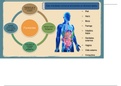
Feel
Observe
Connect
FOCUS Model Understand
Share
Energize
Disconnect
Save
Terms in this set (26)
1. Decreasing health and physical strength
2. Retirement = reduced/fixed income
3. Death of a spouse
7 developmental tasks for
4. Accepting the aging process
older adults:
5. Satisfactory living arrangements
6. Relationships with adult children
7. Maintain quality of life
Prenatal factors
Birth factors
Individual factors
Additional Risk factors of Family factors
Growth and Development Situational factors
Determinants of health
Toxic stress
Health status
basic self-care tasks such as eating, bathing, toileting,
ADL's
walking, and dressing
Nurse explains to the wife of a 42-year-old client with
cognitive (Domain) head trauma why he no longer has the ability to
calculate math
Nurse observes the middle-aged client interacting
with their peers discussing the political landscape.
Communication (Domain)
Despite conflicting views, the participant is not raising
their voice
, Growth and development takes place throughout the
lifespan and are progressive and typically predictable.
Traditional stages of growth and development have
been identified according to age group: embryologic,
Describe the scope of
infant, toddler, preschool, school age, adolescent,
Growth & Development
young adult, adult, middle age, and older adult. The
extent to which growth and development influences a
person is classified as expected, delayed, or
advanced development within traditional stages.
qualitative: difficult to measure in exact units; change
from simple to complex = refinement
Development
Maturation allows for the emergence of persona,
behavioral, or adult-like features
1. Trust vs. Mistrust (0-1)
2. Autonomy vs. Shame and doubt (1-3)
3. Initiative vs. Guilt (3-6)
Erikson's 8 stages of 4. Industry vs. Inferiority (6-11)
development 5. Identity vs. Role Confusion (12-18)
6. Intimacy vs. Isolation (18-35)
7. Generativity vs. Self-absorption (36-65)
8. Integrity vs. despair (65+)
Feel
Observe
Connect
FOCUS Model Understand
Share
Energize
Disconnect