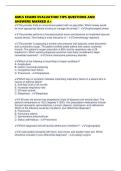
AORN Exam Questions and Answers 100% Solved
Save
Terms in this set (136)
Which professionals are D. operating surgeon
NOT qualified to provide
anesthesia care to the
patient?
A. anesthesiologists
B. CRNA
C. Perioperative nurses
D. The operating surgeon
identify the factors you AC D
would take into
consideration before
determining what
anesthetic to use for a
particular patient:
a. age of the patient
b. sex
c. physiological status of
the patient
d. surgeon's preference
the response to anesthesia depends on the
Protein Receptor Theory
occupation of a critical number of receptor sites
the potency of the anesthetic depends upon its lipid
Meyer-Overton Theory
solubility
, Endogenous Endorphins anesthetics work through opiate-like substances that
Theory suppress various pain pathways
a precise way of looking Phase 1: induction
at general anesthesia is to phase 2: maintenance
divide it into 3 phases: phase 3: emergence
judy is a patient about to Stage 1: induction
undergo sugery. she was Phase 1: initial administration
given anesthesia a few
minuates ago and is
beginning to feel its
effects. what stage and
phase of anesthesia is she
in?
stage 1: initial administration
stage 2: excitement
Stages of Anesthesia
stage 3: intrasurgery
stage 4: possible respiratory failure
intravenous induction of carried out by the action of short-acting drugs that
general anesthesia when are continuously infused throughout the surgery; is
administrating total carried out using drugs such as thiopental and
intravenous anesthesia propofol
what type of anesthesia epidural
involves an injection into
the space between the
ligamentum flavum and
the dura?
what is NOT a local c
anesthetic drug used for
regional anesthesia?
a. bupivicaine
b. lidocaine
c. fentanyl
d. tetracaine
Save
Terms in this set (136)
Which professionals are D. operating surgeon
NOT qualified to provide
anesthesia care to the
patient?
A. anesthesiologists
B. CRNA
C. Perioperative nurses
D. The operating surgeon
identify the factors you AC D
would take into
consideration before
determining what
anesthetic to use for a
particular patient:
a. age of the patient
b. sex
c. physiological status of
the patient
d. surgeon's preference
the response to anesthesia depends on the
Protein Receptor Theory
occupation of a critical number of receptor sites
the potency of the anesthetic depends upon its lipid
Meyer-Overton Theory
solubility
, Endogenous Endorphins anesthetics work through opiate-like substances that
Theory suppress various pain pathways
a precise way of looking Phase 1: induction
at general anesthesia is to phase 2: maintenance
divide it into 3 phases: phase 3: emergence
judy is a patient about to Stage 1: induction
undergo sugery. she was Phase 1: initial administration
given anesthesia a few
minuates ago and is
beginning to feel its
effects. what stage and
phase of anesthesia is she
in?
stage 1: initial administration
stage 2: excitement
Stages of Anesthesia
stage 3: intrasurgery
stage 4: possible respiratory failure
intravenous induction of carried out by the action of short-acting drugs that
general anesthesia when are continuously infused throughout the surgery; is
administrating total carried out using drugs such as thiopental and
intravenous anesthesia propofol
what type of anesthesia epidural
involves an injection into
the space between the
ligamentum flavum and
the dura?
what is NOT a local c
anesthetic drug used for
regional anesthesia?
a. bupivicaine
b. lidocaine
c. fentanyl
d. tetracaine