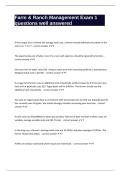
Farm & Ranch Management Exam 1
questions well answered
If the output price is below the average total cost, a farmer should definitely shut down in the
short run. T or F? - correct answer ✔✔F
The opportunity cost of labor, since it's a non-cash expense, should be ignored by farmers. -
correct answer ✔✔F
One acre-inch of water costs $20. Using an extra acre-inch increasing yields by 2 bushels/acre.
Marginal Input Cost is $10.00. - correct answer ✔✔F
If a sugar beet farmer uses an additional unit of pesticide, yields increase by 0.5 tons per acre.
Each unit of pesticide costs $25. Sugar beets sell for $40/ton. The farmer should use the
additional unit of pesticide. - correct answer ✔✔F
You own an organic goat dairy in an industry with increasing costs as herd size expands past 50.
You currently own 50 goats. You should strongly consider increasing your herd size. - correct
answer ✔✔F
If total costs are $50,0000/acre when you produce 700 cwt of beef and half of those costs are
variable, average variable costs are $35.71/cwt. - correct answer ✔✔T
In the long-run, a farmer's average total costs are $3.20/bu and price averages $3.00/bu. The
farmer should shut down. - correct answer ✔✔T
Profits are always maximized where inputs are minimized. - correct answer ✔✔F
, For soybeans, marginal revenue measures the change in total revenue from producing 1 more
bushel. - correct answer ✔✔T
Depreciation is an example of a noncash expense while taxes are an example of a cash expense.
- correct answer ✔✔T
In the long run, all costs are variable. - correct answer ✔✔T
When a farmer uses one more unit of an input, output rises from 140 to 146 bu/acre. Selling
price is $3.00 per bushel. The input costs $15.00 per unit. Marginal Value Product is
6
$3.00
$18.00
$60.00 - correct answer ✔✔$18
For a soybean farmer, average total cost means
A. The cost to use another input
B. The price received for selling 1 bushel of soybeans
C. The cost to produce 1 bushel of soybeans
questions well answered
If the output price is below the average total cost, a farmer should definitely shut down in the
short run. T or F? - correct answer ✔✔F
The opportunity cost of labor, since it's a non-cash expense, should be ignored by farmers. -
correct answer ✔✔F
One acre-inch of water costs $20. Using an extra acre-inch increasing yields by 2 bushels/acre.
Marginal Input Cost is $10.00. - correct answer ✔✔F
If a sugar beet farmer uses an additional unit of pesticide, yields increase by 0.5 tons per acre.
Each unit of pesticide costs $25. Sugar beets sell for $40/ton. The farmer should use the
additional unit of pesticide. - correct answer ✔✔F
You own an organic goat dairy in an industry with increasing costs as herd size expands past 50.
You currently own 50 goats. You should strongly consider increasing your herd size. - correct
answer ✔✔F
If total costs are $50,0000/acre when you produce 700 cwt of beef and half of those costs are
variable, average variable costs are $35.71/cwt. - correct answer ✔✔T
In the long-run, a farmer's average total costs are $3.20/bu and price averages $3.00/bu. The
farmer should shut down. - correct answer ✔✔T
Profits are always maximized where inputs are minimized. - correct answer ✔✔F
, For soybeans, marginal revenue measures the change in total revenue from producing 1 more
bushel. - correct answer ✔✔T
Depreciation is an example of a noncash expense while taxes are an example of a cash expense.
- correct answer ✔✔T
In the long run, all costs are variable. - correct answer ✔✔T
When a farmer uses one more unit of an input, output rises from 140 to 146 bu/acre. Selling
price is $3.00 per bushel. The input costs $15.00 per unit. Marginal Value Product is
6
$3.00
$18.00
$60.00 - correct answer ✔✔$18
For a soybean farmer, average total cost means
A. The cost to use another input
B. The price received for selling 1 bushel of soybeans
C. The cost to produce 1 bushel of soybeans