Med Surg III: Exam 3 Neuro - Understanding Shock and Related Conditions (Complete Solutions)
Module 5 – Neurologic, ch.
Intracranial pressure
- What is normal ICP?
o 0 – 15
- What are the causes of increased ICP?
o Hydrocephalus (increases CSF)
o Infection
o Trauma/injury
o HTN, tumor
- What are s/s of increased ICP?
o Changes in LOC (1st sign)
o Vomiting
o Headache *
o Seizures
o Posturing
o VS changes (late sign)
o Cushing’s Triad
- What is Cushing’s Triad?
o Increased BP w/ widening pulse pressure
o Bradycardia
o Irregular respirations.
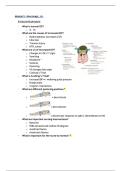
- What are different posturing positions *
o = decorticate
o = decerebrate
o = decorticate response on right C decerebrate on left
- What are important nursing interventions?
o Mannitol
o HOB elevated and midline 30 degrees
o Avoid hip flexion
o Avoid neck flexion
- What is important for the nurse to monitor? *
Med Surg III: Exam 3 Neuro - Understanding Shock and Related Conditions (Complete Solutions)
, Med Surg III: Exam 3 Neuro - Understanding Shock and Related Conditions (Complete Solutions)
o Neuro assessment
o EVD for monitoring ICP
o Monitoring GCS
- What are s/s of herniation?
o Posturing (late sign)
o Bradycardia
o Positive Babinski reflex
o Unilateral dilated pupil
o Increased systolic pressure
Medications
- Increased ICP = mannitol
- Ischemic stroke = rt-PA
- Intubation = pain med, paralytic, sedative
- Brain tumors = glucocorticoids, stool softeners, antiepileptics, VTE prophylaxis
- Contraindication in hemorrhagic stroke = thrombolytics, antiplatelets,
anticoagulants, and any blood thinners.
- TPA contraindications = recent surgery, aspirin, blood thinners.
- Anaphylactic shock = epinephrine (sympathomimetic)
Stroke / TPA
- What are the two kinds of strokes?
o Ischemic
o Hemorrhagic
o
- What is a common s/s w/ stroke? *
o Hemianopia is when there is vision loss on the same side of the visual field
where the stroke occurred causing the patient to turn head to see.
- What diagnostic is used when a patient has a suspected stroke? *
o CT, to rule out if it is ischemic or hemorrhagic, then MRI can be done later.
Ischemic
- Why does ischemic stroke occur?
o Reduced blood supply
Med Surg III: Exam 3 Neuro - Understanding Shock and Related Conditions (Complete Solutions)
Module 5 – Neurologic, ch.
Intracranial pressure
- What is normal ICP?
o 0 – 15
- What are the causes of increased ICP?
o Hydrocephalus (increases CSF)
o Infection
o Trauma/injury
o HTN, tumor
- What are s/s of increased ICP?
o Changes in LOC (1st sign)
o Vomiting
o Headache *
o Seizures
o Posturing
o VS changes (late sign)
o Cushing’s Triad
- What is Cushing’s Triad?
o Increased BP w/ widening pulse pressure
o Bradycardia
o Irregular respirations.
- What are different posturing positions *
o = decorticate
o = decerebrate
o = decorticate response on right C decerebrate on left
- What are important nursing interventions?
o Mannitol
o HOB elevated and midline 30 degrees
o Avoid hip flexion
o Avoid neck flexion
- What is important for the nurse to monitor? *
Med Surg III: Exam 3 Neuro - Understanding Shock and Related Conditions (Complete Solutions)
, Med Surg III: Exam 3 Neuro - Understanding Shock and Related Conditions (Complete Solutions)
o Neuro assessment
o EVD for monitoring ICP
o Monitoring GCS
- What are s/s of herniation?
o Posturing (late sign)
o Bradycardia
o Positive Babinski reflex
o Unilateral dilated pupil
o Increased systolic pressure
Medications
- Increased ICP = mannitol
- Ischemic stroke = rt-PA
- Intubation = pain med, paralytic, sedative
- Brain tumors = glucocorticoids, stool softeners, antiepileptics, VTE prophylaxis
- Contraindication in hemorrhagic stroke = thrombolytics, antiplatelets,
anticoagulants, and any blood thinners.
- TPA contraindications = recent surgery, aspirin, blood thinners.
- Anaphylactic shock = epinephrine (sympathomimetic)
Stroke / TPA
- What are the two kinds of strokes?
o Ischemic
o Hemorrhagic
o
- What is a common s/s w/ stroke? *
o Hemianopia is when there is vision loss on the same side of the visual field
where the stroke occurred causing the patient to turn head to see.
- What diagnostic is used when a patient has a suspected stroke? *
o CT, to rule out if it is ischemic or hemorrhagic, then MRI can be done later.
Ischemic
- Why does ischemic stroke occur?
o Reduced blood supply
Med Surg III: Exam 3 Neuro - Understanding Shock and Related Conditions (Complete Solutions)