Med Surg III: Exam 4 Study Guide on Burns & Environmental Injuries with Complete Solutions
Med Surg III: Exam 4 Study Guide on Burns & Environmental
Injuries with Complete Solutions
Med Surg III: Exam 4 Study Guide
Module 8: Burns & Environmental Injuries
CHAPTER 51
Know your phases of burns – Emergent phase vs Intermediate Interventions and Primary vs
Secondary Interventions
• Know what problems occur during the fluid shift in the emergent phase--> hyperkalemia,
hyponatremia, metabolic acidosis
• Circumferential burns-occur in arms, legs, trunk (thorax) – experiencing compartment
syndrome = need escharotomy to restore pulmonary function.
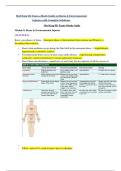
• Know Burn classifications- superficial, etc and study the descriptions of all the classes of
burns (be able to identify) full-thickness burn may involve subq fat. Interventions for
deep partial thickness = give fluid and electrolytes. Superficial partial thickness burns are
deep pink and blisters. Know them all!!!
•
• TBSA- rule of 9’s, need to know how to calculate
Med Surg III: Exam 4 Study Guide on Burns & Environmental Injuries with Complete Solutions
, Med Surg III: Exam 4 Study Guide on Burns & Environmental Injuries with Complete Solutions
Interventions
• Burns- Fluid resuscitation 30 mL/kg, first half given in 8 hours, the rest given in the last
16 hours
• Ensure IV access- at least two large bore IVs
• Burn Injuries- worried about airway, singed hairs, soot in sputum, stridor, change in
voice are concerning = inhalation injury = priority
• Need to know about grafts! Autograft (from own skin), Allograft (high chance of
rejection eventually)
• Scattered areas of scarring- patient is not compliant with compression garments
• Burn patients need placement of a feeding tube (long-term nutritional support)
• Circumferential burn to the thorax affects the ability to breathe--> treatment is
escharotomy (removal of black tissue)
• Compartment syndrome- 6's Pain, Pressure, Paresthesia, Paralysis, Pulselessness,
Poikilothermia (poor
• temperature regulation) --> can happen in the abdomen as well and require placement of
NG tubes for decompression
• Review NG tubes- how do you know it's working? No gastric distension
• SIRS- looks like sepsis but is not sepsis, it precedes it
• Know complications associated with burn recovery associated with rehabilitative phase--
> depression, altered self image, anxiety, scattered areas of scarring
Burn Center Referral
Anatomical location of the burns, qualifiers for going to burn centers – face, hands, feet,
genitalia, perineum, major joints
CHAPTER 69
Snake Bite
Rattlesnakes
• Concerning clinical manifestations (petechial rash)
• Management and interventions following a bite
• Administer antivenom, cardiac monitoring, administration of IV fluids (need IV access)
• Take off any restrictive clothing or jewelry or anything else
• Immobilize the extremity and place below the heart
• No turniquet, no alcohol, no ice
• Monitor coagulant studies
Spider Bite
Med Surg III: Exam 4 Study Guide on Burns & Environmental Injuries with Complete Solutions
Med Surg III: Exam 4 Study Guide on Burns & Environmental
Injuries with Complete Solutions
Med Surg III: Exam 4 Study Guide
Module 8: Burns & Environmental Injuries
CHAPTER 51
Know your phases of burns – Emergent phase vs Intermediate Interventions and Primary vs
Secondary Interventions
• Know what problems occur during the fluid shift in the emergent phase--> hyperkalemia,
hyponatremia, metabolic acidosis
• Circumferential burns-occur in arms, legs, trunk (thorax) – experiencing compartment
syndrome = need escharotomy to restore pulmonary function.
• Know Burn classifications- superficial, etc and study the descriptions of all the classes of
burns (be able to identify) full-thickness burn may involve subq fat. Interventions for
deep partial thickness = give fluid and electrolytes. Superficial partial thickness burns are
deep pink and blisters. Know them all!!!
•
• TBSA- rule of 9’s, need to know how to calculate
Med Surg III: Exam 4 Study Guide on Burns & Environmental Injuries with Complete Solutions
, Med Surg III: Exam 4 Study Guide on Burns & Environmental Injuries with Complete Solutions
Interventions
• Burns- Fluid resuscitation 30 mL/kg, first half given in 8 hours, the rest given in the last
16 hours
• Ensure IV access- at least two large bore IVs
• Burn Injuries- worried about airway, singed hairs, soot in sputum, stridor, change in
voice are concerning = inhalation injury = priority
• Need to know about grafts! Autograft (from own skin), Allograft (high chance of
rejection eventually)
• Scattered areas of scarring- patient is not compliant with compression garments
• Burn patients need placement of a feeding tube (long-term nutritional support)
• Circumferential burn to the thorax affects the ability to breathe--> treatment is
escharotomy (removal of black tissue)
• Compartment syndrome- 6's Pain, Pressure, Paresthesia, Paralysis, Pulselessness,
Poikilothermia (poor
• temperature regulation) --> can happen in the abdomen as well and require placement of
NG tubes for decompression
• Review NG tubes- how do you know it's working? No gastric distension
• SIRS- looks like sepsis but is not sepsis, it precedes it
• Know complications associated with burn recovery associated with rehabilitative phase--
> depression, altered self image, anxiety, scattered areas of scarring
Burn Center Referral
Anatomical location of the burns, qualifiers for going to burn centers – face, hands, feet,
genitalia, perineum, major joints
CHAPTER 69
Snake Bite
Rattlesnakes
• Concerning clinical manifestations (petechial rash)
• Management and interventions following a bite
• Administer antivenom, cardiac monitoring, administration of IV fluids (need IV access)
• Take off any restrictive clothing or jewelry or anything else
• Immobilize the extremity and place below the heart
• No turniquet, no alcohol, no ice
• Monitor coagulant studies
Spider Bite
Med Surg III: Exam 4 Study Guide on Burns & Environmental Injuries with Complete Solutions