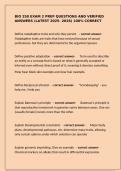
BIO 250 EXAM 2 PREP QUESTIONS AND VERIFIED
ANSWERS (LATEST 2025- 2026) 100% CORRECT
Define maladaptive traits and why they persist. - correct answer-
Maladaptive traits are traits that have evolved because of sexual
preferences, but they are detrimental to the organism/species
Define putative adaptation - correct answer- Term used to describe
an entity or a concept that is based on what is generally accepted or
inferred even without direct proof of it, meaning it denotes something
Polar bear black skin example and clear hair example.
Define Reciprocal altruism - correct answer- "Scorekeeping" - you
help me, I help you
Explain Bateman's principle - correct answer- Bateman's principle is
that reproductive investment in gametes varies between sexes. One sex
(usually female) invests more than the other.
Explain Developmental constraints - correct answer- Major body
plans, developmental pathways, etc. determine many traits, allowing
only certain options under which selection can operate
Explain genomic imprinting. Give an example - correct answer-
Chemical markers on alleles that result in differential expression.
,Male: increase cell division
Ex: Insulin-like growth factor II- Male IGF II is widely expressed in male
mice, while almost completely turned off in females.
Female: turn gene off to conserve resources, bind excess hormone.
Explain Kin Selection - correct answer- Kin selection is the idea that
you will help in the reproductive success of your siblings or other family
because that passes on some of your genes as well.
ex: ground squirrels- related females and unrelated males make up a
colony, the females are the ones who trill or whistle in danger because it
is better if they die, rather than the males
Explain Muller's Ratchet - correct answer- When there are
dangerous or deletious mutations, asexual populations cannot get rid of
it, it simply proliferates/becomes more frequent throughout the
population
Explain Phylogenetic constraints - correct answer- Each species,
population, individual inherits a 'history'.
Limitations on future evolutionary pathways that have been imposed by
previous adaptations.
Explain the energetic/metabolic tradeoffs in life history evolution. Give
examples. - correct answer- Species only have so much energy, and
it can only be successfully dedicated to so many things
, Individuals that start reproducing earlier will generally be smaller (once
you start to reproduce, you stop putting energy to growing)
Number of children in each 'clutch'
Explain the evolution of the sex ratio - correct answer- Females are
more likely to pass on genes, but cost more to produce. Males don't
always pass on genes, but cost less to produce.
Explain the Maynard Smith Model - correct answer- With sexual
reproduction, you pass on fewer genes (only half goes to offspring) and
often create fewer offspring
Explain the problem with sex that still remains - correct answer- It
doesn't act quickly enough in an evolutionary context: you can produce
so many more offspring through asexual reproduction that asexual
should be selected for
Explain the two hypotheses of human menopause - correct answer-
Artifact Hypothesis: Proposes that historically few individuals lived
beyond 40-50 years of age so there is no selection for extended
reproductive lifespan.
Grandmother Hypothesis: Post-menopausal women (grandmothers)
help raise offspring thus resulting in higher inclusive fitness through
grandchildren.
ANSWERS (LATEST 2025- 2026) 100% CORRECT
Define maladaptive traits and why they persist. - correct answer-
Maladaptive traits are traits that have evolved because of sexual
preferences, but they are detrimental to the organism/species
Define putative adaptation - correct answer- Term used to describe
an entity or a concept that is based on what is generally accepted or
inferred even without direct proof of it, meaning it denotes something
Polar bear black skin example and clear hair example.
Define Reciprocal altruism - correct answer- "Scorekeeping" - you
help me, I help you
Explain Bateman's principle - correct answer- Bateman's principle is
that reproductive investment in gametes varies between sexes. One sex
(usually female) invests more than the other.
Explain Developmental constraints - correct answer- Major body
plans, developmental pathways, etc. determine many traits, allowing
only certain options under which selection can operate
Explain genomic imprinting. Give an example - correct answer-
Chemical markers on alleles that result in differential expression.
,Male: increase cell division
Ex: Insulin-like growth factor II- Male IGF II is widely expressed in male
mice, while almost completely turned off in females.
Female: turn gene off to conserve resources, bind excess hormone.
Explain Kin Selection - correct answer- Kin selection is the idea that
you will help in the reproductive success of your siblings or other family
because that passes on some of your genes as well.
ex: ground squirrels- related females and unrelated males make up a
colony, the females are the ones who trill or whistle in danger because it
is better if they die, rather than the males
Explain Muller's Ratchet - correct answer- When there are
dangerous or deletious mutations, asexual populations cannot get rid of
it, it simply proliferates/becomes more frequent throughout the
population
Explain Phylogenetic constraints - correct answer- Each species,
population, individual inherits a 'history'.
Limitations on future evolutionary pathways that have been imposed by
previous adaptations.
Explain the energetic/metabolic tradeoffs in life history evolution. Give
examples. - correct answer- Species only have so much energy, and
it can only be successfully dedicated to so many things
, Individuals that start reproducing earlier will generally be smaller (once
you start to reproduce, you stop putting energy to growing)
Number of children in each 'clutch'
Explain the evolution of the sex ratio - correct answer- Females are
more likely to pass on genes, but cost more to produce. Males don't
always pass on genes, but cost less to produce.
Explain the Maynard Smith Model - correct answer- With sexual
reproduction, you pass on fewer genes (only half goes to offspring) and
often create fewer offspring
Explain the problem with sex that still remains - correct answer- It
doesn't act quickly enough in an evolutionary context: you can produce
so many more offspring through asexual reproduction that asexual
should be selected for
Explain the two hypotheses of human menopause - correct answer-
Artifact Hypothesis: Proposes that historically few individuals lived
beyond 40-50 years of age so there is no selection for extended
reproductive lifespan.
Grandmother Hypothesis: Post-menopausal women (grandmothers)
help raise offspring thus resulting in higher inclusive fitness through
grandchildren.