

ENZYMES
Enzymes are biological catalysts which are unchanged throughout a
reaction. They are proteins produced by organisms to increase the rate of
biochemical reactions.
The general mechanism of enzyme action is that the substrate goes into
the active site and complementary groups bind to each other to form an
enzyme substrate complex.
The enzyme and substrate have complementary structures and the
enzymes active site is specific to that substrate.
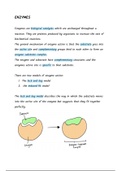
There are two models of enzyme action:
1. The lock and key model
2. the induced fit model
The lock and key model describes the way in which the substrate moves
into the active site of the enzyme but suggests that they fit together
perfectly.
, The induced fit model is slightly more advanced and describes the way in
which the complementary groups in the substrate bind with groups in the
active site to change the structure of the enzyme and make the substrate
bind more tightly.
Intermolecular forces between the substrate molecule and the active site
of the enzyme cause a conformational change in the enzyme which makes
the substrate bind more tightly. This occurs because enzymes are proteins
and changes in the active site lead to the tertiary structure being altered,
so the 3D shape changes. The enzyme- substrate complex is also known
as a transition state as it occurs during the reaction, before the products
are released.
FACTORS AFFECTING THE RATE OF ENZYME REACTIONS
● Enzyme concentration- Increasing enzyme concentration increases
the rate up to a point. At this point, substrate concentration
becomes the limiting factor because there will be more enzyme
molecules than substrate molecules so increasing the concentration
of the enzyme will not increase the rate after this point
Enzymes are biological catalysts which are unchanged throughout a
reaction. They are proteins produced by organisms to increase the rate of
biochemical reactions.
The general mechanism of enzyme action is that the substrate goes into
the active site and complementary groups bind to each other to form an
enzyme substrate complex.
The enzyme and substrate have complementary structures and the
enzymes active site is specific to that substrate.
There are two models of enzyme action:
1. The lock and key model
2. the induced fit model
The lock and key model describes the way in which the substrate moves
into the active site of the enzyme but suggests that they fit together
perfectly.
, The induced fit model is slightly more advanced and describes the way in
which the complementary groups in the substrate bind with groups in the
active site to change the structure of the enzyme and make the substrate
bind more tightly.
Intermolecular forces between the substrate molecule and the active site
of the enzyme cause a conformational change in the enzyme which makes
the substrate bind more tightly. This occurs because enzymes are proteins
and changes in the active site lead to the tertiary structure being altered,
so the 3D shape changes. The enzyme- substrate complex is also known
as a transition state as it occurs during the reaction, before the products
are released.
FACTORS AFFECTING THE RATE OF ENZYME REACTIONS
● Enzyme concentration- Increasing enzyme concentration increases
the rate up to a point. At this point, substrate concentration
becomes the limiting factor because there will be more enzyme
molecules than substrate molecules so increasing the concentration
of the enzyme will not increase the rate after this point


