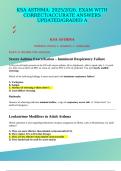
KSA ASTHMA: 2025/2026, EXAM WITH
CORRECT/ACCURATE ANSWERS
UPDATED/GRADED A
KSA ASTHMA
Multiple choice + answers + rationales
Exam is divided into sections
Severe Asthma Exacerbation – Imminent Respiratory Failure
A 28-year-old male presents to the ED with severe asthma. He is diaphoretic, able to speak only 1–2 words
at a time, has an SpO₂ of 88% on room air, and his PEF is 15% of predicted. You note barely audible
wheezing.
Which of the following findings is most associated with imminent respiratory failure?
A. Tachypnea
B. Fatigue
C. Absence of wheezing (“silent chest”) ✔️
D. Loud diffuse wheezing
Rationale:
Absence of wheezing indicates minimal airflow, a sign of respiratory arrest risk. A “silent chest” is a
medical emergency.
Leukotriene Modifiers in Adult Asthma
Which statement is true regarding leukotriene receptor antagonists (LTRAs), such as Montelukast, for adult
asthma?
A. They are more effective than inhaled corticosteroids (ICS)
B. They replace ICS as first-line therapy
C. They are less effective than inhaled corticosteroids ✔️
D. They should only be used for acute attacks
,Rationale:
LTRAs have some benefit but are inferior to ICS for controlling persistent asthma. They are usually add-on
therapy.
Viral-Induced Asthma in a 5-Year-Old
A 5-year-old child wheezes only during viral infections. What is the recommended treatment?
A. Daily ICS therapy
B. LABA monotherapy
C. SABA as needed ✔️
D. Oral corticosteroids daily
Rationale:
Children with intermittent viral-triggered wheezing use short-acting bronchodilators (SABA) PRN.
Moderate Persistent Asthma — Post-Bronchodilator FEV₁ 68%
An 18-year-old female has the following spirometry values:
FEV₁ = 68% predicted
PEF = 70% predicted
FEV₁/FVC = 69%
after bronchodilator therapy.
What is the best next treatment?
A. SABA PRN only
B. Montelukast alone
C. Fluticasone/Salmeterol (Advair) ✔️
D. Oral prednisone long-term
Rationale:
FEV₁ < 70% = moderate persistent asthma, requiring combination ICS/LABA therapy.
No Response to Albuterol in Viral-Triggered Exacerbation
,A 20-year-old female with an asthma flare receives albuterol in the ED but has no improvement. She
already uses ICS/LABA and Montelukast at home.
Which reliever medication should be added?
A. Tiotropium
B. Ipratropium Bromide ✔️
C. Antihistamines
D. Theophylline
Rationale:
Ipratropium is recommended during moderate to severe exacerbations when SABA alone is inadequate.
Long-Term ICS Use in Children
Which statement is true regarding long-term use of inhaled corticosteroids (ICS) in children?
A. ICS cause permanent large height loss
B. ICS lead to a permanent decrease in PEF
C. ICS may slightly slow growth velocity but do not reduce final adult height ✔️
D. ICS should never be used long-term
Rationale:
ICS may slow early growth by ~1 cm but do not harm final height.
They do not cause permanent PEF reduction.
Early-Morning Asthma Symptoms Triggered Seasonally
A 29-year-old male on Budesonide reports worsening symptoms in the early morning during a particular
season.
Which trigger is most likely?
A. Mold spores
B. Dust mites
C. Tree pollen ✔️
D. Pet dander
Rationale:
Tree pollen peaks seasonally (especially spring) and commonly causes early-morning asthma symptoms.
, Exercise-Induced Bronchoconstriction — Identifying Mild Asthma
A 10-year-old girl has baseline FEV₁ 84% predicted. One month after exercise training, which value
indicates mild asthma?
A. FEV₁ ≥ 90% predicted
B. FEV₁ 85–90% predicted
C. FEV₁ < 80% predicted ✔️
D. FEV₁ < 50% predicted
Rationale:
An FEV₁ drop to < 80% predicted is diagnostic for asthma, including mild persistent asthma.
New Medication Causing Worsened Cough & Night Symptoms
A 35-year-old woman with asthma has worsening cough and new nighttime awakenings after starting an
add-on medication.
Which medication most likely caused these symptoms?
A. Tiotropium
B. Fluticasone
C. Montelukast (Singulair) ✔️
D. Salmeterol
Rationale:
Montelukast is known for neuropsychiatric side effects, including sleep disturbance, agitation, and
worsening cough.
Section 1: Diagnosis & Classification (SINA Guidelines)
Q1. A 25-year-old male presents to the clinic with a 3-month history of shortness of breath and
wheezing, particularly at night. He has no other medical history. Spirometry shows an FEV1/FVC
ratio of 0.65. Which of the following post-bronchodilator findings would confirm a diagnosis of
asthma?
A. Increase in FEV1 of >12% and >200 mL
CORRECT/ACCURATE ANSWERS
UPDATED/GRADED A
KSA ASTHMA
Multiple choice + answers + rationales
Exam is divided into sections
Severe Asthma Exacerbation – Imminent Respiratory Failure
A 28-year-old male presents to the ED with severe asthma. He is diaphoretic, able to speak only 1–2 words
at a time, has an SpO₂ of 88% on room air, and his PEF is 15% of predicted. You note barely audible
wheezing.
Which of the following findings is most associated with imminent respiratory failure?
A. Tachypnea
B. Fatigue
C. Absence of wheezing (“silent chest”) ✔️
D. Loud diffuse wheezing
Rationale:
Absence of wheezing indicates minimal airflow, a sign of respiratory arrest risk. A “silent chest” is a
medical emergency.
Leukotriene Modifiers in Adult Asthma
Which statement is true regarding leukotriene receptor antagonists (LTRAs), such as Montelukast, for adult
asthma?
A. They are more effective than inhaled corticosteroids (ICS)
B. They replace ICS as first-line therapy
C. They are less effective than inhaled corticosteroids ✔️
D. They should only be used for acute attacks
,Rationale:
LTRAs have some benefit but are inferior to ICS for controlling persistent asthma. They are usually add-on
therapy.
Viral-Induced Asthma in a 5-Year-Old
A 5-year-old child wheezes only during viral infections. What is the recommended treatment?
A. Daily ICS therapy
B. LABA monotherapy
C. SABA as needed ✔️
D. Oral corticosteroids daily
Rationale:
Children with intermittent viral-triggered wheezing use short-acting bronchodilators (SABA) PRN.
Moderate Persistent Asthma — Post-Bronchodilator FEV₁ 68%
An 18-year-old female has the following spirometry values:
FEV₁ = 68% predicted
PEF = 70% predicted
FEV₁/FVC = 69%
after bronchodilator therapy.
What is the best next treatment?
A. SABA PRN only
B. Montelukast alone
C. Fluticasone/Salmeterol (Advair) ✔️
D. Oral prednisone long-term
Rationale:
FEV₁ < 70% = moderate persistent asthma, requiring combination ICS/LABA therapy.
No Response to Albuterol in Viral-Triggered Exacerbation
,A 20-year-old female with an asthma flare receives albuterol in the ED but has no improvement. She
already uses ICS/LABA and Montelukast at home.
Which reliever medication should be added?
A. Tiotropium
B. Ipratropium Bromide ✔️
C. Antihistamines
D. Theophylline
Rationale:
Ipratropium is recommended during moderate to severe exacerbations when SABA alone is inadequate.
Long-Term ICS Use in Children
Which statement is true regarding long-term use of inhaled corticosteroids (ICS) in children?
A. ICS cause permanent large height loss
B. ICS lead to a permanent decrease in PEF
C. ICS may slightly slow growth velocity but do not reduce final adult height ✔️
D. ICS should never be used long-term
Rationale:
ICS may slow early growth by ~1 cm but do not harm final height.
They do not cause permanent PEF reduction.
Early-Morning Asthma Symptoms Triggered Seasonally
A 29-year-old male on Budesonide reports worsening symptoms in the early morning during a particular
season.
Which trigger is most likely?
A. Mold spores
B. Dust mites
C. Tree pollen ✔️
D. Pet dander
Rationale:
Tree pollen peaks seasonally (especially spring) and commonly causes early-morning asthma symptoms.
, Exercise-Induced Bronchoconstriction — Identifying Mild Asthma
A 10-year-old girl has baseline FEV₁ 84% predicted. One month after exercise training, which value
indicates mild asthma?
A. FEV₁ ≥ 90% predicted
B. FEV₁ 85–90% predicted
C. FEV₁ < 80% predicted ✔️
D. FEV₁ < 50% predicted
Rationale:
An FEV₁ drop to < 80% predicted is diagnostic for asthma, including mild persistent asthma.
New Medication Causing Worsened Cough & Night Symptoms
A 35-year-old woman with asthma has worsening cough and new nighttime awakenings after starting an
add-on medication.
Which medication most likely caused these symptoms?
A. Tiotropium
B. Fluticasone
C. Montelukast (Singulair) ✔️
D. Salmeterol
Rationale:
Montelukast is known for neuropsychiatric side effects, including sleep disturbance, agitation, and
worsening cough.
Section 1: Diagnosis & Classification (SINA Guidelines)
Q1. A 25-year-old male presents to the clinic with a 3-month history of shortness of breath and
wheezing, particularly at night. He has no other medical history. Spirometry shows an FEV1/FVC
ratio of 0.65. Which of the following post-bronchodilator findings would confirm a diagnosis of
asthma?
A. Increase in FEV1 of >12% and >200 mL