

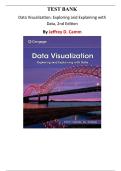
TEST BANK
Data Visualization: Exploring and Explaining with
Data, 2nd Edition
By Jeffrey D. Camm
SC
O
R
EG
U
ID
ES
,TABLE OF CONTENT
Chapter 1. Introduction
Chapter 2. Selecting a Chart Type
SC
Chapter 3. Data Visualization and Design
Chapter 4. Purposeful Use of Color
O
Chapter 5. Visualizing Variability
R
EG
Chapter 6. Exploring Data Visually
Chapter 7. Explaining Visually to Influence with Data
U
Chapter 8. Data Dashboards
ID
Chapter 9. Telling the Truth with Data Visualization
ES
,Name Class Dat
: : e:
Chapter 1 Introduction
Multiple Choice
1. The graphical representation of data and information using displays such as charts, graphs, and maps is known as data
_____.
a. visualization
b. mining
SC
c. analytics
d. science
ANSWER: a
2. The set of analytical tools that describe what has happened and includes techniques such as data queries, reports,
descriptive or summary statistics, and data visualization is _____.
a. descriptive analytics
O
b. predictive analytics
c. prescriptive analytics
d. diagnostic analytics
R
ANSWER: a
3. What field of analytics consists of techniques that use mathematical models constructed from past data to predict future
events or better understand the relationships between variables?
EG
a. Descriptive analytics
b. Predictive analytics
c. Prescriptive analytics
d. Restorative analytics
ANSWER: b
U
4. Mathematical or logical models that suggest a decision or course of action and include mathematical optimization
models, decision analysis, and heuristic or rule-based systems are used in the field of _____.
a. descriptive analytics
b. predictive analytics
ID
c. prescriptive analytics
d. restorative analytics
ANSWER: c
ES
5. The scientific process of transforming data into insights for making better decisions is _____.
a. analytics
b. visualization
c. surveying
d. sampling
ANSWER: a
6. Descriptive analytics is the set of analytical tools that describe __________.
a. what has happened
b. what may happen
Copyright Cengage Learning. Powered by Cognero. Page 1
, Name Class Dat
: : e:
Chapter 1 Introduction
c. a course of action to take
d. future trends
ANSWER: a
7. Predictive analytics consists of techniques that use mathematical models constructed from past data to predict future
events or __________.
SC
a. describe what has happened in the past
b. better understand the relationships between variables
c. determine a course of action for the future
d. suggest a decision
ANSWER: b
O
8. Prescriptive analytics are mathematical or logical models that __________.
a. describe the past
b. predict the future
c. suggest a decision or course of action
R
d. describe a relationship between two variables
ANSWER: c
EG
9. Data for which numerical values are used to indicate magnitude, such as how many or how much, are referred to as:
a. quantitative
b. qualitative
c. categorical
d. ordinal
ANSWER: a
U
10. What type of data is that for which categories of like items are identified by labels or names?
a. Quantitative
b. Numerical
ID
c. Categorical
d. Arithmetic
ANSWER: c
ES
11. Which of the following arithmetic operations can be performed on categorical data?
a. Addition
b. Subtraction
c. Multiplication
d. None of these choices
ANSWER: d
12. If we collect data on the number of wins each team in the NFL had during the 2023–2024 season, we have
__________ data.
a. cross-sectional
Copyright Cengage Learning. Powered by Cognero. Page 2
Data Visualization: Exploring and Explaining with
Data, 2nd Edition
By Jeffrey D. Camm
SC
O
R
EG
U
ID
ES
,TABLE OF CONTENT
Chapter 1. Introduction
Chapter 2. Selecting a Chart Type
SC
Chapter 3. Data Visualization and Design
Chapter 4. Purposeful Use of Color
O
Chapter 5. Visualizing Variability
R
EG
Chapter 6. Exploring Data Visually
Chapter 7. Explaining Visually to Influence with Data
U
Chapter 8. Data Dashboards
ID
Chapter 9. Telling the Truth with Data Visualization
ES
,Name Class Dat
: : e:
Chapter 1 Introduction
Multiple Choice
1. The graphical representation of data and information using displays such as charts, graphs, and maps is known as data
_____.
a. visualization
b. mining
SC
c. analytics
d. science
ANSWER: a
2. The set of analytical tools that describe what has happened and includes techniques such as data queries, reports,
descriptive or summary statistics, and data visualization is _____.
a. descriptive analytics
O
b. predictive analytics
c. prescriptive analytics
d. diagnostic analytics
R
ANSWER: a
3. What field of analytics consists of techniques that use mathematical models constructed from past data to predict future
events or better understand the relationships between variables?
EG
a. Descriptive analytics
b. Predictive analytics
c. Prescriptive analytics
d. Restorative analytics
ANSWER: b
U
4. Mathematical or logical models that suggest a decision or course of action and include mathematical optimization
models, decision analysis, and heuristic or rule-based systems are used in the field of _____.
a. descriptive analytics
b. predictive analytics
ID
c. prescriptive analytics
d. restorative analytics
ANSWER: c
ES
5. The scientific process of transforming data into insights for making better decisions is _____.
a. analytics
b. visualization
c. surveying
d. sampling
ANSWER: a
6. Descriptive analytics is the set of analytical tools that describe __________.
a. what has happened
b. what may happen
Copyright Cengage Learning. Powered by Cognero. Page 1
, Name Class Dat
: : e:
Chapter 1 Introduction
c. a course of action to take
d. future trends
ANSWER: a
7. Predictive analytics consists of techniques that use mathematical models constructed from past data to predict future
events or __________.
SC
a. describe what has happened in the past
b. better understand the relationships between variables
c. determine a course of action for the future
d. suggest a decision
ANSWER: b
O
8. Prescriptive analytics are mathematical or logical models that __________.
a. describe the past
b. predict the future
c. suggest a decision or course of action
R
d. describe a relationship between two variables
ANSWER: c
EG
9. Data for which numerical values are used to indicate magnitude, such as how many or how much, are referred to as:
a. quantitative
b. qualitative
c. categorical
d. ordinal
ANSWER: a
U
10. What type of data is that for which categories of like items are identified by labels or names?
a. Quantitative
b. Numerical
ID
c. Categorical
d. Arithmetic
ANSWER: c
ES
11. Which of the following arithmetic operations can be performed on categorical data?
a. Addition
b. Subtraction
c. Multiplication
d. None of these choices
ANSWER: d
12. If we collect data on the number of wins each team in the NFL had during the 2023–2024 season, we have
__________ data.
a. cross-sectional
Copyright Cengage Learning. Powered by Cognero. Page 2

