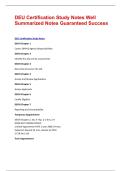
DEU Certification Study Notes Well
Summarized Notes Guaranteed Success
DEU Certification Study Notes
DEOH Chapter 1
Covers OPM & Agency Responsibilities
DEOH Chapter 2
Identify the Job and its assessments
DEOH Chapter 3
Recruit & Announce the Job
DEOH Chapter 4
Accept and Review Applications
DEOH Chapter 5
Assess Applicants
DEOH Chapter 6
Certify Eligibles
DEOH Chapter 7
Reporting and Accountability
Temporary Appointment
DEOH Chapter 2, Sec A- Pgs. 2-2 thru 2-4
DOES NOT CONFER STATUS
Limited Appointment NTE 1 year; MBE 24 mos.
Extension beyond 24 mos. elevate to OPM
5 CFR Part 316
Term Appointment
,DEOH Chapter 2, Sec A- Pgs. 2-5 thru 2-6
DOES NOT CONFER STATUS
More than one year but less than four years. Employment for specific project.
Extension beyond 4 years elevate to OPM
5 CFR Part 316
Direct Hire
authority to appoint qualified candidates directly to jobs for which public notice has been given
and OPM determines there is:
1. A severe shortage of candidates, or
2. A critical hiring need.
What is job analysis?
Foundation of Human Resources Management
identifies the competencies /KSAs directly related to performance on the job. It is a systematic
procedure for gathering, documenting, and analyzing information about the content, context,
and requirements of the job. It demonstrates that there is a clear relationship between the
tasks performed on the job and the competencies/KSAs required to perform the tasks.
2-13
Parts of a Job Analysis/ Methodology
Step 1: Collect info about the job using the PD, classification standards, SME input, performance
and occupational standards. MOSAIC tasks also good source of info
Step 2: List Tasks that are required to perform successfully on the job based on the information
and/or SME input collected in step 1
Step 3: (A) SMEs rate tasks on importance and frequency. (B) Eliminate tasks that were rated as
not performed on either importance & frequency by at least half the SMEs (C) Compute an
average rating for each task on each scale. (D) Identify the tasks critical for the job- involves
determining cutoffs for both importance and frequency scale. Recommended cutoff is 3.0- with
anything scoring higher than 3.0 as critical to the job.
Step 4: List competencies that are required to perform successfully in the job based on the job
information collected and/or SME input, along with the source of that information. Ch 2; Sec. C
,Step 5: (A)SMEs individually rate the competencies on the importance, need at entry, and
distinguishing value scales. [scales can differ] (B) Average the SME ratings to produce an overall
rating for each competency for each scale. (C) identify which competencies are critical for the
job, based on importance and need at entry. This involves determining cutoffs for each of these
scales. Recommended cutoffs for the scales shown on the worksheet are 3.0 or above for
importance and 2.0 or below on need at entry.
Step 6: Link tasks and competencies. Have each SME work independently to rate the extent to
which each competency is important for effective task performance. Again, SME ratings should
be averaged to come up with an overall rating for each task-competency linkage. *You and the
SMEs should eliminate any tasks not linked to one or more competencies, and only
competencies that are not linked to at least one task.
Step 7: Of the competencies remaining at the end of Step 6 of the Job Analysis process,
eliminate competencies that cannot be reasonably assessed via a rating schedule. The resulting
competencies will later be considered for assessment.
Step 8: Determine which competencies will be used as selective and/or quality ranking factors
(if any).
This ends the formal job analysis process.
What are competencies?
a measurable pattern of knowledge, skills, abilities, behaviors and other characteristics that an
individual needs in order to perform work roles or occupational functions successfully.
What is the product of a job analysis?
Assessments / Assessment development and strategy
Appendix D-3 & Chapter 2-B-13
A valid job analysis is used to develop effective recruitment, qualification and assessment,
selection, performance management, and career development methodologies.
competencies/KSAs identified in the job analysis are the foundation for your assessment
strategy. You should consider those competencies/KSAs that have been identified as critical (i.e.,
important, required at entry to the position, and linked to important job tasks) both in order to
be considered at all and for your subsequent selection process. 2-B-17
What documents need to be updated when duties change to a position?
PD, Assessments, Selection Tools 2-B-15
What are assessment tools?
, Structured Interview
Test
Assessment Center
Work Sample
Occupational Questionnaire (Crediting Plan/Rating Schedule)
2-C-18
What are the Uniform Guidelines on Employee Selection Procedures?
provide / a set of principles for determining proper test use and selection procedures, covering
topics such as test fairness and adverse impact.
What is reliability?
Reliability is the degree of consistency or stability of an assessment tool over time, in different
situations, or across applicants, and/or raters.
What is validity?
Validity is the degree to which an assessment tool measures a job-related characteristic and
how well it is measuring that characteristic. Validity shows the relationship between
performance on an assessment tool and performance on the job.
Validity is also an indicator of how well the assessment tool is measuring the job-related
competencies.
Who approves the use of direct hire?
OPM—-Chief Human Capital Officer Act of 2002 (Title XIII of the Homeland Security Act and
codified at 5 U.S.C. § 3304) provides you with the authority to appoint qualified candidates
directly to jobs for which public notice has been given and OPM determines there is:
1. A severe shortage of candidates, or
2. A critical hiring need.
2-A-7
Direct-hire authority is issued for a permanent or nonpermanent position or group of
positions in the competitive service at GS-15 (or equivalent) and below. This authority may be
issued for one or more of the following:
Summarized Notes Guaranteed Success
DEU Certification Study Notes
DEOH Chapter 1
Covers OPM & Agency Responsibilities
DEOH Chapter 2
Identify the Job and its assessments
DEOH Chapter 3
Recruit & Announce the Job
DEOH Chapter 4
Accept and Review Applications
DEOH Chapter 5
Assess Applicants
DEOH Chapter 6
Certify Eligibles
DEOH Chapter 7
Reporting and Accountability
Temporary Appointment
DEOH Chapter 2, Sec A- Pgs. 2-2 thru 2-4
DOES NOT CONFER STATUS
Limited Appointment NTE 1 year; MBE 24 mos.
Extension beyond 24 mos. elevate to OPM
5 CFR Part 316
Term Appointment
,DEOH Chapter 2, Sec A- Pgs. 2-5 thru 2-6
DOES NOT CONFER STATUS
More than one year but less than four years. Employment for specific project.
Extension beyond 4 years elevate to OPM
5 CFR Part 316
Direct Hire
authority to appoint qualified candidates directly to jobs for which public notice has been given
and OPM determines there is:
1. A severe shortage of candidates, or
2. A critical hiring need.
What is job analysis?
Foundation of Human Resources Management
identifies the competencies /KSAs directly related to performance on the job. It is a systematic
procedure for gathering, documenting, and analyzing information about the content, context,
and requirements of the job. It demonstrates that there is a clear relationship between the
tasks performed on the job and the competencies/KSAs required to perform the tasks.
2-13
Parts of a Job Analysis/ Methodology
Step 1: Collect info about the job using the PD, classification standards, SME input, performance
and occupational standards. MOSAIC tasks also good source of info
Step 2: List Tasks that are required to perform successfully on the job based on the information
and/or SME input collected in step 1
Step 3: (A) SMEs rate tasks on importance and frequency. (B) Eliminate tasks that were rated as
not performed on either importance & frequency by at least half the SMEs (C) Compute an
average rating for each task on each scale. (D) Identify the tasks critical for the job- involves
determining cutoffs for both importance and frequency scale. Recommended cutoff is 3.0- with
anything scoring higher than 3.0 as critical to the job.
Step 4: List competencies that are required to perform successfully in the job based on the job
information collected and/or SME input, along with the source of that information. Ch 2; Sec. C
,Step 5: (A)SMEs individually rate the competencies on the importance, need at entry, and
distinguishing value scales. [scales can differ] (B) Average the SME ratings to produce an overall
rating for each competency for each scale. (C) identify which competencies are critical for the
job, based on importance and need at entry. This involves determining cutoffs for each of these
scales. Recommended cutoffs for the scales shown on the worksheet are 3.0 or above for
importance and 2.0 or below on need at entry.
Step 6: Link tasks and competencies. Have each SME work independently to rate the extent to
which each competency is important for effective task performance. Again, SME ratings should
be averaged to come up with an overall rating for each task-competency linkage. *You and the
SMEs should eliminate any tasks not linked to one or more competencies, and only
competencies that are not linked to at least one task.
Step 7: Of the competencies remaining at the end of Step 6 of the Job Analysis process,
eliminate competencies that cannot be reasonably assessed via a rating schedule. The resulting
competencies will later be considered for assessment.
Step 8: Determine which competencies will be used as selective and/or quality ranking factors
(if any).
This ends the formal job analysis process.
What are competencies?
a measurable pattern of knowledge, skills, abilities, behaviors and other characteristics that an
individual needs in order to perform work roles or occupational functions successfully.
What is the product of a job analysis?
Assessments / Assessment development and strategy
Appendix D-3 & Chapter 2-B-13
A valid job analysis is used to develop effective recruitment, qualification and assessment,
selection, performance management, and career development methodologies.
competencies/KSAs identified in the job analysis are the foundation for your assessment
strategy. You should consider those competencies/KSAs that have been identified as critical (i.e.,
important, required at entry to the position, and linked to important job tasks) both in order to
be considered at all and for your subsequent selection process. 2-B-17
What documents need to be updated when duties change to a position?
PD, Assessments, Selection Tools 2-B-15
What are assessment tools?
, Structured Interview
Test
Assessment Center
Work Sample
Occupational Questionnaire (Crediting Plan/Rating Schedule)
2-C-18
What are the Uniform Guidelines on Employee Selection Procedures?
provide / a set of principles for determining proper test use and selection procedures, covering
topics such as test fairness and adverse impact.
What is reliability?
Reliability is the degree of consistency or stability of an assessment tool over time, in different
situations, or across applicants, and/or raters.
What is validity?
Validity is the degree to which an assessment tool measures a job-related characteristic and
how well it is measuring that characteristic. Validity shows the relationship between
performance on an assessment tool and performance on the job.
Validity is also an indicator of how well the assessment tool is measuring the job-related
competencies.
Who approves the use of direct hire?
OPM—-Chief Human Capital Officer Act of 2002 (Title XIII of the Homeland Security Act and
codified at 5 U.S.C. § 3304) provides you with the authority to appoint qualified candidates
directly to jobs for which public notice has been given and OPM determines there is:
1. A severe shortage of candidates, or
2. A critical hiring need.
2-A-7
Direct-hire authority is issued for a permanent or nonpermanent position or group of
positions in the competitive service at GS-15 (or equivalent) and below. This authority may be
issued for one or more of the following: