S T UV IA AP PR OV E
,S T UV IA AP PR OV E
,S T UV IA AP PR OV E
, T S
UV IA
P A
R P
V O
E
,S T UV IA AP PR OV E
,S T UV IA AP PR OV E
, T S
UV IA
P A
R P
V O
E


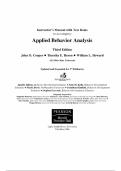
This verified Instructor’s Manual & Test Bank entry for Applied Behavior Analysis (3rd Edition) by John O. Cooper, Timothy E. Heron, and William L. Heward (ISBN 9780134752556) provides a fully chapter‑aligned teaching and assessment resource tailored to the textbook’s official structure. Beginning with Chapter 1: Definition and Characteristics of Applied Behavior Analysis, the text advances into Chapter 2: Basic Concepts and Principles, Chapter 3: Selecting and Defining Target Behaviors, Chapter 4: Measuring Behavior, and Chapter 5: Improving and Assessing the Quality of Behavioral Measurement. It continues through Chapter 6: Constructing and Interpreting Graphic Displays of Behavioral Data, Chapter 7: Analyzing Behavior Change: Basic Assumptions and Strategies, Chapter 8: Reversal and Multielement Designs, Chapter 9: Multiple Baseline and Changing Criterion Designs, and Chapter 10: Planning and Evaluating Applied Behavior Analysis Research. The manual then covers the reinforcement content in Chapter 11: Positive Reinforcement, Chapter 12: Negative Reinforcement, Chapter 13: Schedules of Reinforcement, Chapter 14: Positive Punishment, Chapter 15: Negative Punishment, Chapter 16: Motivating Operations, and Chapter 17: Stimulus Control. Verbal and complex behavior are addressed in Chapter 18: Verbal Behavior, Chapter 19: Equivalence‑Based Instruction, Chapter 20: Engineering Emergent Learning with Nonequivalence Relations, and Chapter 21: Modeling, Imitation, and Observational Learning. Behavioral skill acquisition is detailed in Chapter 22: Shaping, Chapter 23: Chaining, Chapter 24: Extinction, Chapter 25: Differential Reinforcement, and Chapter 26: Antecedent Interventions. The book continues into Chapter 27: Functional Behavior Assessment, Chapter 28: Token Economy, Group Contingencies, and Contingency Contracting, Chapter 29: Self‑Management, Chapter 30: Generalization and Maintenance of Behavior Change, and concludes with Chapter 31: Ethical and Professional Responsibilities of Applied Behavior Analysts.

Calidad en la que puedes confiar: escrito por estudiantes que aprobaron y evaluado por otros que han usado estos resúmenes.
¡No te preocupes! Puedes elegir directamente otro documento que se ajuste mejor a lo que buscas.
Sin suscripción, sin compromisos. Paga como estés acostumbrado con tarjeta de crédito y descarga tu documento PDF inmediatamente.

“Comprado, descargado y aprobado. Así de fácil puede ser.”