Revision303 Revision303 Revision303
Please check the examination details below before entering your candidate information
Candidate surname Other names
Centre Number Candidate Number
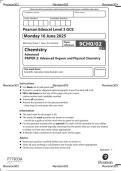
Pearson Edexcel Level 3 GCE
Monday 16 June 2025
Morning (Time: 1 hour 45 minutes) Paper
reference 9CH0/02
Chemistry
Advanced
PAPER 2: Advanced Organic and Physical Chemistry
You must have: Total Marks
Scientific calculator, Data Booklet, ruler
Instructions
Revision303
• Use black ink or ball‑point pen.
Revision303 Revision303
• IfFillpencil is used for diagrams/sketches/graphs it must be dark (HB or B).
• centre number
in the boxes at the top of this page with your name,
and candidate number.
• Answer all questions.
• Answer the questions in the spaces provided
– there may be more space than you need.
Information
• The total mark for this paper is 90.
• The marks for each question are shown in brackets
– use this as a guide as to how much time to spend on each question.
• toForstructure
the question marked with an asterisk (*), marks will be awarded for your ability
your answer logically, showing how the points that you make are related
or follow on from each other where appropriate.
• A Periodic Table is printed on the back cover of this paper.
Advice
• Read each question carefully before you start to answer it.
• Show all your working in calculations and include units where appropriate.
• your answers if you have time at the end.
Check
Turn over
P77833A
©2025 Pearson Education Ltd.
Y:1/1/1/
Revision303 Revision303 Revision303
, Revision303 Revision303 Revision303
Answer ALL questions.
Some questions must be answered with a cross in a box . If you change your mind about an
DO NOT WRITE IN THIS AREA DO NOT WRITE IN THIS AREA
answer, put a line through the box and then mark your new answer with a cross .
1 This question is about mass spectrometry.
(a) Which molecule would not give a molecular ion peak with m/z = 74?
(1)
A C2H5COOH
B CHOCOOH
C CH2(OH)COOH
D CH3COOCH3
(b) The fragmentation pattern in a mass spectrum can be used to distinguish
between structural isomers.
Which m/z peak would be present in the mass spectrum of propanal, CH3CH2CHO,
but not in the mass spectrum of propanone, CH3COCH3 ?
(1)
A 15
B 29
Revision303 C 43 Revision303 Revision303
D 59
(Total for Question 1 = 2 marks)
DO NOT WRITE IN THIS AREA
3
Revision303
Revision303 Revision303
Turn over
, Revision303 Revision303 Revision303
2 Intermolecular forces affect the physical properties of compounds.
(a) Which of these isomers, with the formula C8H18 , will have the
DO NOT WRITE IN THIS AREA
lowest boiling temperature?
(1)
A (CH3)2CHCH2C(CH3)3
B (CH3)2CHCH2CH(CH3)CH2CH3
C CH3CH2CH2C(CH3)2CH2CH3
D CH3CH2CH2CH2CH2CH2CH2CH3
(b) Pentan‑1‑ol and hexane have the same number of electrons but pentan‑1‑ol is
much less volatile than hexane.
Explain this difference in volatility.
(2)
. . . . . . . . . . . . .. .. .. .. .. .. .. .. .. .. . . . . . . . . . . . . . . . . . . . . . . . . . . . . . . . . . . . . . . . . . . . . . . . . . . . . . . . . . . . . . . . . . . . . . .......................... ................................................................................................................. .............. .. . . . . . . . . . . . . . . . . . . . .
DO NOT WRITE IN THIS AREA DO NOT WRITE IN THIS AREA
. . . . . . . . . . . . .. .. .. .. .. .. .. .. .. .. . . . . . . . . . . . . . . . . . . . . . . . . . . . . . . . . . . . . . . . . . . . . . . . . . . . . . . . . . . . . . . . . . . . . . .......................... ............................................................................................................................... .. . . . . . . . . . . . . . . . . . . . .
. . . . . . . . . . . . .. .. .. .. .. .. .. .. .. .. . . . . . . . . . . . . . . . . . . . . . . . . . . . . . . . . . . . . . . . . . . . . . . . . . . . . . . . . . . . . . . . . . . . . . .......................... ................................................................................................................. .............. .. . . . . . . . . . . . . . . . . . . . .
Revision303 Revision303 Revision303
. . . . . . . . . . . . .. .. .. .. .. .. .. .. .. .. . . . . . . . . . . . . . . . . . . . . . . . . . . . . . . . . . . . . . . . . . . . . . . . . . . . . . . . . . . . . . . . . . . . . . .......................... ............................................................................................................................... .. . . . . . . . . . . . . . . . . . . . .
. . . . . . . . . . . . .. .. .. .. .. .. .. .. .. .. . . . . . . . . . . . . . . . . . . . . . . . . . . . . . . . . . . . . . . . . . . . . . . . . . . . . . . . . . . . . . . . . . . . . . .......................... ................................................................................................................. .............. .. . . . . . . . . . . . . . . . . . . . .
. . . . . . . . . . . . .. .. .. .. .. .. .. .. .. .. . . . . . . . . . . . . . . . . . . . . . . . . . . . . . . . . . . . . . . . . . . . . . . . . . . . . . . . . . . . . . . . . . . . . . .......................... ............................................................................................................................... .. . . . . . . . . . . . . . . . . . . . .
(c) Iodine is a solid at room temperature but on gentle heating it vaporises.
What bonds or forces are being broken?
(1)
A covalent bonds
B ionic bonds
C London forces
D permanent dipole‑dipole forces
4
Revision303 Revision303 Revision303
Please check the examination details below before entering your candidate information
Candidate surname Other names
Centre Number Candidate Number
Pearson Edexcel Level 3 GCE
Monday 16 June 2025
Morning (Time: 1 hour 45 minutes) Paper
reference 9CH0/02
Chemistry
Advanced
PAPER 2: Advanced Organic and Physical Chemistry
You must have: Total Marks
Scientific calculator, Data Booklet, ruler
Instructions
Revision303
• Use black ink or ball‑point pen.
Revision303 Revision303
• IfFillpencil is used for diagrams/sketches/graphs it must be dark (HB or B).
• centre number
in the boxes at the top of this page with your name,
and candidate number.
• Answer all questions.
• Answer the questions in the spaces provided
– there may be more space than you need.
Information
• The total mark for this paper is 90.
• The marks for each question are shown in brackets
– use this as a guide as to how much time to spend on each question.
• toForstructure
the question marked with an asterisk (*), marks will be awarded for your ability
your answer logically, showing how the points that you make are related
or follow on from each other where appropriate.
• A Periodic Table is printed on the back cover of this paper.
Advice
• Read each question carefully before you start to answer it.
• Show all your working in calculations and include units where appropriate.
• your answers if you have time at the end.
Check
Turn over
P77833A
©2025 Pearson Education Ltd.
Y:1/1/1/
Revision303 Revision303 Revision303
, Revision303 Revision303 Revision303
Answer ALL questions.
Some questions must be answered with a cross in a box . If you change your mind about an
DO NOT WRITE IN THIS AREA DO NOT WRITE IN THIS AREA
answer, put a line through the box and then mark your new answer with a cross .
1 This question is about mass spectrometry.
(a) Which molecule would not give a molecular ion peak with m/z = 74?
(1)
A C2H5COOH
B CHOCOOH
C CH2(OH)COOH
D CH3COOCH3
(b) The fragmentation pattern in a mass spectrum can be used to distinguish
between structural isomers.
Which m/z peak would be present in the mass spectrum of propanal, CH3CH2CHO,
but not in the mass spectrum of propanone, CH3COCH3 ?
(1)
A 15
B 29
Revision303 C 43 Revision303 Revision303
D 59
(Total for Question 1 = 2 marks)
DO NOT WRITE IN THIS AREA
3
Revision303
Revision303 Revision303
Turn over
, Revision303 Revision303 Revision303
2 Intermolecular forces affect the physical properties of compounds.
(a) Which of these isomers, with the formula C8H18 , will have the
DO NOT WRITE IN THIS AREA
lowest boiling temperature?
(1)
A (CH3)2CHCH2C(CH3)3
B (CH3)2CHCH2CH(CH3)CH2CH3
C CH3CH2CH2C(CH3)2CH2CH3
D CH3CH2CH2CH2CH2CH2CH2CH3
(b) Pentan‑1‑ol and hexane have the same number of electrons but pentan‑1‑ol is
much less volatile than hexane.
Explain this difference in volatility.
(2)
. . . . . . . . . . . . .. .. .. .. .. .. .. .. .. .. . . . . . . . . . . . . . . . . . . . . . . . . . . . . . . . . . . . . . . . . . . . . . . . . . . . . . . . . . . . . . . . . . . . . . .......................... ................................................................................................................. .............. .. . . . . . . . . . . . . . . . . . . . .
DO NOT WRITE IN THIS AREA DO NOT WRITE IN THIS AREA
. . . . . . . . . . . . .. .. .. .. .. .. .. .. .. .. . . . . . . . . . . . . . . . . . . . . . . . . . . . . . . . . . . . . . . . . . . . . . . . . . . . . . . . . . . . . . . . . . . . . . .......................... ............................................................................................................................... .. . . . . . . . . . . . . . . . . . . . .
. . . . . . . . . . . . .. .. .. .. .. .. .. .. .. .. . . . . . . . . . . . . . . . . . . . . . . . . . . . . . . . . . . . . . . . . . . . . . . . . . . . . . . . . . . . . . . . . . . . . . .......................... ................................................................................................................. .............. .. . . . . . . . . . . . . . . . . . . . .
Revision303 Revision303 Revision303
. . . . . . . . . . . . .. .. .. .. .. .. .. .. .. .. . . . . . . . . . . . . . . . . . . . . . . . . . . . . . . . . . . . . . . . . . . . . . . . . . . . . . . . . . . . . . . . . . . . . . .......................... ............................................................................................................................... .. . . . . . . . . . . . . . . . . . . . .
. . . . . . . . . . . . .. .. .. .. .. .. .. .. .. .. . . . . . . . . . . . . . . . . . . . . . . . . . . . . . . . . . . . . . . . . . . . . . . . . . . . . . . . . . . . . . . . . . . . . . .......................... ................................................................................................................. .............. .. . . . . . . . . . . . . . . . . . . . .
. . . . . . . . . . . . .. .. .. .. .. .. .. .. .. .. . . . . . . . . . . . . . . . . . . . . . . . . . . . . . . . . . . . . . . . . . . . . . . . . . . . . . . . . . . . . . . . . . . . . . .......................... ............................................................................................................................... .. . . . . . . . . . . . . . . . . . . . .
(c) Iodine is a solid at room temperature but on gentle heating it vaporises.
What bonds or forces are being broken?
(1)
A covalent bonds
B ionic bonds
C London forces
D permanent dipole‑dipole forces
4
Revision303 Revision303 Revision303