=======
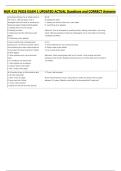
NUR 425 PEDS EXAM 1 UPDATED ACTUAL Questions and CORRECT Answers
According to Erikson, for an infant who is in B,C,D
the Trust vs. Mistrust stage, trust is B. Holding the infant
developed within the infant by meeting the C. Making sure that the infant has a clean diaper
following needs? (Select all that apply) D. Comforting when agitated
A. Feeding when not even hungry
B. Holding the infant Rationale: Trust is developed by meeting comfort, feeding, stimulation, and caring
C. Making sure that the infant has a clean needs. Mistrust develops of needs are inadequately met or met without even being
diaper vocalized by infant.
D. Comforting when agitated
A nurse is performing a developmental A, D, E
screening on a 10 month old infant. Which A. Show preference for use of dominant hand
of the following fine motor skills should the D. Grasp a rattle by the handle
nurse expect the infant to perform? (Select E. Use a crude pincer grasp
all that apply)
A. Show preference for use of dominant Rationale: Infant should grasp rattle by 10 months. Crude pincher and hand
hand dominance by 9 months. Building 2 block tower by 12 months. Walk with one hand at
B. Try building a two-block tower 12 months.
C. Place objects into a container
D. Grasp a rattle by the handle
E. Use a crude pincer grasp
At 18 months of age, a child should be able C. Throw a ball overhand
to do the following?
A. Draw circles on paper Throw ball overhand is correct. Jump rope at 5 years old. Draws circle on paper
B. Jump rope with a friend between 2-3 years. Stands on one foot for a few seconds at 3 years old.
C. Throw a ball overhand
D. Stands on one foot for a few seconds
, A nurse is providing teaching about age- C.
appropriate activities to the caregiver of a
2 year old. Which of the following Transition objects such as favorite stuffed animal provides a sense of security for
statements by the caregiver indicates an toddlers. Riding a tricycle is a gross motor skill of a 3 year old. Parallel play is
understanding of the teaching? characteristic of the toddler stage not playing a team sport. Drawing a square is not
A. "The soccer team my child will be until around 4 years of age.
playing on starts practicing next week."
B. "I should expect my child to be able to
copy a square."
C. "I will send my child's favorite stuffed
animal with them when napping away from
home."
D. "My child should be able to ride a
tricycle."
In Piaget's preoperational phase, B. She will be coming to see you after you eat breakfast
preschoolers are beginning to understand
the concept of time. Four-year-old Johnny Preschoolers begin to understand sequence of daily events. Time is best described
asks the nurse, "when is my mommy coming to them by an event such as a mealtime.
to see me?" The nurse knows that during
this stage of development it would be best
to answer the following.
A. She will be here at 9:00 am.
B. She will be coming to see you after you
eat breakfast
C. I don't know when she is coming
D. She will be here later this morning
Children develop language, cognition, C. Differentiated, orderly, unique, directional, and paced
motor and psychosocial skills in patterns.
Which answer correctly identifies the Development is interrelated. Differentiated meaning general to specific. Orderly and
patterns of development? sequential meaning predictable and having a universal timetable. There is a
A. Differentiated, disorganized, common, sequence. Unique meaning each child has their own sequence which can be
directional, and interrelated influenced by environment. Directional meaning cephalocaudal and proximodistal.
B. Differentiated, disorganized, unique, Paced meaning does not develop at same pace. When learning new skill may growth
directional, and paced in other areas minimally.
C. Differentiated, orderly, unique,
directional, and paced
D. Differentiated, orderly, normal,
deviation, and paced
C. 12 months
At what age does a child give kisses and
12 months gives hugs and kisses, uses neat pincher, begins to drink from cup,
hugs?
cruising, walks with one hand held. 9 months can put cereal in mouth using crude
A. 9 months
pincher, hold bottle, respond to simple commands, comprehends no, mama and
B. 18 months
dadada, sits on own, uses crude pincher to pick up cereal and put in mouth. 18
C. 12 months
months feeds self with spoon, likes to do for self, throws temper tantrums, walks,
D. 2 years
walks upstairs with help, throws ball overhand, scribbles, runs clumsily. 2 years feeds
themselves, runs, kicks balls, goes upstairs with 2 feet on each step
NUR 425 PEDS EXAM 1 UPDATED ACTUAL Questions and CORRECT Answers
According to Erikson, for an infant who is in B,C,D
the Trust vs. Mistrust stage, trust is B. Holding the infant
developed within the infant by meeting the C. Making sure that the infant has a clean diaper
following needs? (Select all that apply) D. Comforting when agitated
A. Feeding when not even hungry
B. Holding the infant Rationale: Trust is developed by meeting comfort, feeding, stimulation, and caring
C. Making sure that the infant has a clean needs. Mistrust develops of needs are inadequately met or met without even being
diaper vocalized by infant.
D. Comforting when agitated
A nurse is performing a developmental A, D, E
screening on a 10 month old infant. Which A. Show preference for use of dominant hand
of the following fine motor skills should the D. Grasp a rattle by the handle
nurse expect the infant to perform? (Select E. Use a crude pincer grasp
all that apply)
A. Show preference for use of dominant Rationale: Infant should grasp rattle by 10 months. Crude pincher and hand
hand dominance by 9 months. Building 2 block tower by 12 months. Walk with one hand at
B. Try building a two-block tower 12 months.
C. Place objects into a container
D. Grasp a rattle by the handle
E. Use a crude pincer grasp
At 18 months of age, a child should be able C. Throw a ball overhand
to do the following?
A. Draw circles on paper Throw ball overhand is correct. Jump rope at 5 years old. Draws circle on paper
B. Jump rope with a friend between 2-3 years. Stands on one foot for a few seconds at 3 years old.
C. Throw a ball overhand
D. Stands on one foot for a few seconds
, A nurse is providing teaching about age- C.
appropriate activities to the caregiver of a
2 year old. Which of the following Transition objects such as favorite stuffed animal provides a sense of security for
statements by the caregiver indicates an toddlers. Riding a tricycle is a gross motor skill of a 3 year old. Parallel play is
understanding of the teaching? characteristic of the toddler stage not playing a team sport. Drawing a square is not
A. "The soccer team my child will be until around 4 years of age.
playing on starts practicing next week."
B. "I should expect my child to be able to
copy a square."
C. "I will send my child's favorite stuffed
animal with them when napping away from
home."
D. "My child should be able to ride a
tricycle."
In Piaget's preoperational phase, B. She will be coming to see you after you eat breakfast
preschoolers are beginning to understand
the concept of time. Four-year-old Johnny Preschoolers begin to understand sequence of daily events. Time is best described
asks the nurse, "when is my mommy coming to them by an event such as a mealtime.
to see me?" The nurse knows that during
this stage of development it would be best
to answer the following.
A. She will be here at 9:00 am.
B. She will be coming to see you after you
eat breakfast
C. I don't know when she is coming
D. She will be here later this morning
Children develop language, cognition, C. Differentiated, orderly, unique, directional, and paced
motor and psychosocial skills in patterns.
Which answer correctly identifies the Development is interrelated. Differentiated meaning general to specific. Orderly and
patterns of development? sequential meaning predictable and having a universal timetable. There is a
A. Differentiated, disorganized, common, sequence. Unique meaning each child has their own sequence which can be
directional, and interrelated influenced by environment. Directional meaning cephalocaudal and proximodistal.
B. Differentiated, disorganized, unique, Paced meaning does not develop at same pace. When learning new skill may growth
directional, and paced in other areas minimally.
C. Differentiated, orderly, unique,
directional, and paced
D. Differentiated, orderly, normal,
deviation, and paced
C. 12 months
At what age does a child give kisses and
12 months gives hugs and kisses, uses neat pincher, begins to drink from cup,
hugs?
cruising, walks with one hand held. 9 months can put cereal in mouth using crude
A. 9 months
pincher, hold bottle, respond to simple commands, comprehends no, mama and
B. 18 months
dadada, sits on own, uses crude pincher to pick up cereal and put in mouth. 18
C. 12 months
months feeds self with spoon, likes to do for self, throws temper tantrums, walks,
D. 2 years
walks upstairs with help, throws ball overhand, scribbles, runs clumsily. 2 years feeds
themselves, runs, kicks balls, goes upstairs with 2 feet on each step