

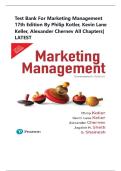
Test Bank For Marketing Management
17th Edition By Philip Kotler, Kevin Lane
Keller, Alexander Chernev All Chapters|
LATEST
,TABLE OF CONTENTS
PART I:FUNDAMENTALS OF MARKETING MANAGEMENT
1. Defining Marketing for the New Realities
2. Marketing Planning and Management
PARTII: UNDERSTANDING THE MARKET
3. Analyzing Consumer Markets
4. Analyzing Business Markets
5. Conducting Marketing Research
PARTIII: DEVELOPING A WINNING MARKETING STRATEGY
6. Identifying Market Segments and Target Customers
7. Crafting a Customer Value Proposition and Positioning
PARTIV: DESIGNING VALUE
8. Designing and Managing Products
9. Designing and Managing Services
10. Building Strong Brands
11. Managing Pricing and Sales Promotions
PART V:COMMUNICATING VALUE
12. Managing Marketing Communications
13. Designing an Integrated Marketing Campaign in the Digital Age
14. Personal Selling and Direct Marketing
PARTVI: DELIVERING VALUE
15. Designing and Managing Distribution Channels
16. Managing Retailing
PARTVII: MANAGING GROWTH
17. Driving Growth in Competitive Markets
18. Developing New Market Offerings
19. Building Customer Loyalty
20. Tapping into Global Markets
21. Socially Responsible Marketi
1
.
, TEST BANK FOR
Marketing Management, 17th edition Philip Kotler Kevin Lane Keller
Alexander Chernev
Copyright 2026
Chapter 1-21
Chapter 1 Defining Marketing for the New Realities
1) Which of these is an accurate characterization of the contemporary view of marketing?
A) Marketing is synonymous with selling.
B) With the rise of social commerce, company-driven marketing is no longer important.
C) Marketing's emphasis within the firm continues to decline.
D) To improve efficiency, most firms now restrict marketing activities within the
"official" boundaries of the marketing department.
E) Marketing is about identifying and meeting human and social needs in a way that
harmonizes with the goals of the organization.
ANS: E Diff: 3
LO: 1.1: Define the scope of marketing.
AACSB: Reflective thinking
2) With regard to the selling function, what did Peter Drucker have to say about
the aim of marketing?
A) Selling should replace marketing.
B) Selling should have equal importance in the corporate hierarchy.
C) To know and understand the customer so well that the product or service fits the
individual and sells itself.
D) The sales function should set strategy, while the marketing function owns tactics.
Selling and marketing are synonymous. ANS: C
Diff: 2
LO: 1.1: Define the scope of marketing.
AACSB: Reflective thinking
3) Which of these was identified as a key reason why Toyota had a hit with the Prius
and Apple with the iPad?
A) Both companies designed the right product based on thoughtful research.
B) Both products were flukes that happened to hit the market at the right time.
C) Neither product led its category, but both were sold aggressively.
D) Both products underpriced their competition.
American consumers have enough disposable income to afford luxury gadgets. ANS: A
Diff: 2
LO: 1.1: Define the scope of marketing.
AACSB: Reflective thinking
2
.
, 4) Which of these entities represent the largest fraction of the U.S. economy?
A) Experiences
B) Services
C) Goods
D) Events
Places ANS: B Diff: 1
LO: 1.1: Define the scope of marketing.
AACSB: Reflective thinking
5) Which of the following marketing domains is represented by the phrase "What
Happens Here, Stays Here"?
A) Organizations
B) Persons
C) Events
D) Places
Experiences ANS: D Diff: 2
LO: 1.1: Define the scope of marketing.
AACSB: Reflective thinking
6) A public service announcement (PSA) encouraging people to wear masks during a
pandemic outbreak represents what kind of marketing domain?
A) Ideas
B) Services
C) Experiences
D) Information
Social good ANS: A Diff: 3
LO: 1.1: Define the scope of marketing.
AACSB: Reflective thinking
7) Which of these is NOT one of the ten marketing domains?
A) Ideas
B) Places
C) Entities
D) Events
People ANS: C Diff: 2
LO: 1.1: Define the scope of marketing.
AACSB: Reflective thinking
3
.
17th Edition By Philip Kotler, Kevin Lane
Keller, Alexander Chernev All Chapters|
LATEST
,TABLE OF CONTENTS
PART I:FUNDAMENTALS OF MARKETING MANAGEMENT
1. Defining Marketing for the New Realities
2. Marketing Planning and Management
PARTII: UNDERSTANDING THE MARKET
3. Analyzing Consumer Markets
4. Analyzing Business Markets
5. Conducting Marketing Research
PARTIII: DEVELOPING A WINNING MARKETING STRATEGY
6. Identifying Market Segments and Target Customers
7. Crafting a Customer Value Proposition and Positioning
PARTIV: DESIGNING VALUE
8. Designing and Managing Products
9. Designing and Managing Services
10. Building Strong Brands
11. Managing Pricing and Sales Promotions
PART V:COMMUNICATING VALUE
12. Managing Marketing Communications
13. Designing an Integrated Marketing Campaign in the Digital Age
14. Personal Selling and Direct Marketing
PARTVI: DELIVERING VALUE
15. Designing and Managing Distribution Channels
16. Managing Retailing
PARTVII: MANAGING GROWTH
17. Driving Growth in Competitive Markets
18. Developing New Market Offerings
19. Building Customer Loyalty
20. Tapping into Global Markets
21. Socially Responsible Marketi
1
.
, TEST BANK FOR
Marketing Management, 17th edition Philip Kotler Kevin Lane Keller
Alexander Chernev
Copyright 2026
Chapter 1-21
Chapter 1 Defining Marketing for the New Realities
1) Which of these is an accurate characterization of the contemporary view of marketing?
A) Marketing is synonymous with selling.
B) With the rise of social commerce, company-driven marketing is no longer important.
C) Marketing's emphasis within the firm continues to decline.
D) To improve efficiency, most firms now restrict marketing activities within the
"official" boundaries of the marketing department.
E) Marketing is about identifying and meeting human and social needs in a way that
harmonizes with the goals of the organization.
ANS: E Diff: 3
LO: 1.1: Define the scope of marketing.
AACSB: Reflective thinking
2) With regard to the selling function, what did Peter Drucker have to say about
the aim of marketing?
A) Selling should replace marketing.
B) Selling should have equal importance in the corporate hierarchy.
C) To know and understand the customer so well that the product or service fits the
individual and sells itself.
D) The sales function should set strategy, while the marketing function owns tactics.
Selling and marketing are synonymous. ANS: C
Diff: 2
LO: 1.1: Define the scope of marketing.
AACSB: Reflective thinking
3) Which of these was identified as a key reason why Toyota had a hit with the Prius
and Apple with the iPad?
A) Both companies designed the right product based on thoughtful research.
B) Both products were flukes that happened to hit the market at the right time.
C) Neither product led its category, but both were sold aggressively.
D) Both products underpriced their competition.
American consumers have enough disposable income to afford luxury gadgets. ANS: A
Diff: 2
LO: 1.1: Define the scope of marketing.
AACSB: Reflective thinking
2
.
, 4) Which of these entities represent the largest fraction of the U.S. economy?
A) Experiences
B) Services
C) Goods
D) Events
Places ANS: B Diff: 1
LO: 1.1: Define the scope of marketing.
AACSB: Reflective thinking
5) Which of the following marketing domains is represented by the phrase "What
Happens Here, Stays Here"?
A) Organizations
B) Persons
C) Events
D) Places
Experiences ANS: D Diff: 2
LO: 1.1: Define the scope of marketing.
AACSB: Reflective thinking
6) A public service announcement (PSA) encouraging people to wear masks during a
pandemic outbreak represents what kind of marketing domain?
A) Ideas
B) Services
C) Experiences
D) Information
Social good ANS: A Diff: 3
LO: 1.1: Define the scope of marketing.
AACSB: Reflective thinking
7) Which of these is NOT one of the ten marketing domains?
A) Ideas
B) Places
C) Entities
D) Events
People ANS: C Diff: 2
LO: 1.1: Define the scope of marketing.
AACSB: Reflective thinking
3
.


