
Unit 16 Assignment 4
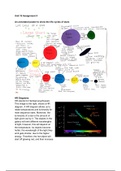
An annotated poster to show the life cycles of stars
HR Diagrams
HR stands for Hertzsprung-Russell.
This image to the right, shows a HR
diagram. A HR diagram allows us to
relate temperatures and luminosity for
main sequence stars. Moreover, the
luminosity of a star is the amount of
light given out by it. The objects in the
galaxy will emit different wavelengths
of light, however, this will depend on
the temperature. As objects become
hotter, the wavelength of the light they
emit gets shorter, due to the higher
energy. Therefore, the hot object will
start off glowing red, and then increase
, to bright yellow as it increases. Due to the stars being so hot, as the temperature rises, the
wavelength of light passes from yellow into blue and violet wavelengths.
What causes the stage of a star to end/change?
A star will die due to them exhausting their nuclear fuel, and the end of a star's life events will
depend on the mass of it. In addition, when there is no fuel at all left, the star will collapse,
causing the outer layer to explode as a supernova. A supernova is a luminous and powerful
explosion that will usually happen when there is a supergiant that converts its helium into iron.
Moreover, the gravity will give the supernova the energy, and therefore the core of the star will
gain a lot of mass, and it cannot support its own weight, so it starts to explode inside the core,
causing a star to change and start to end. However, a supernova is rare in our galaxy, and on
average, it will occur once a century.
Techniques used to calculate the distances of stars
One technique that can be used to calculate the distance of the stars is by using a method
called stellar parallax, or trigonometric parallax. This method will measure the movement of the
star against more distant stars, or the background, as the earth revolves around the sun.This
can be done by measuring two angles, and the side of a triangle, which is formed by the star,
the measurement is the earth on one side of its orbit, and the earth six months later on the other
side of its orbit. Moreover, for the measurement of the distance of a star, the astronomers will
use a baseline of 1 AU, this is the average distance between the earth and the sun, which is
around 93 million miles. By measuring the distances to some of the stars that are nearby, the
astronomers are then able to use this information to see the relationships between the star's
color and its brightness. Therefore,If a star is too far away to measure its parallax, the
astronomers can match its color and spectrum to one of the standard candles and determine its
brightness. In addition, another way to calculate this is by completing reproduction and the
display of 3D images. For astronomers to be able to capture 2D images, is to do it from two
slightly different angles, which is similar to the way human eyes do, and to present the images
in a way that each eye sees only one of the two images.
The big bang
The big bang is the way in which the astronomers are able to explain the way the universe
began. It is the idea that the universe began as just one single point and then started to expand
and stretch to grow as large as it is right now, and the universe could still be stretching. In
addition, when the universe started, it was hot and small particles mixed with light and energy,
and as everything expanded, it took up more space and it cooled down. In addition, the particles
started to come together and formed atoms, which then grouped together over time to form
stars and galaxies. The first stars in the universe made larger atoms, and grouped together to
form molecules, which therefore created more stars, and at the same time, the galaxies were
coming together. In addition, as the new stars were being born and then some stars were dying,
other objects were being made, such as asteroids, comets, planets, and black holes.



