PSY 350 Exam 3 – Questions & Correct Solutions
Save
Practice questions for this set
Learn 1 /7 Study with Learn
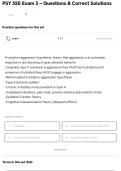
Frustration-aggression hypothesis: theory that aggression is an automatic
response to any blocking of goal-directed behavior
-Originally says: if someone is aggressive they MUST be frustrated and if
someone is frustrated they MUST engage in aggression
-Reformulated frustration-aggression hypothesis
-Type A behavior pattern
-Chronic irritability more prevalent in Type A
-Unpleasant situations; pain, heat, poverty (relative deprivation), threat
-Excitation Transfer Theory
-Cognitive Noeassociation Theory (Weapons Effect)
Choose an answer
1 Friendship 2 Cognitive-Behavioral Therapy (CBT)
3 Coping with Annoyance 4 Social Exchange Theory
Don't know?
Terms in this set (160)
, A person with whom you have an affectionate
Friendship
relationship
Typically NOT a family member or lover, but definitions
Friendship are
may vary
One that attempts to explain all behaviors using one
Domain-General Models
simple rule
-Apart of the Domain-General Model
Reinforcement-Affect
-Assumes people are motivated by a very simple goal:
Model
to feel good
-Apart of the Domain-General Theory
-Motivated to maximize the ratio of benefits to costs
Social Exchange Theory -We're drawn to relationships where we experience
equity: a state of affairs where your benefits and costs
are equal to the benefits and costs for your partner
Domain-Specific Models Friendship serves specific goals
1. Social Support
2. Information
Goals of friendship
3. Status
4. Material Benefits
-Emotional, informational, or material assistance
Social Support
provided by other people
-Experiencing stress or anxiety; A secure relationship
with parents provides less stress on kids in the future
Most Likely to seek social
-In response to loss; Mortality Salience
support when:
-In response to threats; Physical/Mental danger
-When feeling isolated; The loneliness cycle
Reminding people of death= a greater desire to affiliate
Mortality Salience
with others
-Talk more about themselves
-Ask fewer questions
-Over-disclose
The Loneliness Cycle
-Talk about sad things
-Have unrealistically high expectations of self and
others
-Share interests with others
More Likely to receive
-Give them positive feedback
social support if:
-Provide them with useful resources or information
, Cognitive-Behavioral Helps break the loneliness cycle. A common talk
Therapy (CBT) therapy
People push support away when they cannot
Social Support push away reciprocate the support because it makes them feel
worse and embarrassed
-Others may have useful or important information that
we don't have; To get started people usually use self-
disclosure (sharing intimate information about oneself)
Information -Others provide information about ourselves; Classic
Social Comparison theory, We like to compare
ourselves to people who are similar to us, Uncertainty
can lead to social comparison
Classical Social People have the drive to evaluate their abilities and the
Comparison Theory best way to do so is through social comparison
-Gain status through affiliation (w/ higher-ups)
-Stronger motivation in Japan vs. United States
Status
-BIRGing & CORFing in friendships and social groups
-Sometime more friends= more status
-Friendships facilitate sharing
-Risk-pooling, mutual aid
-4 Models of social exchange
Material Benefits
-Common Orientation
-Exchange Orientation
-Social Capital
-Communal Sharing; Take as needed, all share a pool of
resources
-Authority Ranking; High in statue get more
4 Models of Social
-Equality Matching; Everyone gets equal share, all
Exchange
contribute equally
-Market Pricing; Everyone gets out in proportion to
what they put in
Communal Sharing Take as needed, all share a pool of resources
Authority Ranking High in status get more
Equality Matching Everyone gets equal share, all contribute equally
Markey Pricing Everyone gets out in proportion to what they put in
Save
Practice questions for this set
Learn 1 /7 Study with Learn
Frustration-aggression hypothesis: theory that aggression is an automatic
response to any blocking of goal-directed behavior
-Originally says: if someone is aggressive they MUST be frustrated and if
someone is frustrated they MUST engage in aggression
-Reformulated frustration-aggression hypothesis
-Type A behavior pattern
-Chronic irritability more prevalent in Type A
-Unpleasant situations; pain, heat, poverty (relative deprivation), threat
-Excitation Transfer Theory
-Cognitive Noeassociation Theory (Weapons Effect)
Choose an answer
1 Friendship 2 Cognitive-Behavioral Therapy (CBT)
3 Coping with Annoyance 4 Social Exchange Theory
Don't know?
Terms in this set (160)
, A person with whom you have an affectionate
Friendship
relationship
Typically NOT a family member or lover, but definitions
Friendship are
may vary
One that attempts to explain all behaviors using one
Domain-General Models
simple rule
-Apart of the Domain-General Model
Reinforcement-Affect
-Assumes people are motivated by a very simple goal:
Model
to feel good
-Apart of the Domain-General Theory
-Motivated to maximize the ratio of benefits to costs
Social Exchange Theory -We're drawn to relationships where we experience
equity: a state of affairs where your benefits and costs
are equal to the benefits and costs for your partner
Domain-Specific Models Friendship serves specific goals
1. Social Support
2. Information
Goals of friendship
3. Status
4. Material Benefits
-Emotional, informational, or material assistance
Social Support
provided by other people
-Experiencing stress or anxiety; A secure relationship
with parents provides less stress on kids in the future
Most Likely to seek social
-In response to loss; Mortality Salience
support when:
-In response to threats; Physical/Mental danger
-When feeling isolated; The loneliness cycle
Reminding people of death= a greater desire to affiliate
Mortality Salience
with others
-Talk more about themselves
-Ask fewer questions
-Over-disclose
The Loneliness Cycle
-Talk about sad things
-Have unrealistically high expectations of self and
others
-Share interests with others
More Likely to receive
-Give them positive feedback
social support if:
-Provide them with useful resources or information
, Cognitive-Behavioral Helps break the loneliness cycle. A common talk
Therapy (CBT) therapy
People push support away when they cannot
Social Support push away reciprocate the support because it makes them feel
worse and embarrassed
-Others may have useful or important information that
we don't have; To get started people usually use self-
disclosure (sharing intimate information about oneself)
Information -Others provide information about ourselves; Classic
Social Comparison theory, We like to compare
ourselves to people who are similar to us, Uncertainty
can lead to social comparison
Classical Social People have the drive to evaluate their abilities and the
Comparison Theory best way to do so is through social comparison
-Gain status through affiliation (w/ higher-ups)
-Stronger motivation in Japan vs. United States
Status
-BIRGing & CORFing in friendships and social groups
-Sometime more friends= more status
-Friendships facilitate sharing
-Risk-pooling, mutual aid
-4 Models of social exchange
Material Benefits
-Common Orientation
-Exchange Orientation
-Social Capital
-Communal Sharing; Take as needed, all share a pool of
resources
-Authority Ranking; High in statue get more
4 Models of Social
-Equality Matching; Everyone gets equal share, all
Exchange
contribute equally
-Market Pricing; Everyone gets out in proportion to
what they put in
Communal Sharing Take as needed, all share a pool of resources
Authority Ranking High in status get more
Equality Matching Everyone gets equal share, all contribute equally
Markey Pricing Everyone gets out in proportion to what they put in